
On a recent rip to London, writer Joe Griffin got to sit down with Academy Award-winning actor Robin Williams.
Standing in a hotel corridor, clutching a recording device that has been tested (’check, one/two’) numerous times in the past five minutes; there is a sense of trepidation in meeting Robin Williams. Which Robin would turn up? Would it be the muted, contemplative Robin from films like One Hour Photo or World’s Greatest Dad (his latest film), or the wacky, loudmouth persona that won him acres of copy in bad reviews and millions in paycheques and back-end percentages?
I put my ear up to the door. ‘Sell your poo!’ he bellows to the interviewer before me, launching into a routine that parodies the current trend of cash-for-gold commercials. It looks like I have my answer. Happily bemused, the interviewer staggers out of the room and makes brief eye-contact with me, saying ‘You’re in for a wild ride’.
The PR lady introduces us and tells Robin and the director of World’s Greatest Dad, Bobcat Goldthwait, where I travelled from. ‘From Dublin?’ Williams asks, ‘Oh God bless you! Sit here, since you just flew in from Dublin.’
I joke that the 6-minute time difference between Dublin and London is a killer, and that my mother is a big fan. He leans in to my recorder and says (in a decent Irish accent): ‘Tell your Ma I was great to the boy, I treated him decent.’
He sits back, ‘It’s the one accent I don’t do very well, so tell her not to worry. It’s a hard accent to do. I can go Scottish in a rat second, but to go Dublin is crazy!’ Then he looks over to another PR assistant, jokingly shouting, ‘He just flew in; we want to hydrate the boy!’ just before purring to my machine again ‘Mom, we’ll be good.’
Despite the fact that Williams was once the biggest box office draw in the world, his recent slate of films have often felt like acts of atonement for past sins. The tipping point was arguably the sentimental Patch Adams, a financial hit and a critical disaster. That was followed by the flops Jacob the Liar (which had the misfortune of opening after another Holocaust comedy, Life is Beautiful) and the costly, unloved Bicentennial Man. It’s no coincidence that shortly afterwards he made a trilogy of gloomy films; Insomnia, One Hour Photo and the dark farce Death to Smoochy.
Indeed, the actor has spent nearly a decade now making idiosyncratic films. World’s Greatest Dad, a black comedy/drama, sees him play a teacher and aspiring writer who stoops to new lows to boost his career.
But while Williams struggled in his personal life (including a well-documented cocaine addiction), he never struggled professionally like his character in World’s Greatest Dad did. ‘I hit Mork and Mindy right off the bat,’ he says. But he admits that the film’s themes of making art for the right reason appealed to him.
Was it a conscious decision to make smaller films for this past decade?
‘Totally!’ he smiles. ‘Oh very much. As opposed to the unconscious decisions, which was some of the other ones. You want to make that one for money? Yeah! I’m out of rehab! I might need work! The worst decisions I’ve ever made in my career are the ones where they say, “you know this one is going to make a lot of money”. And that’s always been the most dangerous thing. The movies I’ve had the most fun doing and actually have turned out to do the best for me, [they] have been where I’ve thought, “you know, I really like this film”. The ones that have turned out the worst and the ones that also didn’t do very well [financially] have been the ones where they’ve said “this is a hit”. That’s the most dangerous thing you could ever say. Warning!’
Goldthwait chimes in, ‘The character of Lance is unconscious. He’s going through life doing what’s expected, or what he thinks is expected of him, and he’s not happy until he says, “This is who I am”.’
‘That’s a very freeing thing’, says Williams. ‘That’s a hardcore thing. Because the other drive is so huge: ‘“Do you like me? Oh, you don’t like me?” Trying to live like that?’ He leans back and shakes his head, then lets a resigned whistle.
But isn’t that a big part of comedy, the need to be liked?
Williams springs up again. ‘It’s a huge part of comedy! But it’s also very freeing when the other side comes out and says [deep, sinister voice] “I don’t care; this is what I’ve had to say.”’
Despite Williams winning an Oscar (for Good Will Hunting), a Grammy (for his recent stand-up album) and having worked with the cream of Hollywood, including Francis Ford Coppola, Stephen Spielberg, Terry Gilliam, Robert Altman and Christopher Nolan, he can never escape his most iconic role. ‘That’s the thing that I can’t get away from!’ he says of Mork and Mindy. ‘It’s so ingrained in people’s minds from thirty years ago. And then it’s weird because it comes back on TV every few years. There’s this show Nickelodeon where they bring back shows and the moment they do it, it’s back again. It’s in people’s memory banks.’
‘It gets so weird,’ he continues, warming to the subject. ‘In a way I can’t get angry about it because it kicked off my career. A friend said, “how angry can you be, if it got your career going?” And he’s right. You can’t be bitter about it saying, [petulant voice] “why can’t you remember me for my Academy Award?” Where’s the Good Will Hunting guy?’
Bobcat reminds Robin that sometimes people get it wrong, prompting the actor to pipe up, in a redneck accent, impersonating a pushy fan: ‘“What’s that character’s name? Pork and Cindy! Cork and Ghandi? Zippity Zippity?” It doesn’t go away. I can’t be angry. It paid the bills, bought me a ranch. God bless.’
It’s refreshing to hear an actor talk candidly about money, like when Michael Caine said that he hadn’t seen his film Jaws 4, but he saw the house it paid for.
Williams jumps into a passable Caine impression: ‘He also said, “I’ll listen to the critics when they pay my bills.”’
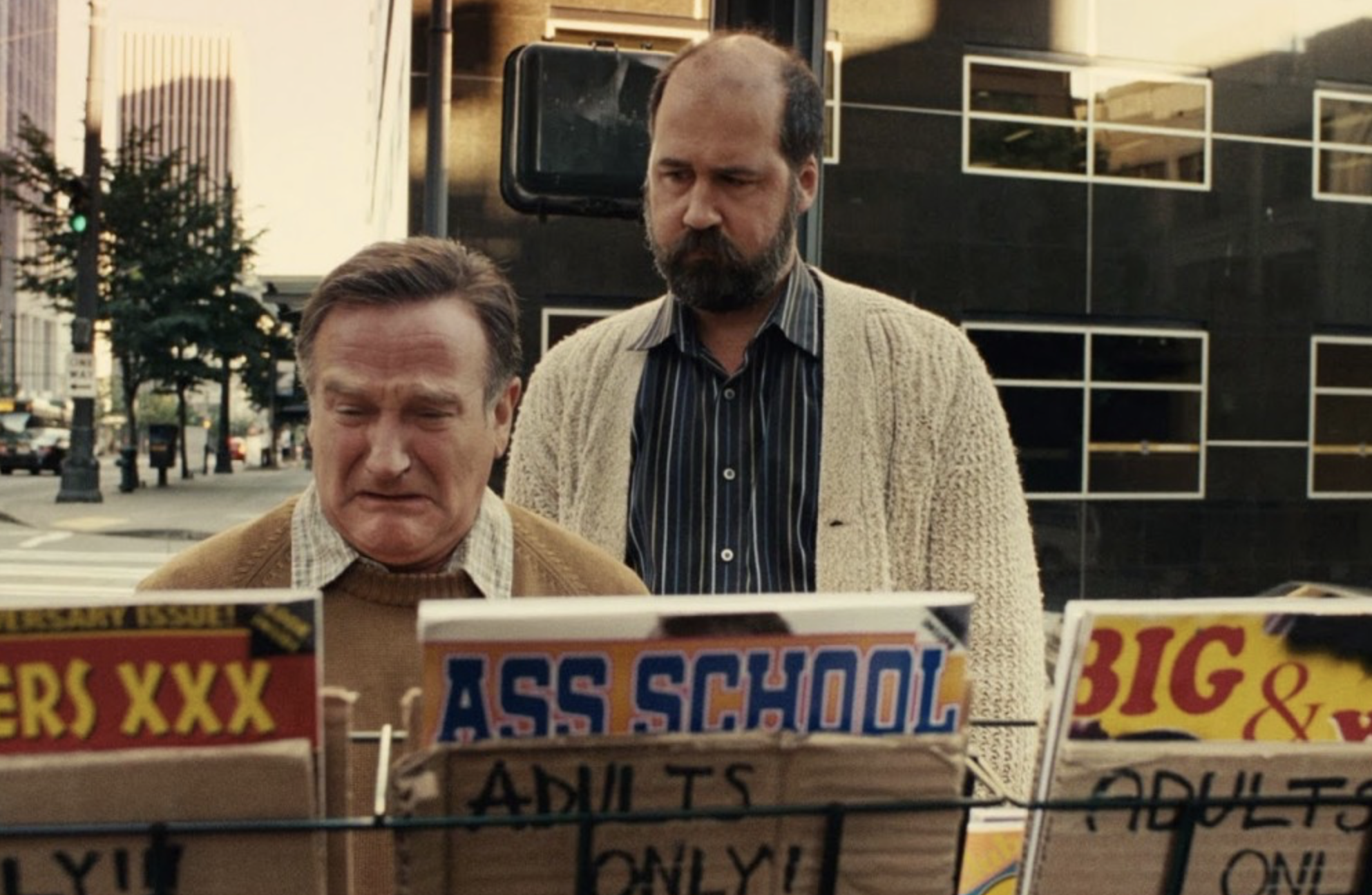
But Williams himself seemed to be searching for acclaim with his recent output. Isn’t it important for him? ‘It’s nice when you get it and it’s also painful when you don’t,’ he sighs. ‘It’s that weird thing…At one point I thought, “well I’ll do what they want and I’ll fashion it like this…”, but then you’re chasing it and you never know what they’ll like. You end up thinking, “well, what would I like to do?” I did this because I found it to be interesting. It’s not like the critics are going bananas. If they do, great, if they don’t, well [the film] has already been done and I’m really proud it. I wasn’t trying to say, [plumy RADA accent] “this will establish me as an artist”. No, it won’t, you’re still a hairy comic. It won’t change perceptions of you. Some people reBicentennialally don’t like you.’
After an assembly line of interviews, Williams went to BBC studios to record his appearance on one of the final episodes of Friday Night with Jonathan Ross. Some say actors do a movie for free, but the promotion and press is what they get paid for…
‘I haven’t got that cheque yet!’ he smiles, before launching into an impression of the type of wacky morning show he’s had to appear on. ‘Welcome to Wild Morning Zoo, I’m here with Bobcat, AKA Zed, and we’ll be right back with Robin Williams and Nanu Nanu! Do you mind if I say that again to really piss you off? Noooo! Bring back that memory – are you going to do Mork and Mindy the movie? No!’
He says that his fee was minimal for this film, both for promoting and performing: ‘You get nothing coming and nothing going! The weird thing is that we’re promoting the movie because we both love it. And we came here to say we’re proud of it and we want it to be seen in an English language speaking country. We hope for that. And we just want people to know it’s out there. It’s a strange, small film and we want to give it some awareness because if not [sinister whisper] it goes away quickly!’
Bobcat continues his point: ‘I don’t make these movies thinking, “this is going to crush Grown Ups, I’m going to steamroll over Toy Story 3”, but obviously we hope folks will see it and like it or discover it. The bottom line is that I make these movies and they come from a sincere place. And that’s it. I was talking to Spike Jonze recently and I said “My movies make literally…hundreds of dollars.”’
Robin takes the bat: ‘I love when an interviewer said today, “are you happy when your movies are projected?” and I said “it’s so much more than when they stay in the can! It’s so much better when they get seen.” In America this film had a second life on the pay-per-view channels. And a lot of people came up and said “I saw this movie in a hotel” and I thought their choice was this movie or porn. And he said, “No, not really. You were first and then the porn came later.”’
So is arthouse cinema like eating your vegetables?
Robin launches into a chiding, paternal voice: ‘You have to have a little bit of art movie before your porn.’ and then, in a whining child voice, ‘But I don’t like porn, mother!’
It’s hard to discern somebody’s mood from a brief interview, but, despite some occasional goofing, Williams seemed quite relaxed; happy to be promoting a film he cared about and contented with the direction his career has taken. Many of his recent films haven’t been released in this country, and he still dabbles in the mainstream (including voice work for Happy Feet and appearances in the Night at the Museum films), but at the age of 59, he seems happier to make films for him.
While he’s still busy, he’s certainly less prolific in films than he once was: ‘I think for me what’s next is paying the bills with stand-up and waiting for the right movie rather than rushing off for the ones that might make money. It’s more about looking around and seeing what work is there.’
The PR assistant clears his throat and moves his finger around in a ‘wrap it up’ gesture. Bobcat and Robin stand up and shake hands, thanking me for my time. Then Robin leans in and whispers to my microphone in a warm brogue, ‘Mom, I think we did well. We were very nice to the boy. He’s got 6-minute jetlag.’ Williams may be making smaller, more serious films, but he still finds it hard not to play the joker. Old habits die hard.
The Best Bits
Good Will Hunting
A low-key, warm performance in a mid-budget drama starring (and written by) two unknown actors, Matt Damon and Ben Affleck. It was one of those rare films to be adored by critics and audiences alike. When Williams picked up his Oscar he said, ‘for the first time in my life I’m speechless’.
Dead Poets Society
Directed by Peter Weir, this was Williams’ first mainstream, successful drama (he’d dabbled before in undeserved flops like The World According to Garp). As an English teacher, the role allowed Williams to improvise some gags, but also to show some passion and sentiment.
Mrs. Doubtfire
Though subsequently dismissed as one of his broader comedies, Mrs Doubtfire was an audacious move, providing Williams an opportunity to cut loose as an aging Scottish widow and to show vulnerability as a weekend dad.
Insomnia
Working with Christopher Nolan (who went on to make Inception), Williams was muted and unnerving as a lonely author and murder suspect.
The Fisher King
Possibly Terry Gilliam’s most complete, accomplished film, the modern fantasy/romance complimented Williams’ large performance as a mentally ill transient.
The Birdcage
As the less flamboyant half of a gay couple (Nathan Lane played his shrieking partner), Williams got to play his comedy (relatively) straight. One of the few American remakes to surpass its French original.