

Set over a lifetime, period romance The History of Sound charts the tragic love story of two young men. A Kentucky folk singer and a musicologist meet at the Boston Conservatory. Together, they embark on a life-changing journey through the Maine wilderness to record the fading songs of their countrymen.
Last year at Cannes Film Festival, correspondent Shannon Cotter sat down with the film's star Paul Mescal and director Oliver Hermanus to discuss the evolution of the story, finding truth for their characters and what years in development can do for creative collaboration. The History of Sound premiered at the Cannes Film Festival and is now in Irish cinemas.
This film was in the works for quite a long time. Did that help to get closer to the character, and to your co-star Josh?
PM: One hundred percent, it’s very singular for me in that regard. This is the longest I’ve lived with a character in a project, and Ollie [Director, Oliver Hermanus] and Josh are at the centre of it. If I could make every film in this mode, I would. But I also think that’s kind of impossible. The film benefited because it made me fundamentally feel very secure in the creative partnerships at the centre, and trust in Ollie and Josh.
How do you think the film would have been different if you had been able to make it back then?
OH: Well, Paul would’ve been younger and so would Josh [laughs]. Maybe a lot of things. The team is a big part of it. I hadn’t met them all those years ago, so it would have been a different movie entirely. Now we have this incredible team. There are so many things - my general intellect, I suppose, my life experience, my patience - that were all evolving in that time. In a way-
PM: I’m very glad that it happened.
OH: Yes. All’s well that ends well.
PM: All’s well that ends well. Exactly.
Do you think that the movie resonates more nowadays because of the attacks on queer rights? Is this love story more important now?
OH: Absolutely. The big thing with this film is that we’re disregarding the coming out process, the shaming, the self-denial and the tension of all that. This relationship that the two characters have is devoid of any of those concerns, which is an announcement, I guess, as a filmmaker. We’re just assuming that contemporary audiences consider queer relationships as they would consider any other relationship.
There is something very soothing about the pacing of the film. Was it inspired by the rhythm of the short story, the era it’s depicting, or perhaps some of the songs?
OH: I think the songs were definitely a big part of that, because you want to play them out. You want them to have their space. I also just like watching people. When you shoot a movie and you work with these incredible, emotive faces, I become very beguiled by them, the expression and performance. I like working with actors, and I like making movies about the nature of the human experience. That’s the work of an actor, to bring this to life. I always want to create that space. It’s an indulgence, perhaps, in some way, but in this particular film, it felt like it was the right tone for this particular life, for this man’s life.
Paul, did you do much research into folk music, and did it, on some level, remind you of being in Ireland?
PM: One hundred percent. In preparation for a film, you’re always predominantly focused on the things that feel further away, but the music in this was something that felt closer. This was an element that never really caused me anxiety. In fact, I was looking forward to it, because, as you said, it’s songs like these that I’m not unfamiliar with. You walk into a bar in Ireland, particularly the west coast, and you would hear music. Maybe not necessarily “Silver Dagger” [a song referenced in the film], but you would hear songs sung in that a cappella style. I was excited to feel like I was expressing somebody who’s from a very different culture to me, but it also aligned. That human experience is very similar regardless of where you’re coming from.
You’re now one of a few select Irish actors to have led a film in the Official Selection of Cannes.
PM: I mean, I was in drama school about six or seven years ago. If you’d said to me then that I’d be walking up those steps, and with a film that I’m making with my friends that I’ve been loyal to for five years, and I get my first Executive Producer credit, it’s huge. I’m incredibly proud of all of it. And weirdly, those kinds of carpet moments generally fill me with anxiety, but I remember I turned to Oliver and I was like, “I’m weirdly calm.” [laughs]
I found with this experience, if you lean into moments like this, that you recognise it for what it is, it is a celebration of cinema. You are there with the Heads of Department and people who are at the heart of the film, and you’re championing the thing that we all love. I mean, we’re all here for the same reason, because we love cinema. You like writing about it, Oliver likes directing it, I like being in it. We all love Cannes for the pageantry, but the films are at the centre of it. You sit there, the room goes dark, and the pageantry disappears. And then it all begins again. [laughs] Aggressively.
Oliver, as far as depicting the love story, you didn’t want to label it. Was that a conscious decision?
OH: Absolutely. That was the nature of the short story. There was this non-conversation in there about the labelling of the relationship in terms of sexual identity, and I found this incredibly refreshing. That was my reaction from the beginning. Because at the time, I had just made a film that was so much about sexual identity and repression and shaming - and the violence of that. Reading The History of Sound six months after finishing that movie, I had the immediate desire to make something that was just going to be loving and romantic, and I don’t want to say happy, but “happy” in the sense that it’s not a film that’s uncomfortable or tense to experience. It’s a film that’s trying to capture the flow of somebody’s life.
Paul, did you and Chris Cooper have a chance to talk? Did it fill you with anxiety that he was going to be playing you later on?
PM: That was one of the cooler phone calls that I got in my career. Chris is a very private man, and he shot with Oliver for two or three days, so I got to sneak on to set and watch his work on the monitor. I met him when the work was finished, on his last day on set. I just think he’s a remarkable actor, full stop. What he does in the final ten minutes of the film really breaks my heart when I watch it.
The film’s very perceptive about the emotion and the history carried in these songs. Are there any songs for you that can trigger that same time capsule sense of feelings or emotions?
OH: I think for me, it’s definitely always songs from my teenage years that I find to be the most traumatic [laughs]. My teenage years were very busy and I seem to be triggered by them often. That’s just the bands that I was listening to, like Radiohead, a lot of British bands, a lot of techno. I’m a runner. I run to solve all problems, big or small, and I find that’s the stuff that I would listen to. It centres me, calms me, and makes me feel like a teenager, I guess.
PM: So many songs jump into my head that I’m going to go with the first one. Right now it’s “September Grass” by James Taylor, which is a song my mum loves. I remember as a teenager being fed up listening to it, but then I heard it recently out of that context. I immediately had a totally different relationship to that song, because it was rooted in a memory rather than the actual song itself. It’s like a sense memory of smell. I feel like songs have a similar capacity.
You’re probably listening to a lot of Beatles songs right now.
PM: [laughs] Yeah.
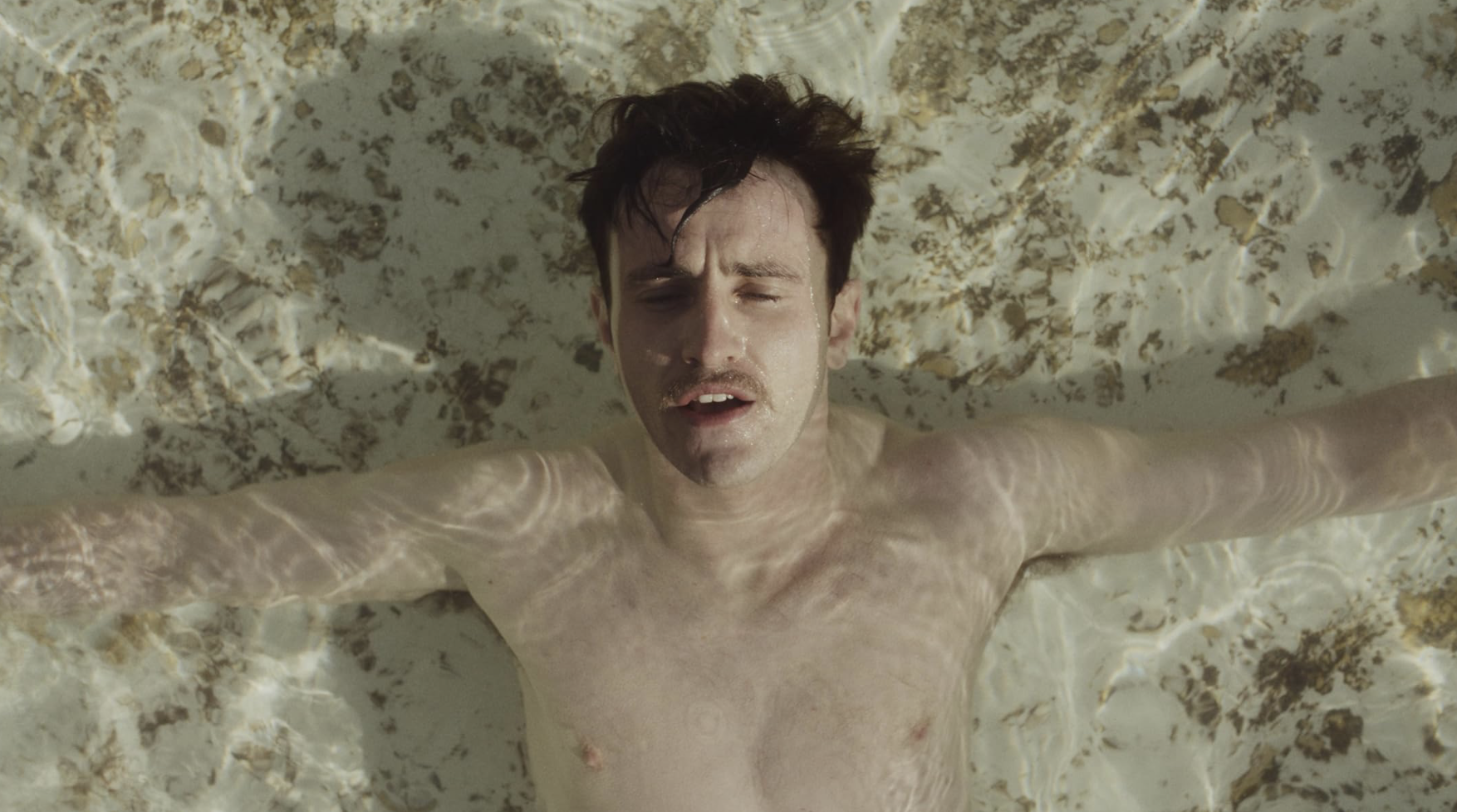
Are you prepared for the Beatlemania?
PM: I’ll hopefully be prepared for it by 2028. We’ve got a second with it, but I mean I saw Harris [Dickinson]'s film [Urchin] in Cannes and it just blew me away. He’s an artist that I really admire, and obviously Joe [Quinn] , and Barry [Keoghan], and Sam [Mendes]. I’m very excited to get into the weeds on that.
I really like the contrast between the songs used in the film and then the stillness. It allows the scenes to blossom in an intimate way. What was the process behind that?
PM: I think our sensibilities-
OH: -are very aligned that way.
PM: It felt like it was there on the page.
OH: It was. Also, I suppose, the nature of Lionel, the character. He’s watching, he’s listening, he’s observing, he’s contemplative, he’s reflective. That became a lot of the detail in the actor-director dialogue about the tonality, pacing, interpretation of scenes and the choices that would make sense to Lionel. A very simple epiphany we had was his relationship between sound and silence. He wanted silence when he’s at his lowest. The joy of making a movie as a director with an actor is that work, all of that connective-
PM: -the discoveries, like having a moment that feels fundamentally creative because you figure out something that isn’t necessarily just on the page. You come together and you get what feels like a fundamental fact about this person’s life.
OH: And that’s the making of a film, I think. If two other people, a different director and a different actor, had the same script, they would make fundamentally different discoveries.
I love the moment when you go to the Lake District later on. Were you familiar with that part of the UK?
PM: I had never, ever been there before. That was the very end of our filming process, and I love that scene. To me, that’s always the most tragically romantic gesture. He visits the Lake District, in his own words, because a friend a long time ago said that he would like it there. And of course, the audience knows that’s from somebody he loved. If an audience can pay attention to those details, if they’re interested in them, I think the film will have a really strong effect.
OH: It’s a movie where really the feelings are expressed not through words, but more through gestures, body language and gazes. It reminds me a bit of Aftersun in that it’s very internal. [To Paul] Kudos for that, by the way [laughs].
Paul, are those your favourite type of scripts? Do you look for that internal quality?
PM: Yeah, I’m more interested in silence. It’s a taste in the things that I like to watch. I like to watch actors thinking rather than talking. That can be difficult sometimes, because your characters generally have to speak. I don’t think it’s about being internal or external, it’s just the nature of Lionel. I would say that David’s actually very internal as well, but his external presents with a social ease. However, maybe there’s an argument to be made that a lot of great characters in modern cinema are internal, linear, introspective.
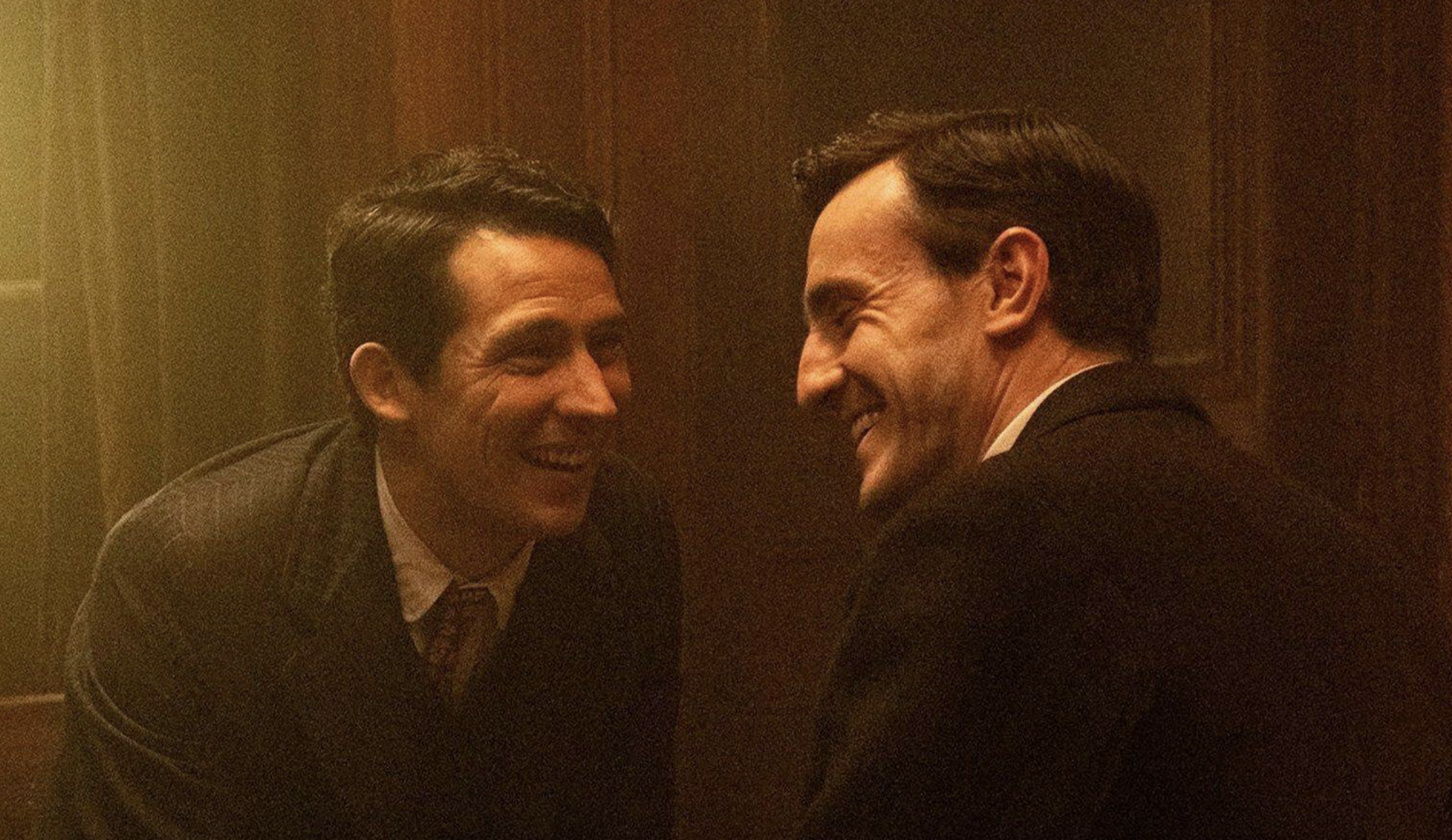
Lionel’s final glance to David is devastating. Was the film shot in sequence? What kind of journey do you have to take to reach that final glance?
PM: I remember Oliver showing that scene to me on the streets around where I would pester him when we’d be drinking on a Friday night. I’d just be like, “Show me the dailies.” I remember seeing that shot when David is sitting down, and the camera catches Lionel looking up before they hug. That whole section, to me, again, it’s if the audience is curious about the details of the human condition, that’s one of those moments. It was moving to play, but I’m glad it translates into the scene.
OH: We didn’t shoot chronologically, but there was a certain sequence in which we shot Josh. The shoot was structured where we had Josh, and Josh was part of Paul’s life, and my life, and these characters were connected. Then for the rest of the shoot, there was no David, so it fit the narrative. It was a weirdly convenient kind of setup.
Paul, you were at Cannes Film Festival for Aftersun not that long ago. How have you managed to stay grounded?
It’s been a wild run, career-wise. I’ve been very lucky that the people that I’ve worked with feel recognisable to me in terms of their qualities as human beings, like Charlotte Wells, Oliver Hermanus, Jessie Buckley, Josh O’Connor, Saoirse Ronan, these people that I feel are real people in the real world. I think that if you can involve yourself with those kinds of people, it makes it easier to navigate the madness. Cannes is a really good example of the madness of this industry. It reminds me of a phrase my friend Fred Hechinger said when we were finishing the Gladiator II press tour, “It’s time to get out of the casino.” It’s trying to go back to real life, because it’s very easy to just get swept up talking about yourself and the work and-
OH: Losing touch.
PM: Losing touch, yeah.
The History of Sound is out now in cinemas.


