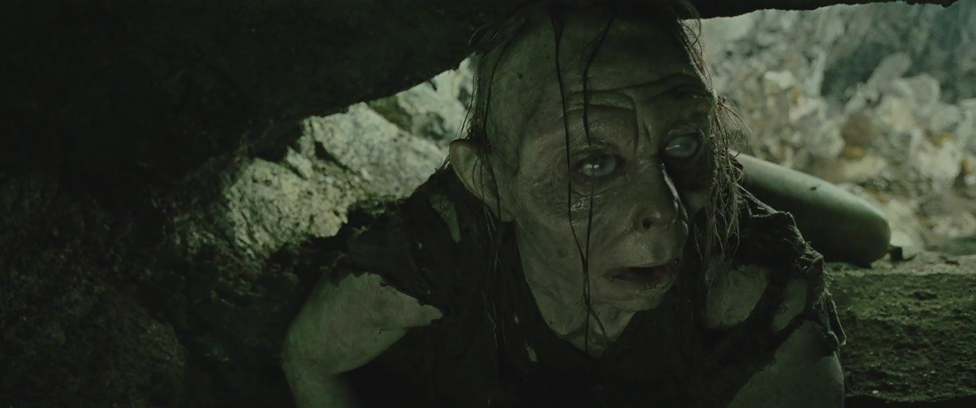

For a trilogy that’s considered cinematic comfort food by many, The Lord of the Rings has a nasty streak a mile wide. These are films many people return to religiously, be it for background noise, nostalgic refuge or a cinematic feeling of home. And yet alongside the pleasant, rolling hills and rousing score is a persistent insistence in scaring our pants off.
It’s really not that surprising. Before the trilogy turned Peter Jackson into a household name as a master of modern fantasy, he cut his teeth with horror. His Bad Taste and Braindead are gleefully excessive, The Frighteners gloriously anarchic. Even Heavenly Creatures, his pivot toward something more prestige, is coloured with psychological terror. The Lord of the Rings is rarely discussed as horror, but Jackson never abandoned his knack for frightful flair. This lineage matters, and it’s the trilogy’s secret weapon. He uses it inventively, adding flavour, depth and much-needed grit to cancel out any risk of tweeness or self-importance.
The films borrow from slasher cinema, creature features, ghost stories, psychological breakdowns and war horror, often within the same sequence. Rewatching the trilogy on its 25th anniversary year, what stands out isn’t just how often it skirts into horror territory, but (with Jackson’s mastery of the genre’s rules) how fluently it speaks the lingo.
Here are 7 moments from The Lord of the Rings trilogy that prove that Middle-earth is one of the scariest places in cinema.
The Birth of the Uruk-hai
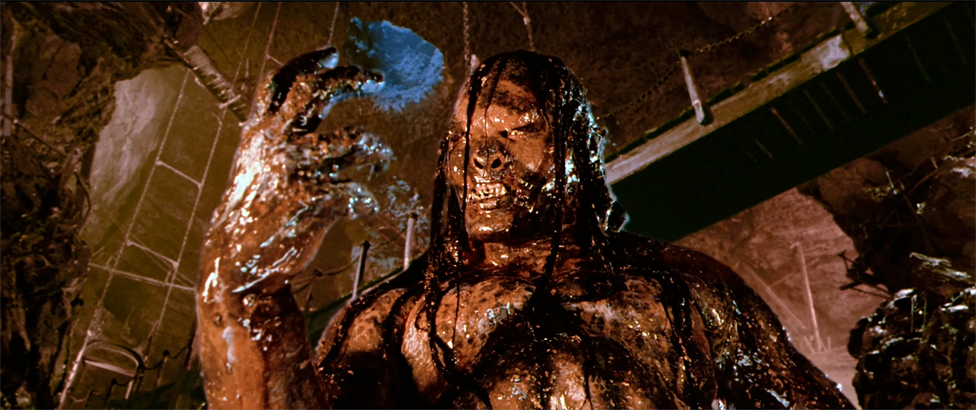
Saruman creating the Uruk-hai, an unholy crossbred of “Orcs with goblin men”, is one of the most unsettling sequences in the trilogy. We’re a long way from The Shire here, folks. New life at Isengard isn’t warmly welcomed into the world with a song and dance. It’s forced out and readied for war.
Mud bubbles and churns, slippery flesh tears free from the earth. The first Uruk-hai emerges slick, mewling and already pissed off (an unfortunate goblin gets immediately choked to death simply for being there). The environment is industrial and cruel, aided by the clanking metal and brooding horns of Howard Shore’s score. This is birth as a coldly impersonal mass production of the ultimate soldier. Eventually, in later adaptations of Tolkien such as Amazon’s Rings of Power, we’ll see the uglier species of Middle Earth treated with sympathy and reverence. Not so here. No one reacts with awe. Saruman only grins, thinking of the wanton destruction to follow. The Uruk-hai isn’t treated as a living being, only as a weapon. It stands, roars, and is immediately handed a sword. Stripped of identity and choice, there is no future for it beyond dishing out violence.
Unlike some of the other frightening scenes in the trilogy, this one doesn’t trap us in a locked room with a gaggle of beasties. Instead, it fills us with impending dread. The Uruk-hai’s birth is scary, but what’s scarier is that this unlimited conveyor belt of relentless killing machines is about to be pointed at our heroes.
The Balrog
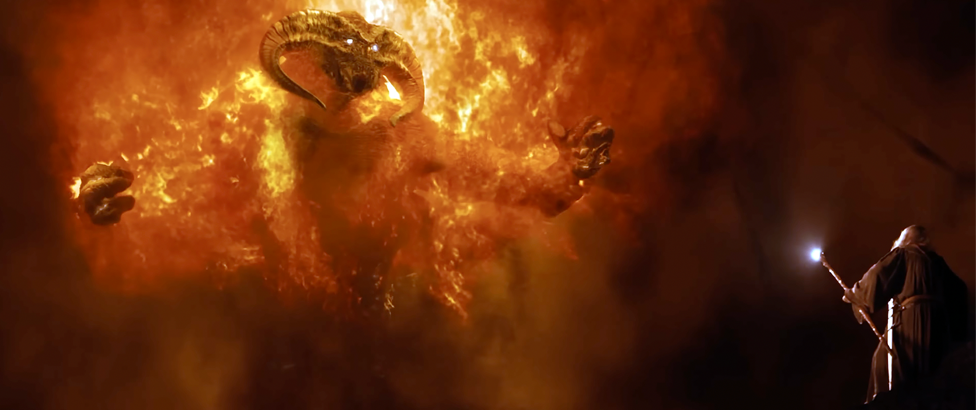
Most of the horror of the Fellowship’s confrontation with the Balrog deep inside the underground city of Moria comes from facing something so powerful, it leaves no room for hope. It changes the stakes - even the greatest, most powerful figures in the story can meet their match and be taken away in an instant.
It also doesn’t help our heart rate that it’s easily one of the most awe-inspiring creatures Tolkien imagined. The Balrog feels less like a monster and more like a natural disaster. It fills the vast, empty halls with its “shadow and flame”. You can almost feel the heat billowing off the footsteps it leaves, exuding an ancient power unlike anything the Fellowship has faced to this point.
Flames ripple across its body, obscuring clear edges and making it difficult to tell where the creature ends and almighty hell begins. Its eyes burn with internal heat, wings unfurling like vast curtains of darkness. Everything about its physical design screams DESTRUCTION; it’s a Black Sabbath song in the flesh. Jackson nods to his horror roots in other ways here too; there’s more than a hint of Halloween’s Michael Myers in the way the Balrog silently, patiently stalks the Fellowship. There’s also a deliberate lack of anthropomorphism - like all classic movie monsters, from the shark in Jaws to the Xenomorph in Alien, the Balrog doesn’t talk, taunt or emote in a human way. That lack of personality, coupled with an inability to communicate with it, reason with it, keeps it terrifying.
The climatic confrontation on the bridge is brief, not a drawn-out, thrilling battle to the finish with Gandalf (spoiler alert - that comes later). The wizard’s stand and famous declaration is less triumph, more delay. His mind isn’t on defeating the Balrog, a foe “beyond any of them”; he’s simply trying to stop the creature long enough for the others to live. After Gandalf falls, the music drops away, the Fellowship stands in shock, grief and disbelief. Their escape comes at a terrible cost.
This “demon of the ancient world” works because it appears, devastates and vanishes - leaving terrible emptiness behind. That’s what a great movie monster does.
Bilbo’s Face at Rivendell
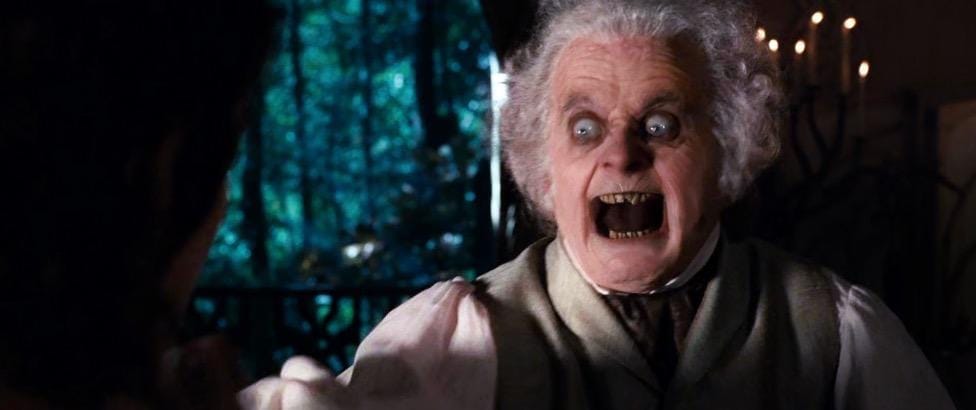
At the Elven stronghold of Rivendell, the Hobbits catch a much-needed breath and the Fellowship readies for its mission. Frodo is given a heartwarming reunion with his uncle Bilbo, but when the older Baggins spies his old Ring around Frodo’s neck, its lure catches him and he reaches for it, his face momentarily twisting into something terrifying.
Peter Jackson understands a fundamental truth of horror cinema - fear works best when it arrives during what feels safe. Rivendell has been presented as a restorative haven, Bilbo is harmless and happy, nostalgically recounting his own past adventures. Everything about the scene tells you to relaaaaax. And that’s exactly why the sudden shift hits so hard.
When the Ring is revealed, Bilbo’s reaction isn’t slow or dramatic. His manner becomes sharp and hungry quickly. His face warps into something nasty and needy as he lunges forward. The change lasts only a moment, slipping out before he can stop it, but it’s enough. For a few seconds, Bilbo becomes his own version of Gollum.
Frodo seeing that beloved face twist into something predatory breaks his - and our - sense of safety. The Ring’s corruption can reach the people we trust most. Jackson doesn’t linger; skips explanation or follow-up confrontation. Bilbo immediately recoils, ashamed and confused. This feels all too real, a very human reaction of guilt and shame rather than a drawn-out theatrical display. Perfect quiet, psychological horror.
The Watcher in the Water
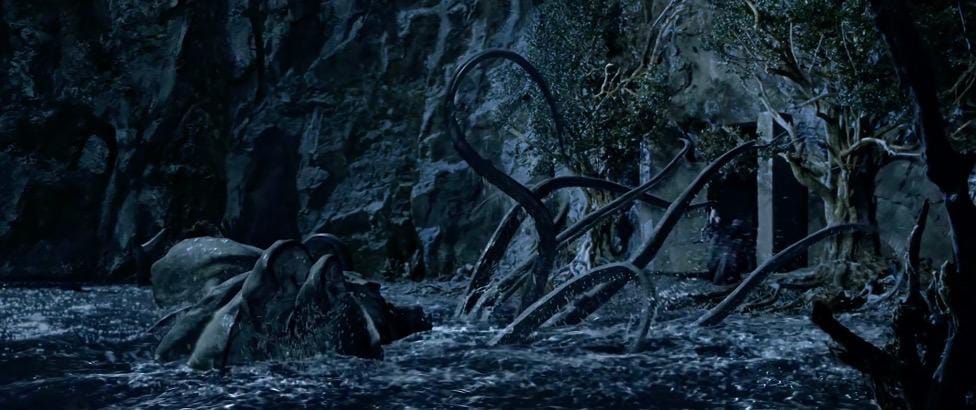
If the Balrog is shock and awe, the lake monster that attacks the Fellowship outside Moria is straight-up video nasty. The Watcher in the Water, or just "the Watcher", is the only name Tolkien gave to this mass of slick, writhing limbs. We don’t get a complete visual read on the creature, but what we can see of it is a Lovecraftian nightmare; a “thing” whose full form cannot be perceived. It shares some DNA with Clash of the Titans’ Kraken - tentacles breaking the surface, coils wrapping around stone, water churning violently. It doesn’t taunt, communicate or emote. Much like with the aforementioned villain of the Jaws franchise, the ambiguity forces our imagination to do the work…and what our imagination sees below the surface is always worse than what a camera can share.
The setting amplifies the horror - the narrow space between the cliff wall and the lake leaves the Fellowship boxed in. Deep water limits their movement and footing. Stone blocks escape. Once the Watcher starts to attack, coordination collapses almost immediately. Everyone reacts at once, drawing their weapons to fight a giant…something? Nothing feels controlled or planned.
What makes the sequence especially effective is how little progress the Fellowship makes against the threat. Like their encounter with The Balrog, they aren’t defeating the Watcher or driving it away through strength or strategy. Their actions are purely defensive - for every limb lopped off, ten more seem to appear. They retreat and the door to Moria slams shut, plunging them into darkness. The Watcher forces our heroes into an unplanned, worse situation, sealing them inside a mountain full of death. Out of the frying pan, into a bigger, hotter frying pan. Survival horror at its finest.
The Dead Marshes
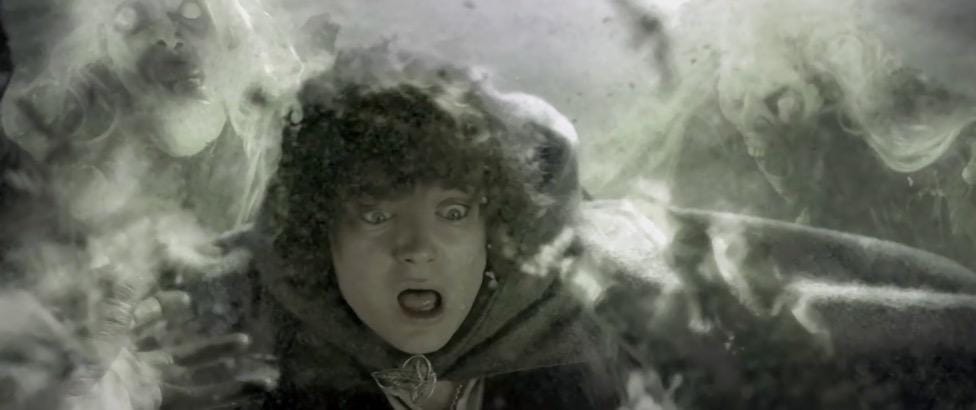
My personal favourite - Frodo, Sam and Gollum cross a vast, swampy landscape where the preserved faces of dead soldiers float just beneath the water’s surface. There’s no sudden attack, no dramatic moment when danger grandly announces itself. Instead, fear here begins with eerie stillness.
The setting is basically a mass grave, teeming with souls never allowed to properly rest. The bodies beneath the water are motionless, staring upward, frozen in horrifying expressions of pain. The stillness makes them scarier - they’re the remains of people either left behind, or refusing to let go.
The marsh stretching endlessly in every direction. Both the camera and sound design become muted and still, making you feel apprehensive rather than panicked. It’s a lot like The NeverEnding Story’s Swamp of Sadness, a place that wears you down footstep by footstep, until all hope is lost.
But when Frodo succumbs to the siren’s call and falls into the murky water, the terror is unleashed. The camera follows him beneath the surface where the faces crowd closer, leering corpses straight out of Jackson’s The Frighteners, arms reaching out to pull him deeper. A slow suffocation, past tragedies pulling him under. Appropriately it’s Gollum, not Sam, who pulls Frodo free of the dead soldiers’ grasp - he knows a thing or two about needless pain and suffering, after all.
Perhaps what makes the Dead Marshes’ inhabitants linger on our minds is the fact that they’re victims themselves - of countless, nameless battles. They want their prey to be absorbed and forgotten, just like them. They represent the futility of endless war - bodies trapped in a malignant stasis, outliving all stories told in their honour. What’s more unsettling than that?
Hiding from the Ringwraith
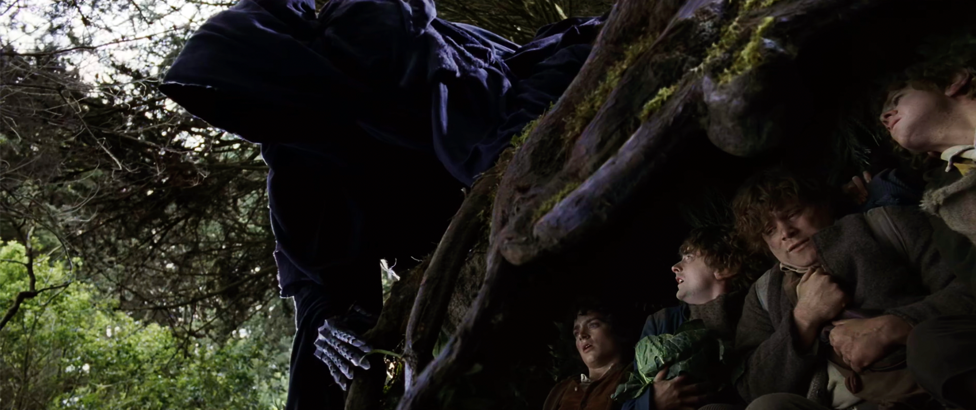
While the Hobbits are traveling toward Bree, Frodo senses something tall, dark and ugly approaching on horseback. The quartet dive beneath the roots of a tree just in time as a Ringwraith stops above them, drawn by the presence of the Ring.
This scene is built around a simple, familiar fear - hiding from a killer and trying not to be found. The hobbits don’t have weapons that can help them, nor do they have a plan. The tree roots barely hide them. They’re helpless, exposed and already too late to run. All they can do is press themselves into the dirt as the Ringwraith stoops and - terrifyingly - sniffs the air like an animal.
The camera stays close to the Hobbit’s faces, showing wide eyes and clenched fists. You feel how uncomfortable it would be to stay still, how hard to shake the urge to flee. The Ringwraith is methodical, calculating, betting on a sense that they’re nearby. You’re likely holding your own breath as it draws closer.
Frodo’s experience makes the moment even worse. The Ring pulls at him, urging him to put it on as the Ringwraith lingers. The threat is close above and inside Frodo’s mind - you can see the struggle on his face as he fights the instinct to give in. The Ring promises safety, while actually meaning exposure - the Ringwraith will be alerted as soon as it is used. Frodo has to resist in silence.
It’s all so unbearably tense. Much like great home-invasion horror (The Strangers, You’re Next), it avoids jump scares and instead stretches time, forcing us to sit inside the fear. Survival comes down to patience, silence, and a little bit of luck.
Shelob’s Lair
Frodo’s fateful encounter with Shelob is the moment when The Lord of the Rings drops all pretence of epic fantasy and becomes bonafide horror. It’s a long time coming; teased at the end of the second movie and not happening until around the middle of the third. Gollum decides the best way of reclaiming his Precious is to lead Frodo to “her”, taking the Ring once the Hobbit is dead. And boy, does he milk the hell out of the mystery of what “her” actually is. “She’s always hungry”, he coos to his watery reflection when left alone, “she always needs to feed...”.
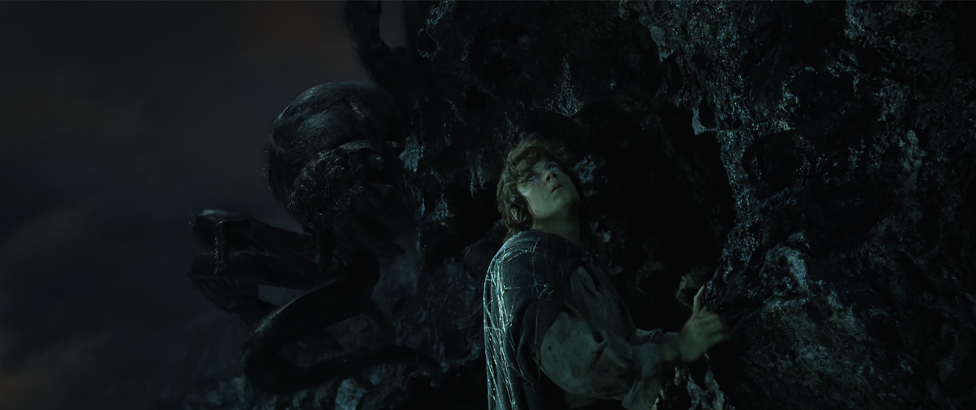
The path Frodo wanders to Shelob’s lair is pure, concentrated terror; narrow tunnels soaked in thick darkness, a place designed for hunting and slow death. Frodo’s light source carves out a small bubble of safety that, like his nerve, could collapse at any moment. Jackson is patient with the big reveal, building our fear through sticky webs holding half-eaten corpses, skittering noises and shifting shadows. We don’t know where the danger is, only that it’s close.
Our nerves reach breaking point when Shelob finally appears…and oh boy, does she appear. Shelob isn’t ambiguous like the Watcher or mythical like the Balrog - she’s fast, she’s ugly, she’s overwhelming. She’s all spindly legs, skittering movements and wordless malevolence. Arachnophobes, heed my warning. She’s a giant f*cking spider.
Hero meets villain in a fight to the death, and it’s quickly apparent that Frodo is completely outmatched. Heroism abandons him. He panics, he runs, he fails - just like any of us would. When Shelob stings him and he collapses, the movie does something unexpectedly brutal - it keeps him down. It doesn’t rush to pull the punch, or even give us a hint to his survival. Sam’s grief when he finds Frodo’s lifeless body is unresolved. For a long moment, the story offers no comfort - Shelob wins. The Ringbearer is…dead?
This scene works so well because it removes all safety railings. It turns Frodo’s journey into a pure survival nightmare. He isn’t protected by fate, power or music swelling at the right time. He’s just prey to a giant f*cking spider. Even Shelob’s later defeat at the blade of Sam doesn’t undo the damage - while he’s kept busy, Frodo’s body is taken by orcs, his fate unknown. Its horror built on tension, violence and loss, and Jackson sticks the landing on all three.
Moments that almost made the list - Aragorn and company walking the Paths of the Dead, the Hobbits’ encounter with the Ringwraiths on Weathertop, the hideous Mouth of Sauron’s appearance, and the sequence depicting Smeagol's transformation into Gollum.