

Oscar Meagher is shaken but not stirred as he picks up The Novel and the Deep Blue Sea: The story behind Never Say Never Again. Bryan Tyrrell's book casts an eye back on the classic film, tracing its development from the original Thunderball project to the finished film in 1983.
The James Bond film series is defined by a strict set of traditions. Since 1962’s Dr No, not a single entry has gone by without the iconic gun-barrel sequence, the title song, the Monty Norman theme, or the iconic closing words reminding us that “James Bond Will Return”. These elements are arguably more essential to the character’s iconography than the Aston Martin, the Rolex watches, or the exotic women with oddly suggestive names. It is also important to note that 1983’s Never Say Never Again does not include any of these elements, a result of its creation being outside the control of EON Productions, the company behind the main series. Without the components that have come to define the character, is Never Say Never Again really a Bond film? According to author Bryan Tyrrell, yes, it is.
His latest book, The Novel and the Deep Blue Sea, primarily serves as a secondary historical document regarding the creation of Irvin Kershner’s Never Say Never Again and a reflection on its placement in the larger series of EON-produced films.
Books documenting the Bond franchise are numerous enough to qualify for their own subgenre. However, this account also takes a personalised, more uniquely Irish perspective. Most of the early chapters detail the film’s numerous links to the country while framing producer and Dún Laoghaire resident Kevin McClory as the book’s quasi-protagonist. This is particularly noteworthy, given that McClory has often been the subject of mostly unfavourable representation, such as in Robert Sellers’ The Battle for Bond (2007). Tyrrell chooses to spare the reader from an extraneous overview of the series’ origins and focuses exclusively on McClory’s contributions, suggesting that he may perhaps be one of the chief architects behind the cinematic Bond.
The James Bond film series strictly refers to those made under the umbrella of EON Productions, or it did until Amazon’s recent takeover. The name EON is an acronym meaning “everything or nothing”, a nod to the tangled film rights of Ian Fleming’s novels. Due to the circumstances under which it was made, Never Say Never Again is generally considered a separate entity from the established canon of the greater film series. It is unambiguously a loose remake of 1964’s Thunderball, or more specifically, a readaptation of Fleming’s 1961 novel. The first section of Tyrrell’s book thoroughly examines the circumstances in which such a film came to be, and with far more detail than any review could hope to convey. It is incredibly insightful, a look behind the curtain at the unglamorous working conditions behind a generally uncomplicated film.
If you did not have a strong opinion on the film before reading, it is hard not to afterwards. Intentionally or not, Tyrrell positions the film as one born entirely out of constant short-term thinking and of desperate attempts at getting one over on the other guy. It was seemingly born from legal and financial necessity rather than any real artistic passion; the title itself was an in-joke referencing the star’s prior reluctance to return to the role. Most revealing were the constraints put on screenwriter Lorenzo Semple Jr to deliver a story close to the source material, but also not “too close” so as to avoid any further legal entanglements with EON. What resulted is a film unable to strive towards advancement but rather forced to exist within the boundaries of a well-worn space.
This franchise has never been known for invention, so Never Say Never Again already fits right in. This account functions equally as both a second-hand historical document and a reappraisal of the film’s merits. His argument is quite convincing too, citing the inclusion of Sean Connery and its numerous ties to the EON series, as well as the character’s literary roots. This reviewer will fully admit that their perspective on the film has indeed shifted as a result. Never Say Never Again is, without a doubt, an official Bond movie. Whether it is good, though, is still up for some debate.
Many of the latter chapters focus on dissecting the changes from book to screen. These range from larger alterations to more trivial ones. These passages are admittedly less interesting and perhaps difficult to process without a visual aid. The book works best as a companion piece, perfect for further reading for fans or critics. With that in mind, the focus on the ultra-specific seems to be the point. It is extremely well researched and a mostly fascinating read. Even if the book does not create any born-again believers in Never Say Never Again, it may provide some assistance in assuaging McClory’s reputation within James Bond history.
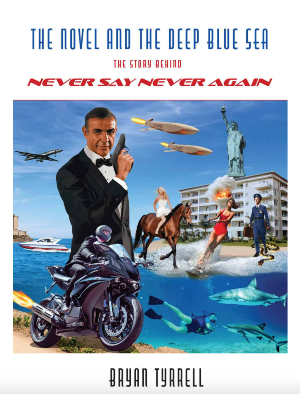
The Novel and the Deep Blue Sea: The story behind Never Say Never Again is written by Bryan Tyrrell and published by the Independent Publishing Network. The book is designed by Aidan J Collins.
The Novel and the Deep Blue Sea: The story behind Never Say Never Again is exclusively available from Buy The Book website.

