
As Die My Love is about to land on MUBI, Steven Dávila gives his take on this labour of love.
Lynne Ramsay always waits for the world to shift. It has been nearly a decade since her last film, You Were Never Really Here. In that time, the film’s perspective of the world has decayed and ruptured further. Her work always stands in such unique points in time and culture that to picture what another significant progression looks like is futile. This is particularly so given that Ramsay is neither in a definable stage of her directorial career, nor has she ever been prolific. However, even with such a profound filmography, there exists one specific thread that spools through her career.
Amidst dense navigations of womanhood, childhood and artistry, she focuses on the inability or refusal to assimilate into the life expected. Physical and psychological reinvention of the self, and the failure to do so, is the outstanding idea behind her four previous feature films. From Morvern Callar’s choice to take on her deceased boyfriend’s manuscript as her own in the film of the same name, or Eva’s contention with a darker being within her son in We Need to Talk About Kevin, acceptance of one’s emotional and real environments is far from Ramsay’s narratives. Yet, in Die My Love, we are dealt a shift in perspective: having reinvention thrust upon you.
Anchored by Jennifer Lawrence, Robert Pattinson and supported by the ever-wonderful Sissy Spacek, Die My Love presents an immediate period of time. Grace (Lawrence) gives birth and develops postpartum depression. An adaptation by Enda Walsh, Lynne Ramsay and Alice Birch of the book of the same name, Ramsay’s film was the opener for Belfast Film Festival, where I first caught the film, drawing a full house in anticipation, but the outcome wasn’t quite as I had hoped.
Past the noise of those big name actors, Ramsay’s return and Martin Scorsese’s direct hand in development, are shades of a tender, shaken heart. Anyone whose mother has suffered postpartum, and that would be many, will know how the shift in the body and the mind becomes a landmark moment. The body, as with the environments in Ramsay’s film, ripples and stretches and tears beyond the process of childbirth. Lawrence, as her character, takes this all on completely. She smashes through a glass door, crawls and sprawls on the floor, bashes her head into a mirror at her wedding reception, puts a dog down, and you could argue the emotional blows she faces are even more violent.
Ramsay, though, admires this mother’s body; naked, beaten up, tender or hard, and Lawrence’s complete committal proves to be the most rewarding facet of the film, resulting in what is probably Lawrence’s career-best endeavour. The way Ramsay shoots the body is layered further with how she shoots in nature, with vast and dense landscapes encompassing form. Environments glimmering and freeing in such a way that reminds me strongly of how Terrence Malick interpreted the world, making the dirt, grass and human body feel cosmically important. These formal divergences are the most affecting portions of Die My Love, richly in conversation with the real world dynamics of motherhood and nature, and too with the rest of Ramsay’s cinematic career.
Die My Love thematically works best there, with that conversation. This is where Ramsay’s most personal elements are clearest. Grace is an author, whose passion has been entirely scuppered by childbirth, and how much of the film aligns with Ramsay’s own experiences is unknown, but there are fears of reinvention that feel very true. In her catalogue of work, so many of Ramsay’s past characters seekout a new identity, or an absence of one, and attempt to break away from violent, morbid experiences, whereas Grace’s new identity is imposed onto her.
Expectations of her as a new mother, a new wife, a sexual partner, and an artist sink her further into darkness. Of course, this also coincides with her physical reinvention, and while Die My Love leaves much to consider, it also feels as though there were still deeper formal layers to reach. The choppy structure of the film works in tandem with Grace’s blunt recollection and reassembling of her past and present, but the richness of the more abstract sequences leaves the narrative-heavy portions feeling lesser. While Die My Love’s more fractured approach brings to the forefront how the creative mind, as well as the body, suffers during postpartum, there is a formal disconnect to the subject matter that only really gets stronger as the film progresses.
As the film concludes, Grace undresses and walks on through a burning forest, an abrupt end but maybe the beginning of both Grace and Ramsay’s desired reinvention. The forest will regrow. The film does boast some great performances, and some of Ramsay’s best, most cerebral filmmaking, but it still stands a distance from her most staggering works. Gone is the freedom of the eternal Glaswegian wheat fields, or the rapturous Spanish nightlife. Now the world pushes in, not out, but even still, Ramsay still finds moments of escape from its hold.
Die My Love screens exclusively on MUBI from 23rd January 2026.
 Film Ireland Editor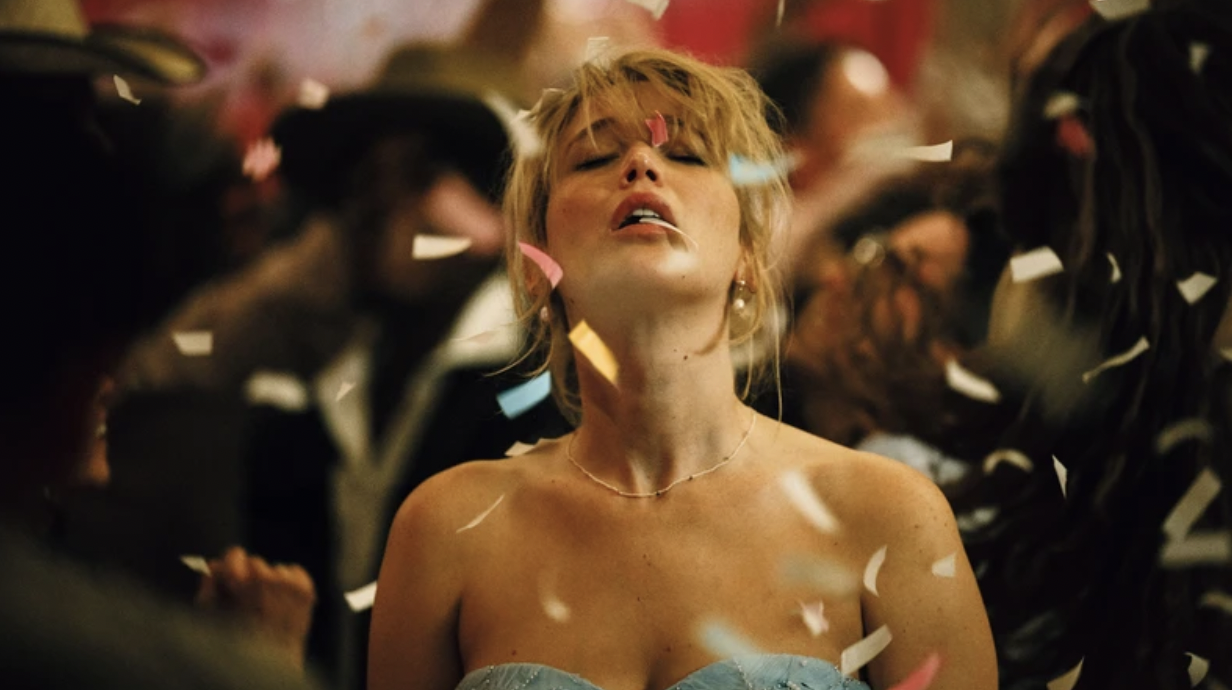
 Film Ireland Editor