
Adam Matthews checks in for Cork-based horror, Hokum.
Damian McCarthy's Hokum is quietly unnerving from the outset, settling in like damp in the walls. Opening on a strange detour, the desert epilogue is pulled from its protagonist writer's own fiction, and holds there just long enough to wrong-foot you. Holding on a moment where a character is poised to smash a glass bottle over a child’s head for the sake of some obscure objective... then cutting away before impact. When folded back into ‘reality’, that early sense of dis-ease sets a strong tone for what's to come.
Ohm Bauman (Adam Scott) arrives at the Billberry Woods Hotel in Cork to scatter his parents’ ashes. Scott plays him with a brittle detachment, an alcoholic writer whose cynicism bubbles just under the surface. This venue is already uneasy: a sealed honeymoon suite no one will open and local whisperings about vanishings. As Ohm begins to involve himself, we’re brought on a familiar trajectory. He's an outsider who doesn’t believe but is gradually worn down by what he can’t explain. The narrative's focus is tightly aligned to his perspective as it begins to fracture.
Most of the action is contained within the building, and McCarthy handles the confined space with precision, just as he does with his earlier work. In this establishment, rooms don’t behave as they should, and the aforementioned suite carries a psychic pressure. This evokes the shifting hostility of 1408 or American Horror Story Season 5 where the venue itself becomes the source of instability. At the same time, the hotel sits on a threshold, brushing up against an Irish Otherworld, where boundaries thin and spaces hold onto what has passed through them. That residue runs through the building, connecting the basement to the suite above via the dumbwaiter.
Cinematographer Colm Hogan’s colour palette in the daylight scenes leans heavily into a yellow and bluish-green tint that flattens the image and drains it of life, giving the hotel an oddly artificial, almost stagnant quality. By contrast, the darker scenes are far more assured, whites taking on a spectral edge while yellows carry a gilded warmth. The focus stays on key images just long enough for them to be perceived, and it’s here that the film finds its strongest visual footing.
The sound design works in a similar register. A layered mix of warped wailing runs beneath the surface, folding into the hotel’s eerie ambience, creaking floors, whipping winds, the steady presence of bells, to create a constant low-level discomfort. Moments where tape recordings are layered over empty space are particularly effective, filling the room while advancing the narrative.
Scott’s performance sits at the centre of the film tension. Ohm is not an easy character to follow, closed off, often abrasive. A late turn in his arc reframes him. This is an abrupt shift, particularly given how deeply the character’s past is tied into the central premise. Around him, David Wilmot’s Jerry provides a sympathetic, occasionally comedic foil, softening the film’s edges just enough to offset Ohm’s mean-spiritedness, while Will O’Connell pulls double acting duty as the struggling writer Alby and the uncanny, hair-raising presence of Jack the Rabbit.
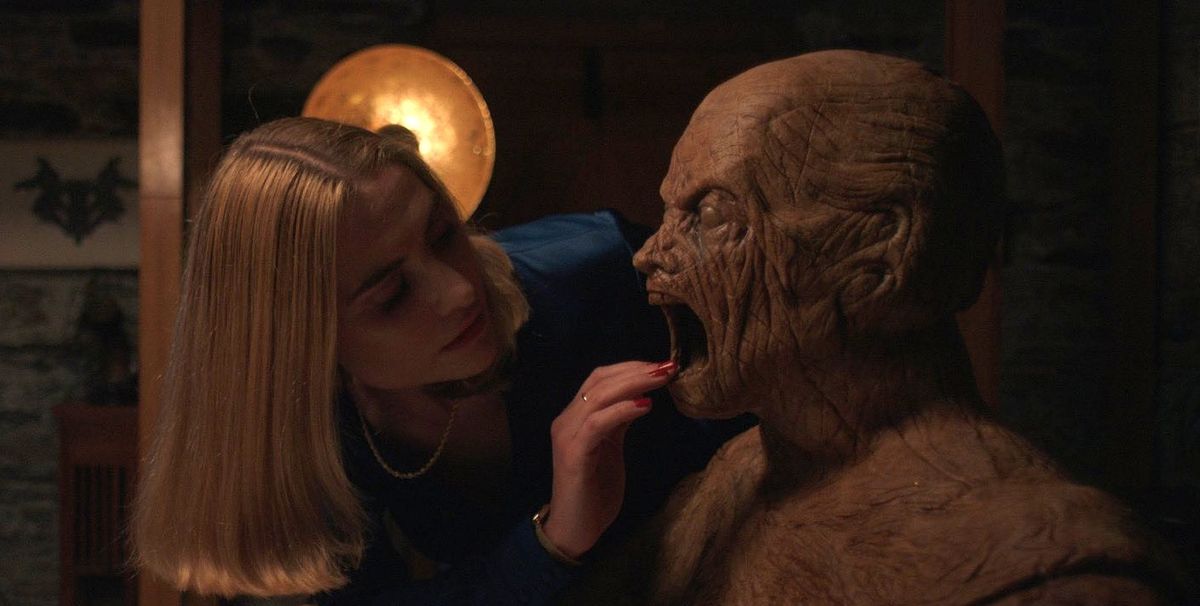
The Jack Rabbit figure threads through all of this, though sits alongside other, more tangible threats. The film gestures toward the Cailleach, reworked into something closer to a Wiccan, spectral hag associated with chains and the dragging of bodies into another realm, a somewhat familiar register. The Jack Rabbit itself is not an arbitrary image. Framed as a children’s television host, a distorted memory of a Bozo-like figure, this ties directly to a pivotal moment of childhood trauma.
The film’s use of folklore sits further back. References to the Cailleach and Samhain, seen in the hotel’s decorations and atmosphere, suggest a wider context. This all works in terms of maintaining tension, but never deepens beyond that suggestion. This is one of many threads of ambiguity. One theme investigates toward the consequences of trauma and its repetitions, but isn't given enough space to fully land.
There’s a clear sense of progression in McCarthy’s work. From Caveat through Oddity to here, each feature has grown more assured. Hokum seems like the point just before something inherently impressive clicks. Beyond the many genre conventions and jump scares, McCarthy's work has potential to rise into the company of the spectral greats. Many sequences stick like resinous glue: the climactic scenes, glimpses of Ohm’s childhood, the recurrence of objects like the bell and hacksaw, all circle back with slight shifts each time. McCarthy has a knack for using every tool in his toolbox, for images and ideas to resurface slightly altered.
When the final credits roll, Hokum lingers in the mind, leaving behind a sense of space marked by an eerie displacement...as if something has settled there and won’t quite let go.
Hokum is in cinemas 1st May 2026.
 Steven