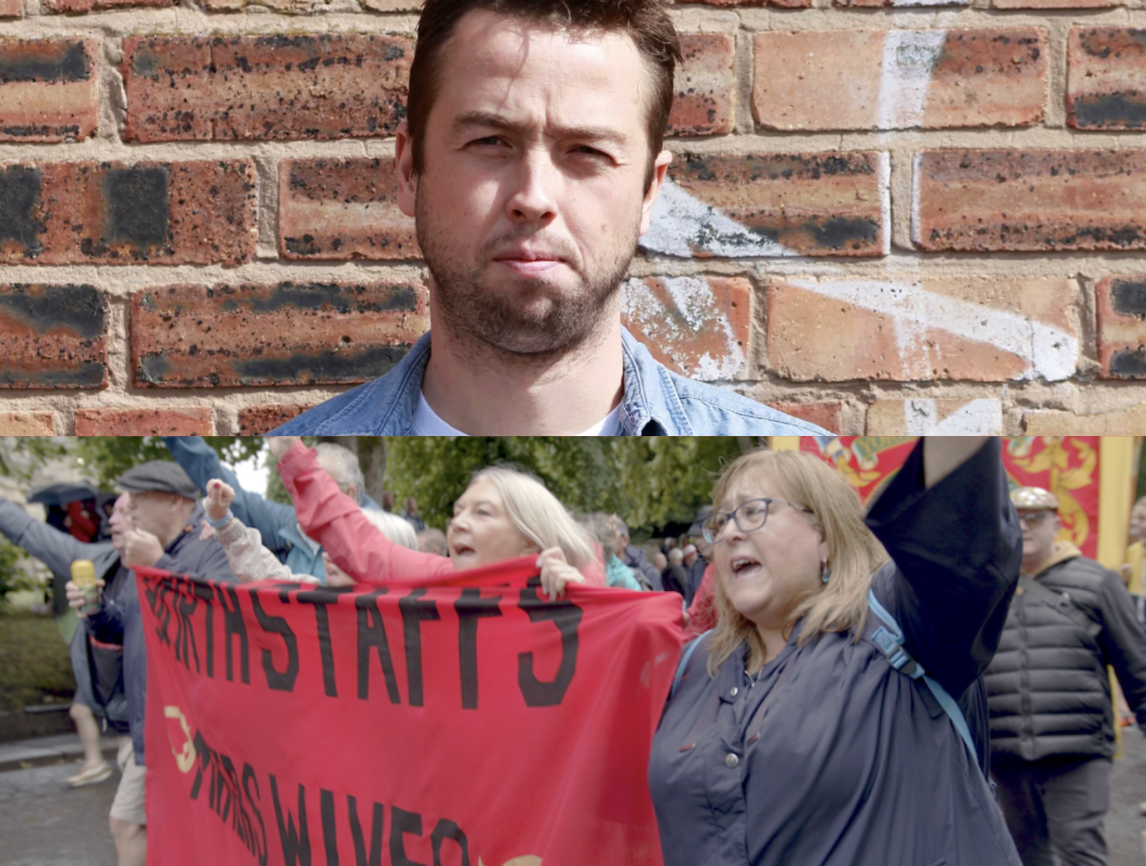

Naemi Victoria casts a steely gaze at Draper's documentary celebrating working class women.
Two women carry a banner that reads: “Cole Not Dole Save Our Pits.” A third drags over a brazier spitting smoke while others stick flyers to the grey walls of the office building. Men in suits exit. One of them eyes the group with curiosity as they set up camp outside the London office of Michael Heseltine, UK Secretary of State for Trade and Industry. It is 1994, ten years after the fateful miners’ strike of 1984/85, and Women Against Pit Closures have not lost their fighting spirit.
Daniel Draper's documentary Iron Ladies is a story of resilience. It is told by members of Women Against Pit Closures, a political group that was formed by women from mining communities across Britain who helped keep the 1984 strike going for as long as it did. Their activism was not motivated by an abstract political idea, but the protection of their livelihoods. They fought at picket lines, organised food and care for families on strike, and campaigned for their cause in the UK and abroad. In a series of interviews, the women share their perspectives on this pivotal moment in working-class history. They set out to support the strike and so they did.
Iron Ladies is decidedly biased and necessarily so. Rather than balancing viewpoints, it hands over to the women of the strike to share their version of history. The interviews are filmed in their homes, their kitchens and living rooms, a setting that reflects how deeply personal the women’s recollections are. It was their upbringing, their families, and tight-knit communities that shaped their political views. Mining was a way of life for generations. When it was threatened by Conservative politics in the 1980s, people started organising. The domestic comfort of the interviews contrasts starkly with the women’s vivid memories of police violence and the vilification of unions they experienced. “When the strike started, we had to become political,” Carol Ross states. Women Against Pit Closures grew out of necessity but became more than that. It changed the women’s lives and demonstrated the potential of collective efforts.
Challenging the demonisation of organised forms of labour, this film blends archival footage of the strike and the women’s recollections, stressing the magnitude of what they were up against. The interviews revolve around the women’s lived experiences with economic hardship and address the abuse they faced from the British government for fighting against it. As the iron ladies of the strike, they came together in solidarity to protect workers’ rights against the attack of neoliberal politics. Aggie Currie reclaims the unyielding will frequently attributed to Margaret Thatcher for an entire community of working-class women. “She was one iron lady, we were hundreds,” Aggie declares.
The fierce class antagonism of the 1980s left scars on working-class communities that remain to this day. Iron Ladies spotlights these. It introduces each former mining community with a series of establishing shots that conjure the ghosts of Britain’s heavy industry. Abandoned collieries loom into the sky like monuments to a lost way of life. They seem to overshadow the landscapes of Staffordshire, South Yorkshire, or South Wales and puncture the narrative with moments of lamentation. Against the backdrop of these industrial ruins, the women’s unwavering determination to fight for a better future is a silver lining. The struggle for class equality, Iron Ladies seems to say, is an ongoing one.
Popular memory tends to emphasise the singularity of the 1984/85 miners’ strike. It is the miners’ strike, rather than a miners’ strike, which was preceded by numerous others. Iron Ladies challenges this singularity. In 1972, the miners went on strike for improved wages and Betty Cook’s family of five depended on her income alone. She remembers working full-time, raising three children and going hungry and cold regardless. Absorbed in the past, Betty pets the cat next to her. “And I cried most during 72,” she remarks with a composure that shows great strength. Despair turned into resolve in 1984, when Betty refused to accept what was happening to her and her family and got involved in local politics. With that, she joined numerous other women who became known as Women Against Pit Closures.
The documentary’s focus on gender offers a compelling insight into a history that tends to be reduced to a battle of wills between one woman and numerous men. Women Against Pit Closures counters this image. The women’s recollections shed light on a time when society expected them to stay at home and mind the children. That domestic labour was in fact labour had not yet entered the public consciousness. Paid work was out of the question if it could be helped. Only it could not. Sharing her lived experiences with these norms, Betty points out that she was always referred to as somebody’s mother or wife, but never herself. This powerful observation on everyday life defines the gendered perspective that Iron Ladies offers on working-class history. When Women Against Pit Closures formed, it became an opportunity for women to speak up and get involved in political change. It provided the framework for them to be recognised as political activists rather than a social role they were expected to fulfil.
Iron Ladies rejects the narrative of defeat that surrounds 1984/85. Instead, the women achieved what they set out to do, which was supporting the strike. Their political involvement and the solidarity it fostered have long outlasted 1984. Last year marked the 40th anniversary of Women Against Pit Closures, which anchors the documentary’s narrative in the present. The iron ladies of the working class have not given up. They continue to strive unapologetically for a better tomorrow, and the documentary joins them on this journey.
Iron ladies will screen in Derry's Nerve Centre at 7pm on 30th January and is followed by a post-screening discussion with Daniel and contributor to the film, Rose Hunter. Get your tickets at NerveCentre.org.
 Film Ireland Editor