

June Butler examines the striking experimental short film Sete, exploring its portrayal of racism, displacement and the emotional toll of living between cultures in contemporary Ireland.
Brazilian Marcello Fidelis experimental short film Sete (Portuguese for’Seven’) looks at racism experienced by Brazilian nationals living in Ireland. The title refers to the maximum length of time in years immigrants from the country are allowed to come to Ireland and remain here - whether for study or work. For those who leave their home and fly thousands of miles to a country they are unfamiliar with, it is not an easy choice to make. Cultural differences in understanding nuances of English can be problematic given the fact that Portuguese is the primary language in Brazil. According to a survey among Brazilians that took place in April 2024, fifty per cent of those interviewed, maintained they had experienced some degree of bigotry and discrimination during their stay in Ireland.
Sete addresses this bias, recounting a tale of workplace bullying that is evidently racially charged. Opening scenes of the black and white film show an unnamed man (Semilore Olusa) staring fixedly at the camera. There is no dialogue. Marcelo Ortega provides a voiceover, narrating a story of harassment that augments into a more serious level of powerplay; the unnamed man in the story, has been subjected to unkind banter about his hair – a Caucasian female along with others, makes a joke and when confronted maintains her words are intended as the mildest of teasing. The man disagrees and takes his complaint to the human resources department, who continue to support his female colleague. As tension mounts, it is evident the victim is mentally unravelling. The actor mimes cooking, chopping garlic, pausing mid-chop to stare into space, and then recommencing the actions. He gazes at a knife as if deciding whether to use it as a weapon or cooking assistant. The man scratches relentlessly at his skin as if somehow trying to peel away the layers of hurt and sadness.
Fidelis makes use of split lighting to engender more tension and create deep shadows across the actor’s face. It is a powerful mechanism to use and enhances Marcello’s film to the point where viewers are propelled into the drama and can witness the disaster unfolding piece by piece. Marcello Fidelis’s film packs an unwavering punch – collaborating with Brazilian music producer Marcelo Ortega and Semilore Olusa, Sete makes a clear statement. It is not enough to stand by and witness others making a mockery of someone simply for the colour of their skin or other physical aspects – the most basic tenet of human existence is dignity. And it should be freely accorded, without exception to every person who lives on this planet.
Sete was screened by Solax Film Club on 14th of August 2025.
Marcello Fidelis
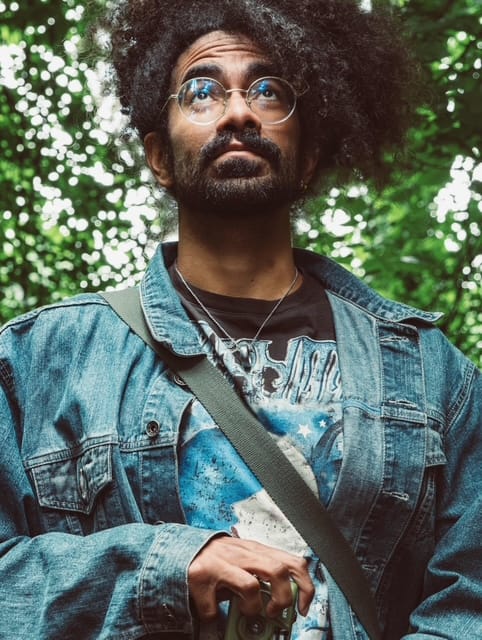
Marcello Fidelis, born in João Pessoa, Paraiba, Brazil, is a director, videographer, artist, actor, and playwright. Fidelis has been working in the Irish film industry since 2017 and has completed a Bachelor of Arts in Film and a Master of Arts in Film and Creative Media. He has directed a number of short films, CAFUNÉ (the PAINTING, or How to Deal with Your Dog’s Death), fr0ggy, Go Home and Sete.