

Nearly one in two of us will be diagnosed with cancer in our lifetime. Director David Wilkinson is one of them. In 2024, a colonoscopy revealed Stage 4 bowel cancer, despite a clear FIT test the previous year. His documentary, 1 in 2, explores his own experience of diagnosis, alongside the rising number of younger people facing the disease.
Ahead of its screening at Lighthouse Cinema on Sunday, 8th November, writer and journalist Rachel Walshe speaks with director David Wilkinson about this deeply personal film.
No one wants to think about cancer. That is until you or someone you love are diagnosed. Then it tends to linger in the mind. Multiple doctors had given director David Wilkinson the all clear for bowel cancer, until he was diagnosed with Stage 4. His latest documentary, 1 in 2, described by Wilkinson as “a ridiculously long film, but, you know, it's the most personal film I'll ever make”, follows him as he navigates his own cancer treatment.
Although the majority of bowel cancer cases are in people over the age of 50 (the age the NHS begins screening in the UK and Scotland. In Ireland, screening begins at 57), there is a growing trend of younger people presenting, often at late stages. 1 in 2 seeks to centre these people’s stories, challenging and, in equal measure, highlighting the responses of medical practitioners across the UK and Ireland, as well as acting as a guide to help you (“Yes, you”) to spot the symptoms.
Wilkinson, who began his career as an actor before working as a producer and distributor (a boon for any filmmaker), came to directing almost by chance. “I'd never intended to be a director. It had never occurred to me. I've always liked being part of a team, that whole esprit de corps that you get in the theatre. And I was an actor from a very young age. Having worked with so many good directors, people like Mike Newell and John Irving on the film side, and really good theatre directors, I just knew I couldn't do it. So it never occurred to me ever to direct a documentary.”
His route into filmmaking came through The First Film, a documentary exploring the claim that Louis Le Prince made the world's first film in Leeds, where Wilkinson himself is from. Making a convincing case for Leeds as the birthplace of cinema, the project was one he had hoped to see directed by someone from his home city “And so I did something called The First Film, which was proving the world's first film was made in Leeds, which is where I'm from. And I always wanted a director from Leeds. And I mean, I'd asked people in the past like Terry Gilliam, who I knew, and loads of people, and nobody wanted to do it.”
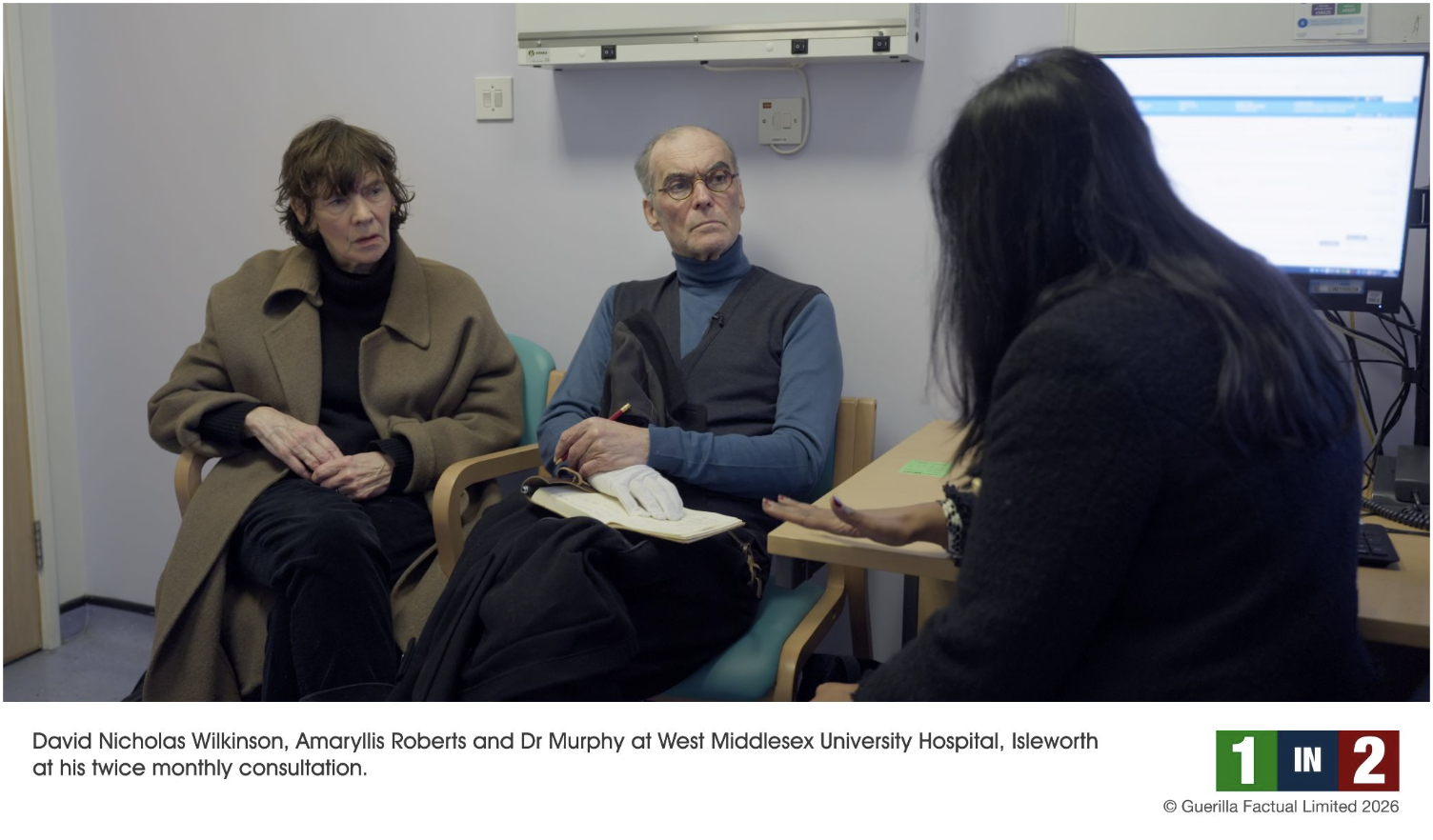
Although Wilkinson describes most of his films as “talking heads” (albeit with efforts to disguise the fact), he had never intended to become the focal point of this film’s narrative. “When I started this one, I wasn't going to be in it as much as I am. I obviously – it opens with me going and having my chemotherapy for the 11th cycle… there, but I was then going to spend a lot more time with the people I was filming, with them being treated or them in the situation. Of course, none of them wanted it…[and] my co-editor John Walker said, ‘David, you're going to have to be in this a lot more.’ I said, ‘Why?’ He said, ‘Because nobody else is going to be willing to show what you show.’”
There is a revelatory frankness to the documentary as Wilkinson lays bare (literally in some cases) the realities and physical toll of living with cancer. The goal being to “demystify the whole cancer treatment”. Wilkinson receives chemotherapy on screen, discusses bowel movements extensively, and shows how treatment can lead to other physical ailments; on his 70th birthday, Wilkinson drives himself to a sexual health clinic, as the tip of his penis was discoloured. Though the film deals with heavy subject matter, there are ripples of humour throughout. Dubbed the “Fuck, Fuck, Fuck” scene, Wilkinson loudly and defiantly decries cancer through a montage of “Fucks”.
David shares how Professor Seamus Martin, Smurfit Professor of Medical Genetics at Trinity College, who was interviewed for the film, told him: “You've got to promise me the one thing you mustn't cut is the fuck, fuck, fuck. You have to keep that in.” David ultimately agrees, explaining that these moments of levity “bring in a degree of humour and a bit of relief”. That was his intention, after all: “I didn't want it to depress the fuck out of everyone because, you know, people do die of cancer, but people live and have it cured if it's caught early enough.”
There was, however, a balance to strike between leaning into the tension-relieving humour and knowing when to pull back. His DOP, Don McVay, cautioned him at one point when talking about incontinence as they filmed on Ilkley Moor. “Don brought it up," David recalls, "But then I actually carried on, but I felt more and more awkward about it." McVay’s intervention prompted Wilkinson to reconsider how his humour might land with others. As he explains: “I said to Don, ‘I'm stopping this now, it's not working’. He had sparked something, and I thought, ‘Yes, I'm taking it for granted because there are some people who are very upset by it all.’” Wilkinson is conscious that his use of humour as a coping mechanism doesn't resonate with everyone. For some, his attempts to find comedy in the experience can be hard to hear. “It's a difficult one. So I was not going to include the scene at all, and then I thought, ‘Oh no, here I can say something about it.’” Wilkinson ultimately decided to keep the scene, recognising it as an opportunity to acknowledge those who struggle with his use of humour, or find it offensive. As he puts it: “I can address those people who just can't see the humorous side at all. They get offended when I go, ‘It's so comical, this cancer.’”
Through his lens, McVay also captured the frustratingly funny scene of Wilkinson trying to explain a procedure. However, each of his takes is continually interrupted by medical staff barging in as they attempt to prepare him for said procedure. “It's edited exactly how we did it."He recalls one particularly chaotic moment: “At one stage I got changed into going up to surgery, and then the nurse said, ‘Oh no, this is too early. Can you change back into your own clothes?’ So that in itself was funny, but unfortunately it wasn't quite as funny when we edited it together.” The experience was not without its tensions, however. “That hospital didn't want me at all to have anything to do with it… there was a lot of tension. I'll diplomatically put it.”
For all the film's intimate access to Wilkinson's cancer treatment, gaining the cooperation of the hospitals proved surprisingly difficult. But for the collaboration of Wilkinson’s oncologist, Dr Ravindhi Murphy, the film may not have been made. “They're all on the defensive at the moment. I think because particularly in the UK, I don't know how it is in Ireland, everybody's becoming so litigious that they're really worried about doing anything wrong.” Despite having permission to film, Wilkinson was eventually asked to stop while capturing footage in the hospital corridors. “Some doctor got really angry. I wasn't interfering with them, I was just walking. And they kicked me out. They said, ‘You can't do it anymore’. And I had permission to do it, and I had another 2 hours to go. So it rattled somebody's cage. Somebody very high up got very upset about it.”
While doctors and medical professionals comment on the rise of bowel cancer in people between the ages of 25–50, proffering lifestyle, diet, or other environmental factors, the patients themselves appear uniform in their response; they were not believed until the cancer had become severe. The majority of contributing patients are female, and there is a longstanding phenomenon of disbelief of women's presentations of pain or illness, a fact Wilkinson is aware of. “If the patient is male, [doctors] take them much more seriously.” He points to the recent experience of one woman he knows. Her doctor reacted angrily when he discovered that she had sought advice on Facebook. “She's convinced – although she didn't say what sex the oncologist was – that it's because she's a woman.”
"And maybe it's also my age, but I'm aware, and this was before I made the film, that they would treat me with a certain respect and reverence that wouldn't be accorded to some of the women I was having treatment at the same time… And obviously – my film features 5 women, and most of my medical people are women, and I've actually become very anti-men, within the medical profession, because men dither. They don't give you any confidence and I don't know if they know it. They need to get together with a group of actors. The whole NHS needs to do this to understand how your patients are all scared and nervous."
The isolation of a cancer diagnosis is something multiple contributors comment on, including Milli Tanner, the youngest interviewee, aged only nineteen. Wilkinson’s experience tallies with this.
“When you tell people you've got cancer, people ghost you and people ignore you. People do walk on the other side of the street, as it were, metaphorically. I have mentioned it to a couple of people...one person actually stepped backwards subconsciously, as if it was COVID and he might catch it.”
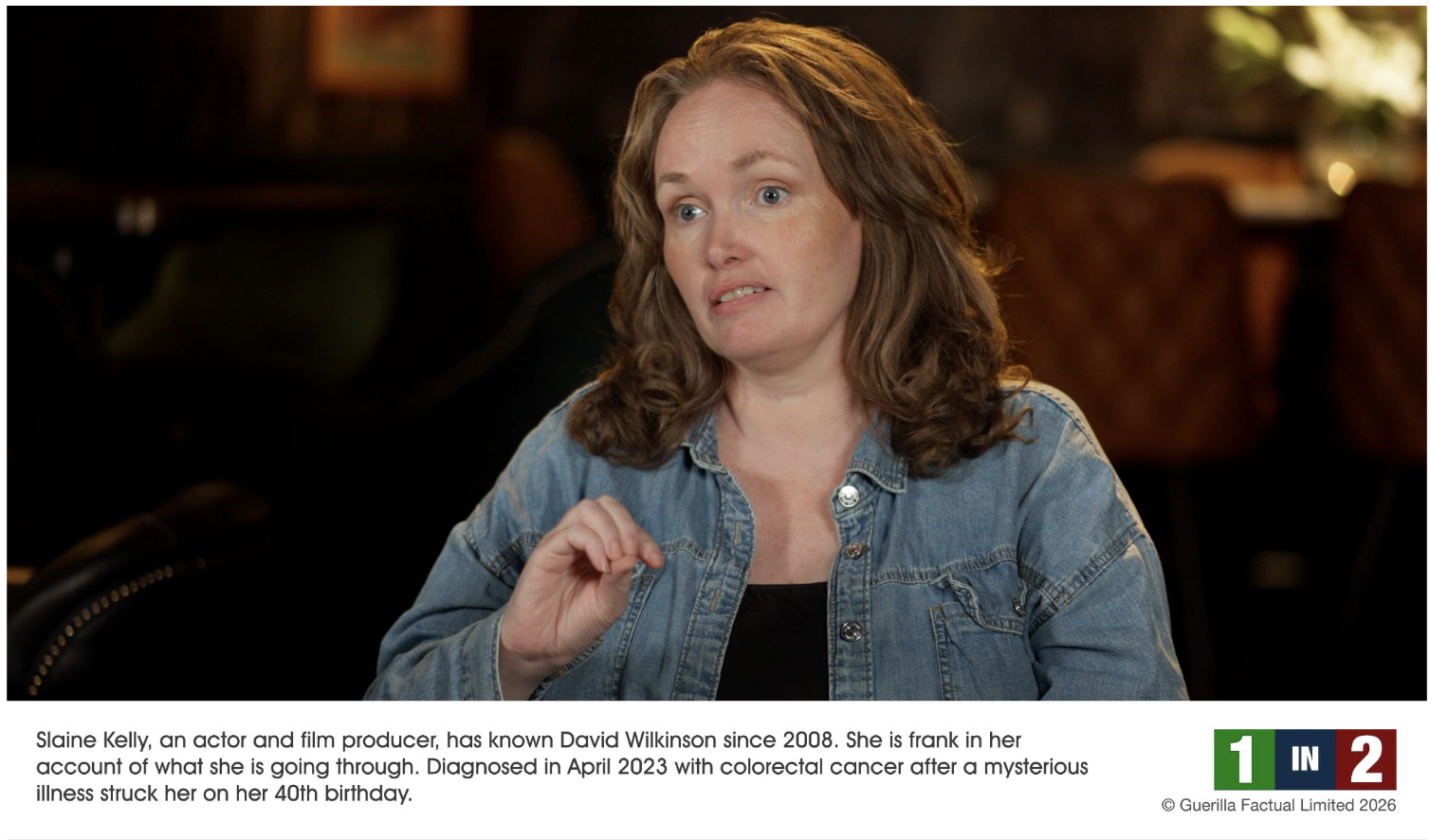
Wilkinson is keenly aware that this latest documentary, while vital, may not be a box office smash. The intention is to release the film online for free from 1st December, so viewers can access the wealth of information provided. The next screening will be in the Lighthouse Cinema on 8th November, and is in memory of actor, writer, and producer Slaine Kelly (The O’Briens, The Tudors), who passed away earlier this year. She and Wilkinson became ‘very good friends’ after meeting at the Galway Film Fleadh, which he describes as "the greatest film festival." When his treatment meant that he was no longer able to attend the event, Wilkinson, who calls himself “prolific” on Facebook, went public about his diagnosis. “And Slaine said, ‘David, have you got bowel cancer?’ And I said, ‘Yes’. She said, ‘Oh my God, so have I’... I knew that I wanted Slaine [for the film]... Of all the people I filmed, she tells it how it really was.” Her contribution to 1 in 2 marks her last on-screen appearance, which was filmed in Galway – the Fleadh bringing them together once more.
Unfortunately, two other contributors also passed away during the making of this film: Dr Lisa Andrews-Dhapre, a Trauma and Orthopaedic surgeon, and Renee Shawcroft, a nurse who specialised in Endoscopy and Colonoscopy. Although unable to attend Kelly’s funeral owing to his ongoing treatment, Wilkinson did attend the funerals of both Andrews-Dhapre and Shawcroft, brief snippets of which are seen within the film. “It shocked me with all of them. And the extraordinary thing is they all died within a short time of each other. I just didn't know how to handle it… But I wanted to do it. I wanted to be respectful.”
Wilkinson had picture locked the film, and yet something brought him back to the edit – hope. Producer Edwina Forkin (Who We Love, As Luck Would Have It), also a friend of Wilkinson's whom he managed to film while at the Galway Fleadh, had previously been diagnosed with ovarian cancer. Her account of her treatment, and her emphasis on the importance of mental as well as physical wellbeing, prompted Wilkinson to reconsider the film's ending. “I had wanted an uplifting ending to the film because people are going to be very upset when they watch it. Particularly those with bowel cancer, they're going ‘Oh my God, 3 of the 5 women featured all died. Is this going to happen to me?’ And again, I thought, ‘I've got to put it in because I owe it to the women’”.
Wilkinson’s own story of treatment concludes (at least within the film) with his cancer regressing. His summation is full of anger and hope, echoing many of the brave souls who took part over the course of the film.
“Fuck cancer, and always follow the science.”


The series of screenings of 1 in 2 will take place across the UK and Ireland. Find the complete list here.

