

In this article, Aubrey Malone reflects on his imaginative approach to chronicling the life of Marilyn Monroe, explaining why he chose to tell her story through the intimate form of a diary rather than a conventional biography.
What first made you want to approach Marilyn Monroe through the form of a diary?
A. I wrote a book some years ago called Hollywood’s Second Sex which was about the mistreatment of women in Hollywood. Marilyn was on the cover and she featured prominently in its pages. I could have expanded this material into a biography but I would have found the exercise repetitive and dull. Deciding on the diary format was a lightbulb moment for me. It gave me a different kind of impetus.
Why was it important to tell the story from the “inside out” rather than from the outside looking in?
A. Her story has been told from the outside too many times. I felt her centenary, which is coming up shortly, deserved more than a re-tread of all the hoary old yarns we know all too well. If I could have her setting the record straight, speaking from the horse’s mouth as it were, I thought it would stop people saying, “Oh no, not another book on Marilyn Monroe.”
How did you find Marilyn’s voice?
A. It was more instincts than sources. I did some acting in the past and enjoyed taking on different guises. In those days it would have been on a stage. A page is different. You’re working with words instead of pitch or projection. I wrote a novel once called A Nursing Life. I did it in the first person, taking on the persona of a woman from her youth to old age. The first chapter was a challenge but after that I built up a momentum and it basically wrote itself. One of the reviewers said, “Aubrey’s had a sex change.” I was flattered.
Were there moments that were difficult to write?
A. I’m not a woman so I don’t know how it feels to have a miscarriage or an abortion but these were difficult pages to write. Marilyn became pregnant many times in her life but never gave birth. I believe a child could have prolonged her life. She had such a strong maternal instinct, as we see from the way she related to the children of her psychiatrist, Ralph Greenson or Arthur Miller’s children by the woman he married before her.
How did you decide which seminal dates in her life to include?
A. I hope I included all of them. They were my pit-stops. In between them I could do what I liked. I tried to find “the story behind the story” but they had to be there as scaffolding. Once you put that date down with the salient facts you shake the tree and see what falls down afterwards.
Were there events you deliberately left out?
A. I didn’t leave out anything I knew about but I’m sure there are lots of things I don’t know. I wasn’t under the bed when she was sleeping with those men, both inside and outside marriage. People speculate about what might have been said or done but at the end of the day that’s all it is – speculation. Some details about her early years are sketchy even in the longer books about her. I’d like to see these filled in by future biographers.
How did you balance documented fact with imaginative reconstruction?
A. I have a book called Marilyn Day By Day. It gives all the seminal dates in her life. That was my tuning fork, if you like. It was the platform I jumped off any which way I could (with Marilyn’s permission). I tried to give myself as much leeway as possible. Norman Mailer once said that when one is writing about a historical era, it’s important to be profoundly ignorant about it before you start. Otherwise you’ll find yourself just recycling what other people said. That’s why he’s so exciting when he’s writing about people like Lee Harvey Oswald or Gary Gilmore – or Marilyn. You have to get away from the tyranny of fact. Writing is the art of the possible – what might have happened on a given day or in a given year. Mailer – who fantasised about bedding her, as did half the hot-blooded men on the planet when she was alive – coined the word “factoids” to refer to things that are partly factual and partly fictional. My book is laced with them.
What themes emerged as you wrote, perhaps loneliness, ambition, performance?
A. All of these. The loneliness of being a foster child, the ambition to get out of that rut, the performances that were the key to such a liberation - fighting off the cattle call routines and the cheesecake roles until she got her foot on the ladder. Some people thought she was pretentious going to the Actors Studio and reading Joyce and Turgenev but she didn’t do these things for the camera. She always wanted to improve herself and that meant reading highbrow literature and taking on classical roles. Sadly we never saw her in those. Like Elvis, she was shoehorned into dumb blonde roles for most of her career. When she tried to break out of them, in films like “Bus Stop” or “The Misfits,” they didn’t tend to do much business at the box office. She retreated into “Some Like It Hot” afterwards. It was her dumbest role and her most successful. There has to be a lesson there somewhere. We live – or die - by our mistakes.
Which period of her life was the hardest to inhabit?
A. Her fatherless childhood, having to deal with a mother who was incarcerated in a psychiatric institution, having to sleep with men she found repulsive, like the executive Joseph Schenck, being terrorised by the fear of ending up like her mother, having nightmares of being strangled by her grandmother as a child - there were so many.
By the end of the project, did you feel you understood her better — or did she remain elusive?
A. I understood her actions better but there was always an X Factor about her mind for me. This is what fuels books like mine, and all the others. She was ultimately a bottomless well, a hall of mirrors. I tried to create a version of her but had to accept that it’s just one version among many. I valued her elusiveness highly. You might think that’s an unusual thing to say when one is writing a diary but think of Albert Camus in “The Outsider.” He wrote in the first person about his character Meursault but was a million miles away from him in essence. He was looking at him from an ironic perspective which was ingenious, writing a confessional tome that was mischievously ironic.
What do you hope readers feel when they close the diary?
A. I hope they’ll shed a tear or two, or feel a lump in their throats reading about a life that could have been so much happier and gone on so much longer. 36 is no age to die for someone who still had so much to give, but once the wheels came off her marriage to Arthur Miller she was basically an accident waiting to happen.
If Marilyn could read your diary of her life, what do you hope she would recognise as true?
A. All of it ideally. Aristotle said, “Know thyself.” I don’t think she did. The behemoth of publicity surrounding her made any kind of self-analysis futile. I interviewed Tony Curtis some years ago and he talked about when he lived with Marilyn as they were both starting out in the forties. “That was the last time she was a real person,” he said to me. If she read my book – or listened to Tony – maybe she’d have stopped seeing herself as “Marilyn Monroe” and returned to the Norma Jeane Baker who could have saved her.
Thank you for chatting with us!
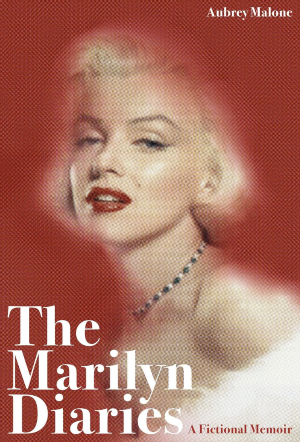
In The Marilyn Diaries, author Aubrey Malone strips away the legend and invites us inside the fragile, searching heart of Norma Jeane Baker. Told in a daring diary format, this is not another retelling of Hollywood myth, but an intimate excavation of the wounded child who became the most famous woman in the world.
Malone reminds us that before the platinum hair and breathless screen presence, there was an abandoned little girl moving through orphanages, longing for stability and love. What makes this book resonate is its emotional truth: Marilyn Monroe didn’t set out to be a symbol - she wanted what most of us want - home, family, security. Instead, she became immortal.
Marshall Terrill
The Marilyn Diaries
From the acclaimed author of The Elvis Diaries comes another hauntingly intimate work of creative fiction, this time tracing the imagined inner world of Hollywood’s most iconic and misunderstood star: Marilyn Monroe. Spanning the years from 1933 to her untimely death in 1962, The Marilyn Diaries unfolds through fictional diary entries that give voice to Norma Jeane’s transformation into the mythic Marilyn, illuminating the private pain behind the public persona.
Aubrey Malone crafts a portrait of Monroe that is as vulnerable as it is vivid. From childhood trauma and life in orphanages to early marriage, exploitation, and the relentless pressures of fame, the diary captures her insecurities, wit, dreams, and downward spirals with aching honesty. Malone’s Marilyn is at once clear-eyed and conflicted - yearning for love, tormented by abandonment, and caught between the desire for visibility and the need for refuge.
With a voice that shimmers with wit and sorrow, these imagined entries reveal a woman grappling with her past, her identity, and her place in a world that wanted her body but never her whole self. As her fame grows, so too does her loneliness, and the diary becomes a quiet cry against the machinery of stardom. The Marilyn Diaries is not a biography, but something more intimate, a reimagined confessional that blends fact and fiction to startling effect. For fans of epistolary fiction, Hollywood history, and richly drawn psychological portraits, this is a moving exploration of a life lived under lights too bright to bear.
Order your copy online here.


