

Cricket fields, Pickpockets, and the Watch of Countess Markievicz test limits for Khushi Jain at GAZE 2026
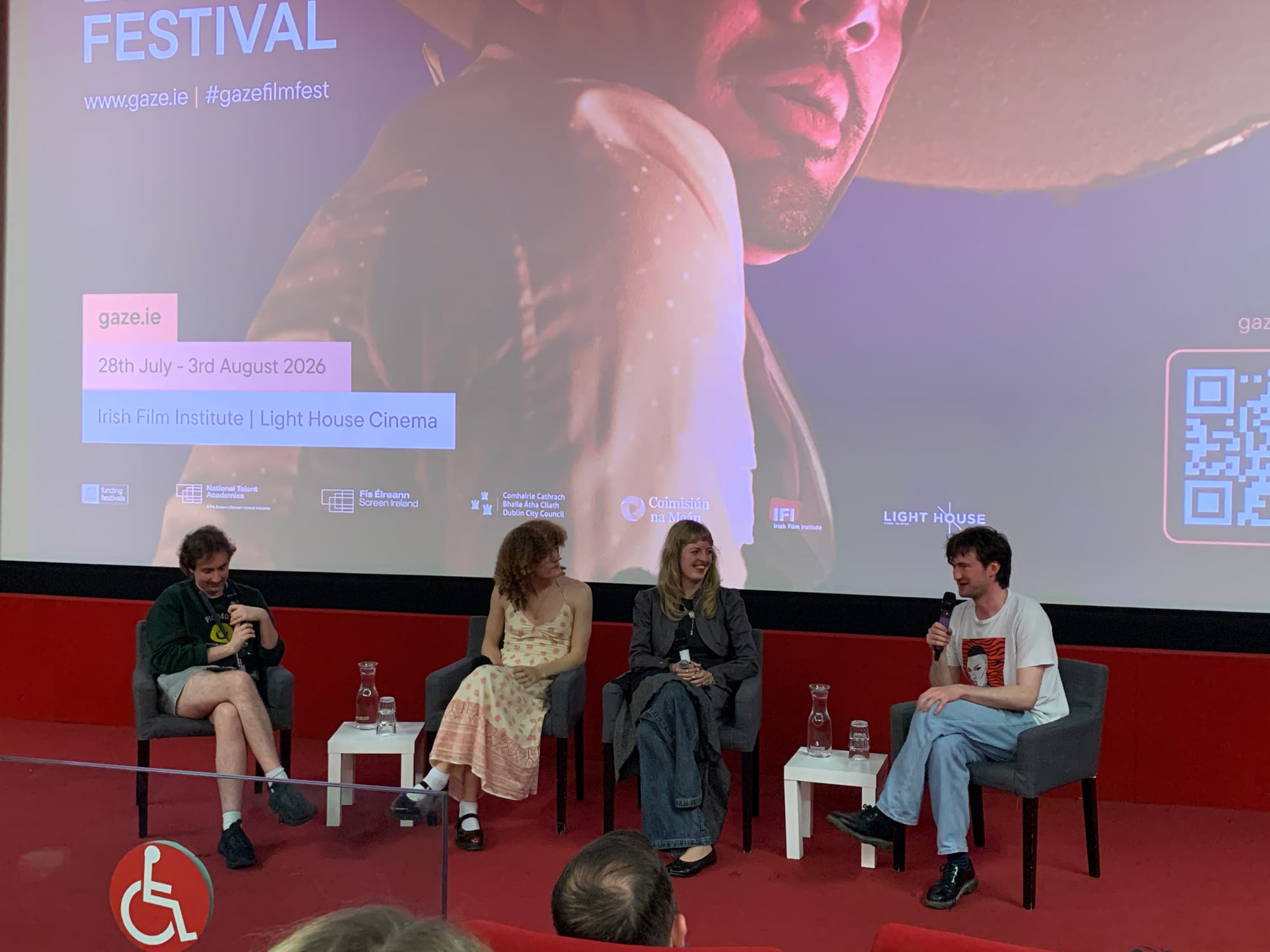
"Sleek, sexy, and thrilling" is how GAZE’s programmer James Hudson described Testing Limits, the final shorts block of the festival’s 2026 edition. Testing Limits was in many ways a spiritual successor to last year's Our Messy People. Seven shorts were screened to a sold-out theatre in the Lighthouse on Sunday, August 2nd, followed by a brief Q&A with three of the films’ creatives in attendance. Curated with a movement of its own, the programme gradually carried the audience from gentle tension on a Dutch cricket field to a frightening encounter in a basement club, along to the more familiar trials and tribulations of a big city.
The opening film was Iniyavan Elumalai’s Dutch production Pakka about four Indian gay friends on the cricket pitch and a night out. This was followed by Nayan Sharma’s verbose British drama I Prefer You Flawed. Set entirely in a small flat, we witness an argument about an open relationship. Written and directed by Conor Toner, Belfast-set Little Miss Fortune sent a young journalist out at night in search of a news story, where he finds himself in the company of two characters fighting over a precious, political heirloom. Night-time continued with Thanasis Tsimpinis’ Simon at the nightshop and Jesse Williams’ Chaser. Concerned with a trans woman's encounter with a dangerous man in a club, Chaser, in many ways, was the crescendo of the bloc. Miguel Alcalde de la Fuente’s Guille, 28 brought us home, and Saurav Mahind’s Upaasmaar (Upon Starvation) closed the bloc with a pickpocket’s love story.
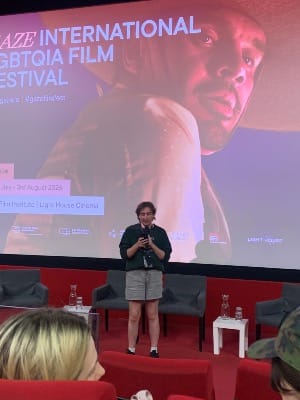
I was pleasantly surprised to see two films with Indian characters and by Indian directors bookending this bloc (Pakka, Upaasmaar). The films overall were led by male characters with only two exceptions (Little Miss Fortune, Chaser). Exploring a life lived after dark, nights out, and clubbing, night is our leitmotif for this block. "Nightlife is the sustenance of being queer," remarked Katie McElligott Ryan, 1st AD on I Prefer You Flawed, during the Q&A. These venues are spaces for community and rebellion, and their particular lighting has been identified as radically queer. Jesse Williams also mentioned scholarly approaches drawing the connection between trans cinema and shimmering images.
Kudos to Hudson for a strong lineup. Here, we take a closer look at four highlights of the programme – with a special mention for Little Miss Fortune. These four films packed surprises, avoided playing safe, and expanded the queer cinematic experience to complicated intersections of situatedness, placing their queer, desiring protagonists in the intricacies of the real world of race, class, the internet, social obligations, and morality. Moreover, they toyed with the medium itself, exhibiting cinematic intellect and experimentation.
Pakka dir. Iniyavan Elumalai (2025)
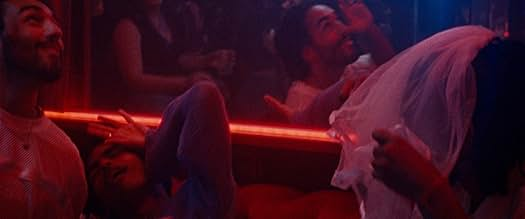
Pakka, Elumalai says, began with an image: "four gay Indian men frolicking on a Dutch cricket field." Bathed in warm sunlight on a grassy verdant rug, and dressed in playful competitiveness and cricket whites, Kathir, Rinkoo, Vasu, and Jiva (Chirag Benedict Lobo, Ruchir Kathusing, Kymo de Valk, and Atharv Dhiman) are the unassuming heroes of this short.
The story, like the storytelling, is equally modest; Kathir is returning to India for an arranged marriage with a woman. The decision, which he deems the most logical, faces a mixture of emotion from his friends. But tempers and tears are still tinged with the tenderness of love, which is delicately recorded by cinematographer Zeeger Verschuren on the suitably fuzzy 16 mm.
The resultant images, in a palette of whites, cool blues, purples, and street lights, are as beautiful as they are melancholic. Dialogue is sparse, the narrative loose –spanning less than a day – and the friendship unspoken. There is a silent quality to Pakka; not a lot happens. But this is precisely how it strengthens itself. The ease of nothingness portrayed by the actors, especially Lobo and Dhiman, conveys the intensity and comfort of the bond between the boys.
Tessel Flora de Vrie’s approach to editing seems to prioritize people over plot, turning Pakka into a poem with a story. The penultimate sequence in the film shows the characters cooking and then eating an Indian rice dish from a large pot. The moment is punctuated with a video call from home, a stolen kiss, and a light-hearted fight for the last piece of chicken. There is no flashy camera work nor ostentatious cutting to distract from the bittersweetness of this last domestic evening. Set design (Julia van der Veen) is also minimal, and the sequence is closed with a sudden downpour. Without any external interference, the film incompletes itself in a complete way.
Despite all its naturalism, Pakka is wonderfully stubborn about being dream-like. The cricket field and pavilion house form a tiny, idyllic cosmos of their own. Kathir’s last night in The Netherlands is celebrated with visits to clubs, where scenes of skateboarding on city streets and dancing under neon lights are wordlessly stitched into a montage. This inconspicuous blending of worlds is testament to the brilliance of the film’s director and co-writer Elumalai. Pakka is his second short, after the 2023 Required Reading, and has been screened in India, Brazil, South Korea, Australia, America, and across Europe.
The word “pakka”, which appears in many Indian languages, including Elumalai’s mother tongue Tamil, means “100% certain”, but also solid and true. We hear it in dialogue, posed as both a question and a response: "Pakka? Pakka." But connotations of this brief exchange ring throughout the film. Kathir is leaving to marry a woman, and this is the last time that the four friends will be on the cricket pitch together. Whatever happens, though, they will be fine. Pakka.
Simon at the nightshop dir. Thanasis Tsimpinis (2024)
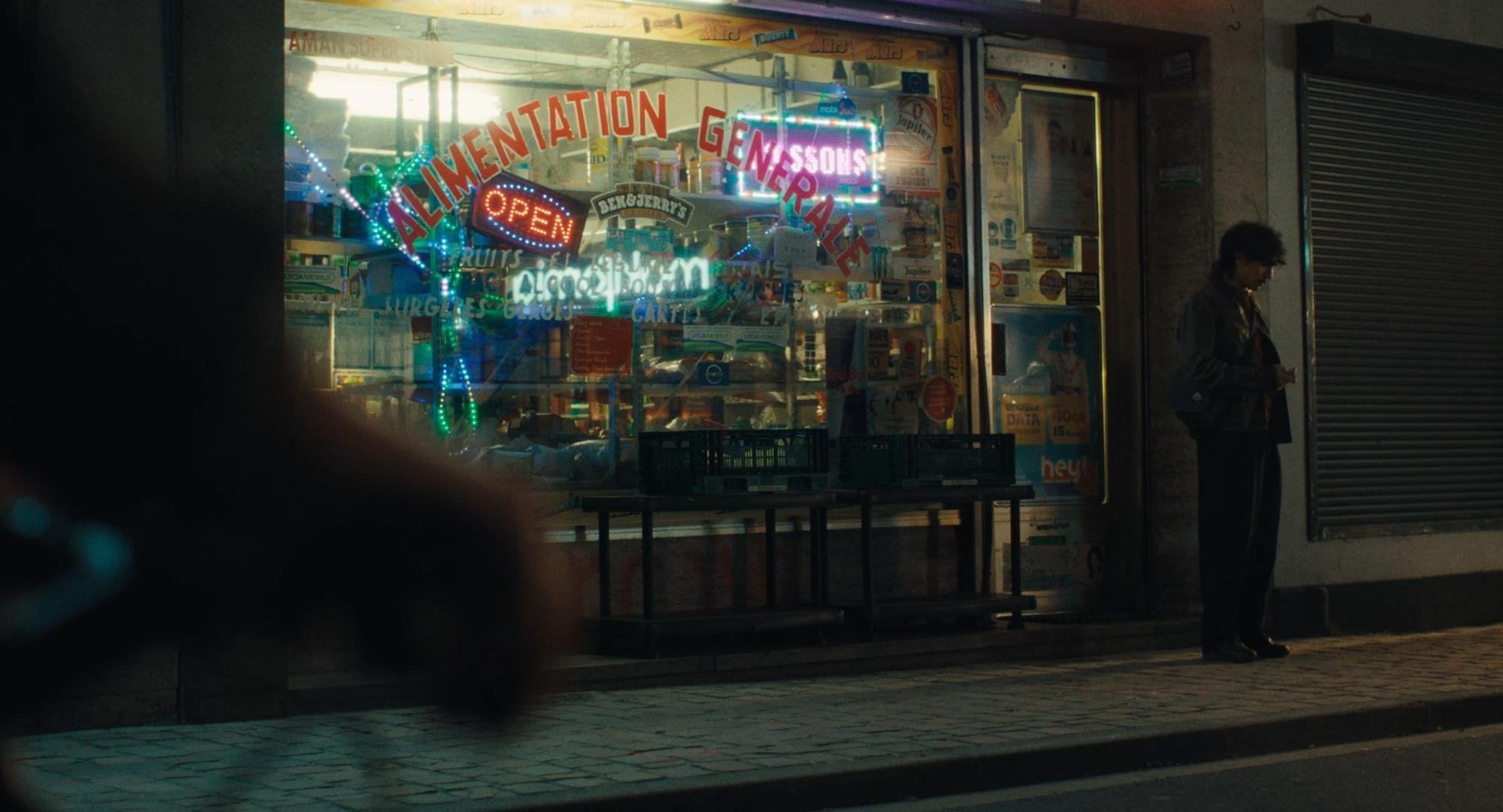
Simon at the nightshop opens at a bathhouse. This is a film that is very conscious of space – the politics, ethics, aesthetics, and the dynamics of space. Simon (Tom Viaene) is a white, middle class, middle aged, gay man desperately texting someone on a dating app in the locker room. When that same someone walks through the door to drop off his things, you know all that there is to know about Simon: he is very, very lonely. Outside this room, naked bodies become hallucinations in the waters of the many pools, and refracted lights dance on tiled walls and the robust torsos of classical statues. Here, Simon spends his time looking.
Simon’s looking is physical, tactile almost, as though he is not simply seeing but touching and grazing with his eyes. Viaene is a gifted actor, immediately realising the intrusive surveillance of his character’s gaze. Editor Noor Eva de Heer deftly alternates between the subject of this gaze and his objects, pausing on the latter just long enough for it to become discomforting. The viewer is made complicit in his lingering unsure whether to sympathise with a lonely man or to be wary of his troubling gaze? It's in this tension that we find the essence of Simon at the nightshop.
Next, we move into an office where we see Simon as a polished corporate figure. He is an architect, a designer of spaces. The final space is the titular nightshop, where Simon meets Arab cashier Hani (Salim Mabrouk). With his soft turtleneck and expensive wool coat, Simon is absurdly out of place in this small, garish shop. When Simon feels noticed by Hani, he decides that he must win him over. But spontaneous interactions soon become planned and methodical, and Simon’s tactile gaze metamorphoses into unwelcomed touching.
Simon’s desire for Hani is dangerous. Inside the bathhouse, office, and nightshop, different facets of Simon’s character emerge, blending and bleeding into one another beyond these spaces into the streets of Brussels. It is on these streets that Simon crosses the line. Hani’s friends step in to protect him, and Simon comes to a realisation that he might be the predator and not the prey. Simon at the nightshop is monotonous for most of its runtime but never dull. Always on the edge, it is a film that threatens.
Guille, 28 dir. Miguel Alcalde de la Fuente (2025)
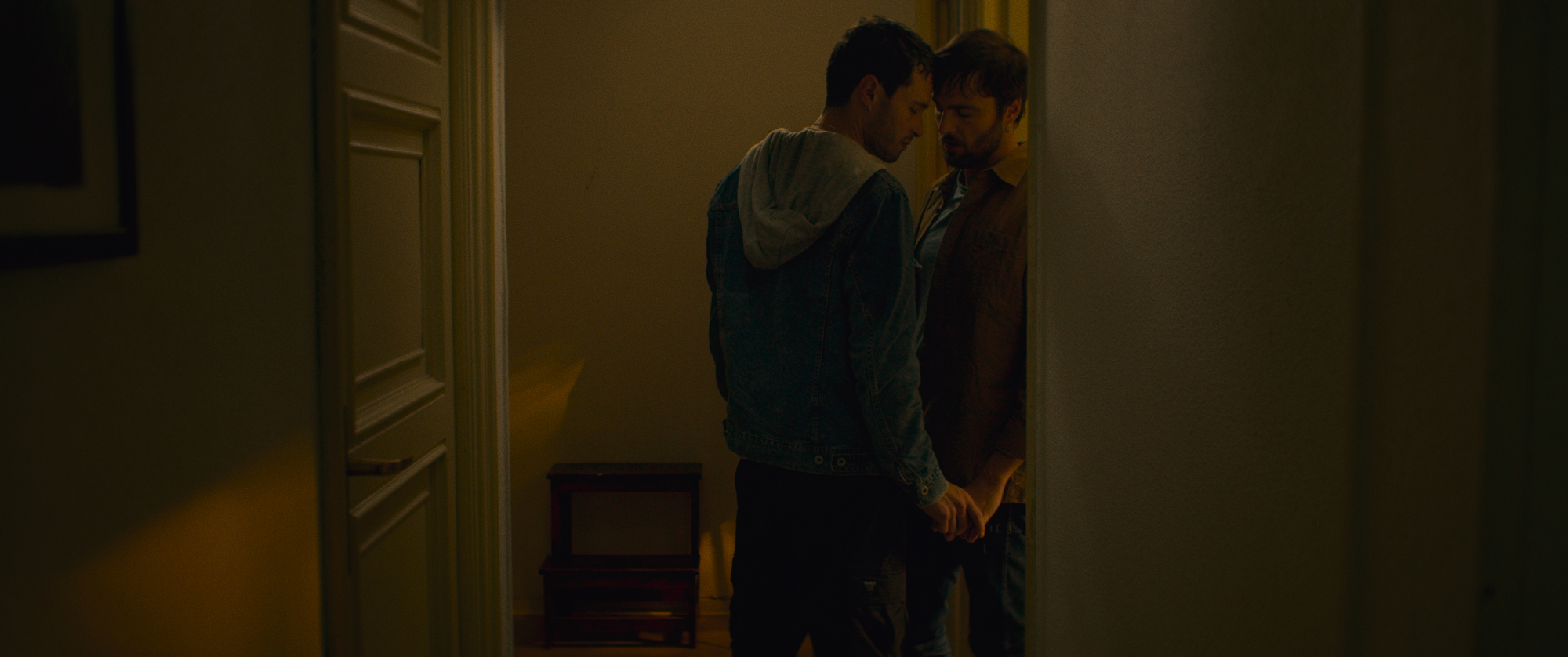
No film at GAZE blew me away as this Spanish domestic thriller did. What starts as a date that is going very well ends up being an absolute mess of identities and relationships – a story that Alcalde tells with the technical and narrative brilliance of a master craftsman.
It begins like a classic boy meets boy when Mario (Mikel Bustamente) meets Guille (Emmanuel Medina) on a dating app. Or at least Mario thinks he is Guille. It is raining when Mario brings Guille home on the pretence of lending him a pair of his own shoes. Wet shoes are left to dry and beer is pulled out of the fridge when Mario receives a call from the real Guille apologising for not showing up for their date.
Identity and privacy have long been concerns of Alcalde's work. Here, the dating-app profile hides rather than reveals. Mario has been talking to someone for days, but he has never really known who that person is. Guille keeps his face hidden in his pictures, presenting a mysterious image composed of silhouettes and landscapes.
That tension enters the physical world when Mario discovers the truth. Mario's living room initially appears deceptively ordinary: a partially visible sofa, a balcony door, a table. An unnaturally yellow exterior light sets the space partially aflame, it's glow now symbolising the truth that Mario has learned. Sandra Bautista Torres’ minimalist art direction bestows Mario with an ordinariness that is opposed to the extraordinary turn that his life is about to take.
The kindness and attraction that were there seconds ago have turned into brutality and obsession. Fake Guille refuses to leave. The conflict escalates when identities shift and the two men exchange roles, with Mario now becoming the imposter. The subtlety with which Alcalde has scripted the increasingly tense dialogue between the two men gives weight to each and every word that is spoken as well as to those that are left unsaid.
The viewer is drawn into Mario and Guille’s heightened awareness of each other, seeing each trying to get what they want by dismantling the other. Continuous shots with an immobile camera are favoured; Bustamente and Medina’s performances bring the dynamism. When the camera does stir, Nicolás Maquieira keeps it slow and focused. He follows the scripted action, steadily moving where the heat of the moment lies. During the climax, Maquieira skilfully navigates a tight hallway, turning, ascending, and finally descending, capturing strained expressions of the fake Guille pinning an injured Mario to the floor.
The violence in Guille, 28 is potent without reaching extreme. The film could have easily been abruptly dramatic and over-the-top, but Alcalde’s careful script and character-conceptualisation make it a cogent and thrilling event. If I had to use one adjective to describe Guille, 28, it would be “intelligent”.
Upaasmaar “Upon Starvation” dir. Saurav Mahind (2025)
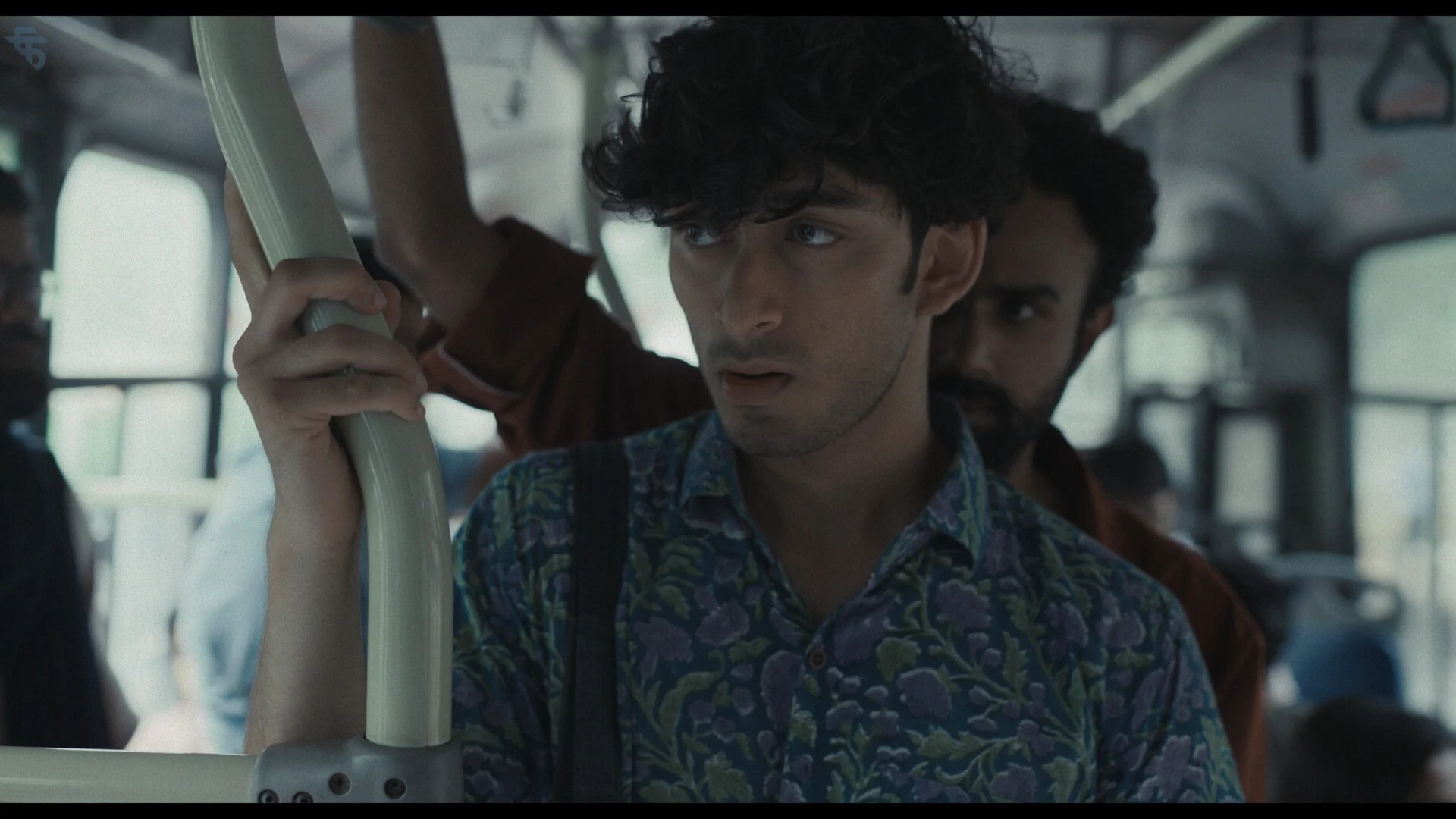
A penis hardening under washed-out denim. This is how Upaasmaar opens, steeped in desire. “Upaasmaar” is from the Marathi language, and it means “starvation”. It is a fitting title for a film in which physical and sexual hunger become almost impossible to separate. GAZE screened the short under the English translation, Upon Starvation, but I will stick to the original Marathi in this article.
The protagonist of Upaasmaar, 30-something Vivek (Tushar Tengale) is in the business of satisfying hungers. He seduces sexually starved men on Mumbai buses, distracting them as he picks their pockets to meet his own hunger for food and other basic necessities. With the money he finds, he eats at street hawkers’ stalls and drinks from a waterbody next to a construction site. In a narrative voiceover, he claims that he has fun, but his words do nothing to hide his desperation. "I’ve tasted half the city myself," he says, referring to both the men and the poverty of Mumbai that he has experienced. But there is one man in the madness of the city who is about to redefine hunger for Vivek.
Kartik (Dhairyasheel Pawar) enters our pickpocket’s life in a block print shirt with a tote-bag. He is a young college student from an upper middle-class family. After Vivek steals his wallet, Kartik returns in search of something unexpected: intimacy. He takes Vivek away from the streets into a small flat and surprises him with his tenderness. Vivek doesn't know what to make of this.
It is not only the characters of the film who are hungry but also its director and co-writer Saurav Mahind. Upaasmaar was Mahind’s graduate project for the Film and Television Institute of India. The film has since travelled the world (Mexico, Ukraine, America) winning awards at most festivals where it was shown (at GAZE, it won best international short). Fresh out of college, Mahind, along with his co-writer Tejas Shende, is currently in the process of turning the short into a feature.
Mahind's commitment to the human is reflected in every element of the film. Cinematographer Maitraiya Kulshreshtha gives visceral close-ups of the two men that at once clarify the erotic vocabulary of the film while also challenging traditional ideals of Indian masculinity. Dev Sarkar turns Mumbai into an audio file, the noise of which is blocked by the walls of Kartik’s flat and replaced with music. Madhurima Kamat and Mehul Philip’s art direction and production design play with the minutiae of the mise-en-scène to create class identities.
Vivek and Kartik’s costumes are especially instrumental in conveying the differences between them, but they also become the means of their complete absorption into each other. Kartik asks Vivek to button him inside his shirt, and they are bound by the cheap well-worn fabric of it. In the final scenes of the film, Vivek is back on the bus but holding a tote-bag on his shoulder, Kartik’s tote-bag. Once fondling strangers to steal purses, he not carries a bag given to him by his lover.
Vivek and Kartik have different understandings of desire and hunger, but Mahind doesn’t let their contrast become conflict; he transforms it into a combination. Upaasmaar is a story that has been due a long time.
Special Mention: Little Miss Fortune dir. Conor Toner (2025)
When this title had been first mentioned to me, I’d asked James Hudson if he’d meant “Little Misfortune”. Suffice it to say that there is nothing even remotely unfortunate about Toner’s short film, which he says was the result of wanting to "make something silly" with silly turning into crazy.
Little Miss Fortune opens with budding journalist Thomas (Timotej Bača) receiving an email from his editor asking for a story by midnight. Thomas begins searching the streets of Belfast for something interesting to write about, and he comes across a someone – the charismatic Conale (Conale). Conale is looking for a stolen family heirloom, which we find out is the watch of Countess Markievicz, and the person responsible for its theft is his good friend Grace (Grace Jennings). From here on, the plot of the film all but disappears. Chaos is unleashed as Grace tries to sell the watch, Conale catches her, and Thomas thirdwheels their hilarious confrontation.
Conale and Jennings, childhood best friends, had not only styled themselves in their own clothes but were also playing themselves. Their chemistry made sure that whichever direction the film went in, it did not crumble. As Toner said in the Q&A, "you need to be very close to someone to accuse them of misgendering Countess Markievicz."
At the end of the day Little Miss Fortune was a bunch of friends coming together to make a film. A tiny crew of four (sound recordist Conall McAuley, producer James Hall and hair stylist Luke O’Reilly, along with Toner) shot the film over a single night in Belfast. The city is captured in its neon glory on hazy film that seems to have a mind of its own, hopping from a blurred image to a focused one as and when it pleases. The unfailing liveliness of such camera work gives the film a touch of cinéma vérité and simultaneously adds to the havoc of the plot.
To say that Little Miss Fortune is funny is understating it. On top of that, the production quality is excellent. A comedy with this level of wit that also looks slick? Impossibly rare. The film is available in its entirety on Toner’s YouTube page. Fortunately.
Testing Limits shorts programme screened on Sunday 2nd August 2026 as part of GAZE International LGBTQIA Film Festival, which took place from Tuesday, 28th July to Monday, 3rd August 2026.


