

Orla Murphy looks at Frank Berry's highly anticipated feature The Lost Children of Tuam.
In a small rural town in Co. Galway, a historic excavation is underway. Forensic scientists are exhuming the remains of hundreds of ‘illegitimate’ babies under a housing estate, grotto dedicated to the Virgin Mary and the adjoining, enormous playground. The religious order of nuns entrusted with their care entombed these bodies in the sewer system there.
“But weren’t they a nursing order?” asks Catherine Corless, a local historian, as she tries to understand the volume of deaths (a rate of one every two weeks). The order offers neither explanation nor help as Catherine continues to ask questions. Her painstaking research unearths a terrible secret. Initially, her findings were dismissed. But when a sample exhumation confirmed her suspicions, public outrage forced seismic changes. The State issued an apology – finally, so too did the religious order. The current excavation was ordered. Its work is ongoing. The shameful news travelled around the world.
The Lost Children of Tuam tracks the journey of Catherine, a number of survivors, and her community, as they attempt to come to terms with systemic atrocities she describes as ‘pure evil’.
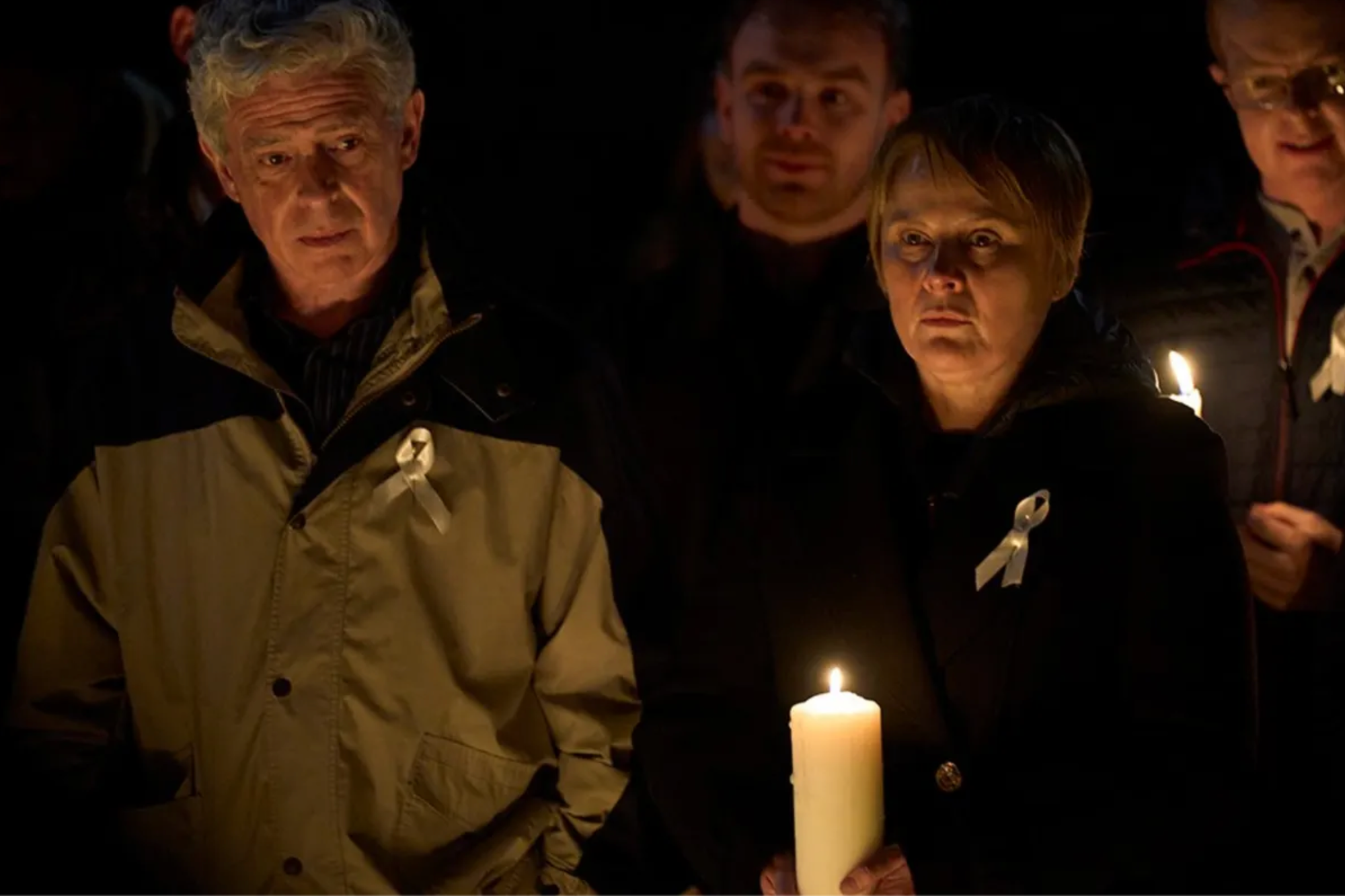
One does not expect to leave such a film uplifted. And yet, even as the darkest undercurrents in recent Irish history are interrogated, this film offers an avenue for hope. When faced with the worst misdeeds of their collective past, this group of ordinary, decent people refuse to look away and force change.
The most ordinary and the most decent of all is self-effacing grandmother Catherine (Monica Dolan). As the film opens, she joins a community history class, commenting how "it’ll get me out of the house". Too shy to stand up in front of the class, she chooses instead to write an essay on the former local Mother and Baby Home, whose children Catherine had been at school with. Her mother was an ‘illegitimate’ child, fostered out for farm labour by the same order of nuns.
When her research points to a lack of burial records for the alarming number of infant deaths in the home, Catherine follows the thread. She circumvents the religious order’s gnomic denials and the county council officials’ platitudes by doing her own painstaking research and talking to the community. Though visibly affected by the horror she is uncovering, Catherine persists, gathering a handful of locals, survivors, and journalists to her side. The scale of the resistance she faces matches the scale of the secrets revealed. The eventual number of babies believed to have been buried there is profoundly shocking.
As self-effacing an auteur as Catherine Corless is an activist, Frank Berry is quietly masterful in his handling of this sensitive material. Known originally for comprehensive documentaries, and more recently empathetic features with a social focus, like Michael Inside, this marks his first time directing from another writer’s script. Rebecca Lenkiewicz wrote the screenplay, adapted from Dan Barry’s article in the New York Times, with additional contributions by Frank. Here he opens a new chapter in Irish cinema’s engagement with the abuse of children and women by clerical and societal institutions.
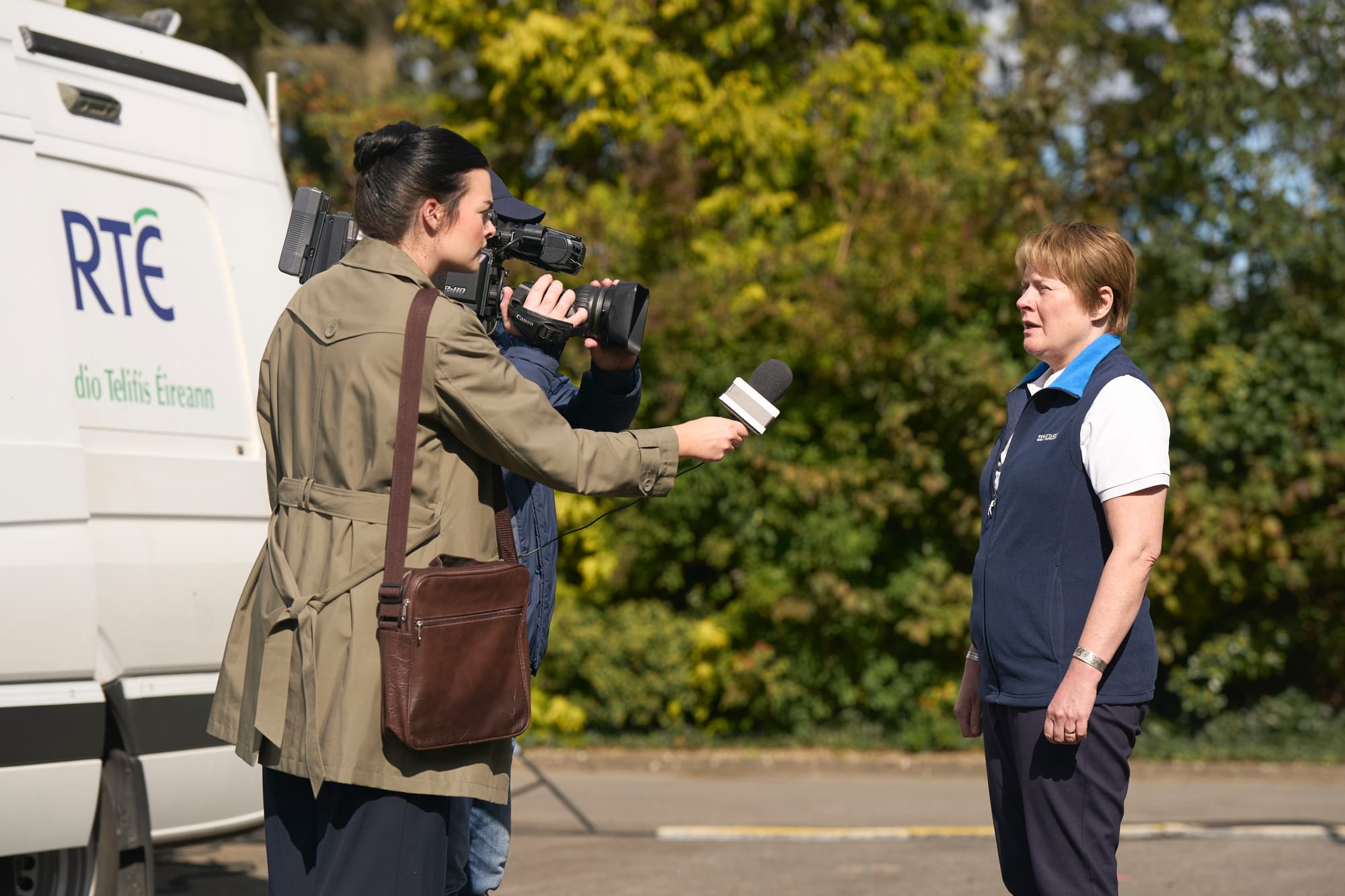
Berry embeds us in the life of the very relatable figure of Catherine from the outset, bringing us into her ordinary, grounded world – farm, kitchen, family. Through the recurring locations in the town – the shop, community hall, graveyard – we come to know Tuam as the kind of small Irish town where everyone knows everyone. By implication here, not much could remain hidden. Shots situate us at Catherine’s side as she studies maps and death certificates. We experience the discoveries she makes in real time. As the narrative progresses, the slow drip feed of facts is bolstered by documentary-style inclusions (recordings of survivors’ testimonies, footage of the Taoiseach of Ireland’s public apology in the Irish parliament, Catherine’s appearance on influential Irish chat show The Late Late Show).
Alongside Guinness and Riverdance, Irish culture has one well-consumed export. Whether fiction or factual, the systemic abuse by clerical institutions has been a staple in Irish films ever since Cathal Black’s short docudrama Our Boys (1981). In fact, Irish cinema has often been ahead of the curve in its engagement with this issue. It took ten years after its Cork Film Festival premiere before The Boys was deemed acceptable for national TV. In the many years since, much has changed. The visceral assault scene in Aisling Walsh’s Song for a Raggy Boy traumatised a generation of cinemagoers. National treasure Cillian Murphy walked the red carpet opening Berlinale with the adaptation of Claire Keegan’s novella Small Things like These. Sinéad O’Shea’s insightful and searing documentaries Pray for our Sinners and Testimony explore the resistance and experiences of ordinary people in the face of clerical abuse, and Margo Harkin’s Stolen is part of a comprehensive bundle of her hard-hitting work available to rent right now at IFI@Home.
The Lost Children of Tuam resists the urge to simply demonise the nuns and instead poses complex questions as to who would be held accountable. In reality, the people of Ireland were not entirely passive victims of an evil ‘other’ institution. These homes did not exist in a vacuum, and the weight of the minute but many acts of complicity by the community hangs heavy on all those who remember this. Taking that as its starting position, the film then goes further to show what happens when we try to do something about righting those wrongs.
‘Home babies, we called them,’ Catherine’s husband Aidan (Andrew Bennett) explains to his adult son over dinner, ‘Children are cruel’. Catherine herself was no exception, as she shamefully remembers how she played a trick, offering a stone, hidden in a sweet wrapper, to a girl in school. These are all small, meaningless acts of cruelty that contributed to the dehumanisation of these children, ‘born on the other side of the blanket’.
For director Frank Berry, this film represents a continued expansion in terms of style and theme. The thread of community and social engagement that runs through his work is found here, but alongside a more pointed social critique. Utilising every hard-earned element in his expansive filmic toolbox, he merges a documentary fidelity to the facts with the pathos, pace, and emotional heft of fiction. And thereby forges The Lost Children of Tuam into a visceral, accomplished piece of cinema, wholly greater than the sum of its parts.
Such is the achievement of verisimilitude that one can forget at times that the actors are acting, that this is a constructed narrative, or that the cameras were not in fact in Tuam for the 8 years we experience over the runtime of 80 minutes.
In her finely balanced, deeply moving script, Rebecca Lenkiewicz knows exactly when to widen the lens and when to close in on the characters’ personal lives. She peppers the pain with many unexpected moments of levity that feel utterly authentic to the region. In a local deli, Catherine, a staunch vegetarian, asks if there’s any meat in the salad. The response? No, of course not. However, on second thoughts, the server notes, there is ‘just a little bit of ham’. Catherine’s marriage too provides many such moments. As Aidan moves from sceptic to stalwart support, they prepare for a confrontation with the nuns. He yields an impressive-looking briefcase, which he reveals to be empty. His logic is inarguable, this prop is to show the nuns they ‘mean business’. These all allow much-needed relief to an audience who are being asked to engage with the darkest sides of humanity.
Colin Campbell and Nathan Nugent’s editing is equally masterful. As the revelations pile up, the quiet normality of Catherine’s private life – grand-babies, TV, fields, cows – contrasts with chaotic media noise, shots of burials, excavations. The skilful deployment of imagery of the original ‘home babies’ is delivered at key emotional moments, keeping the victims firmly in view. These children are vividly brought to life. Photographs, archival footage, and the sparing but highly effective use of reconstruction build images and memories that reek of incarceration and exclusion.
Guided by Berry, the actors excel themselves. An admirable restraint is present in the most poignant scenes. Often, silence and glances are allowed to hold space for the unsayable. In an early, particularly moving scene, Catherine elicits the help of local graveyard manager, John (Lalor Roddy). Perched in the back of his van, surrounded by graves, Catherine reads aloud the list of dead children’s names. The horror slowly dawns: each and every one is missing.
To prepare for her role, Monica visited Catherine at home, pulled on wellies, and walked the fields with her. This research has paid dividends. She delivers the performance of a lifetime, embodying the physicality and character of Catherine through subtle performance details. Monica’s voice and stance morph in step, as she conveys the growing righteous anger that fuels Catherine’s transformation from private individual to public activist. Andrew Bennett brings gentle warmth and a sense of mischief to the role of her husband. As Aidan, he embodies the charisma of someone who, as Aidan says himself, was once ‘the most handsome lad in Tuam’.
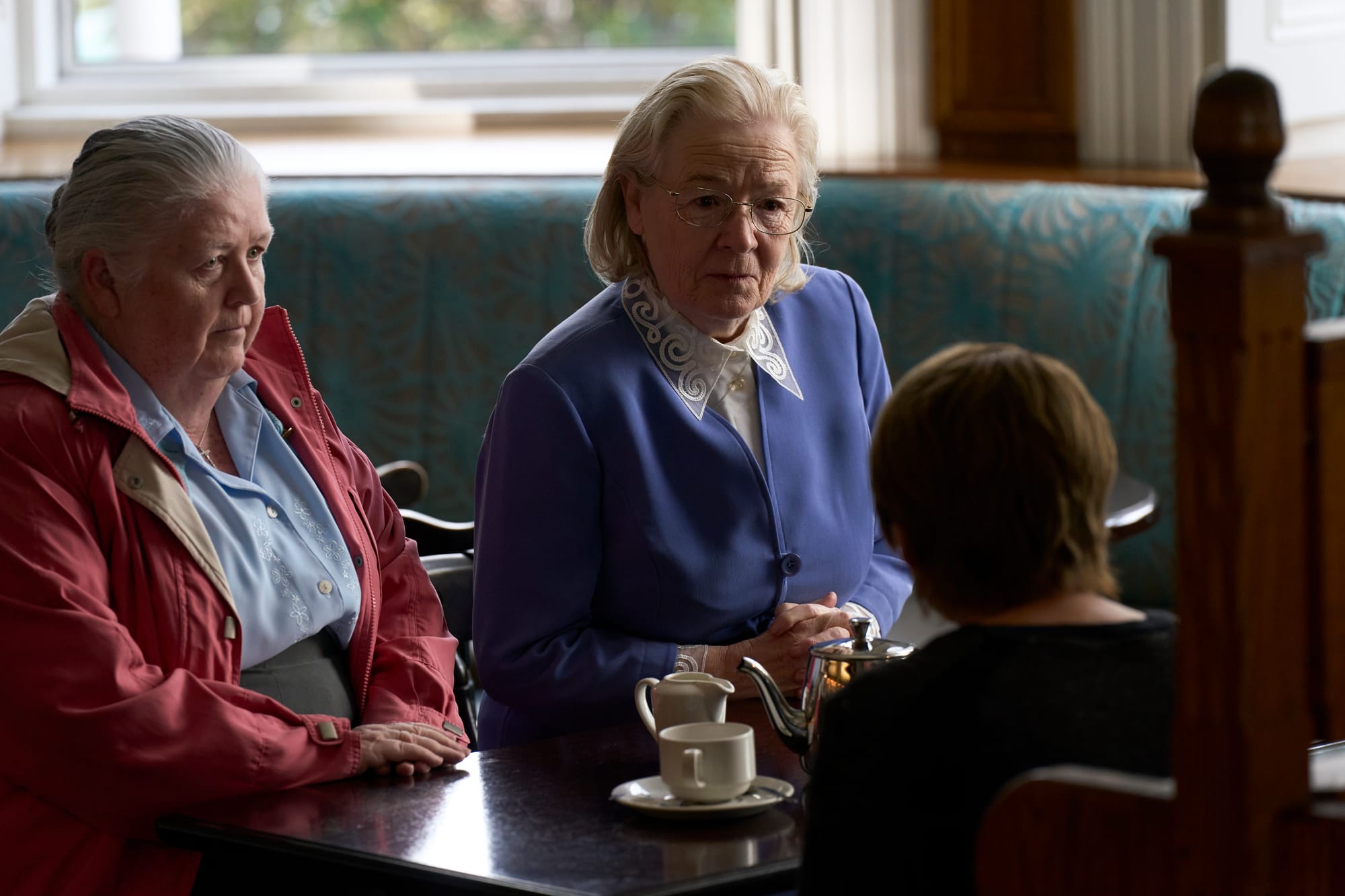
The secondary performances are uniformly excellent – especially considering how many of the cast were embodying living people. Clare Barrett and Jeanne Nicole Ní Áinle imbue their public servant roles with a compassion which is noticeably absent from some of their political counterparts. Patrick O’Donnell and Eoin Geoghegan play a pair of grown-up orchard-robbing teens, with a perfect combination of impish swagger and adult anxiety. Denis Conway, as Graham, the teacher who encourages Catherine, carries a kindness and matter-of-fact sense of justice. In casting the film, Berry included actual survivors as background players whom he met as he spent time in the community. This deepens the stakes for Ian McElhinney, who plays a survivor alongside them with gravitas and grace. Rising admirably to the challenge, Ruth McCabe as Sister Bridget gives a tour de force performance which communicates the attitude of the Bon Secours congregation in Ireland. When asked what happened, she delivers a glare fuelled with equal parts cold fury and bafflement at the audacity of the question.
Every Head of Department is operating at the peak of their abilities in this film; every aspect, from shot composition to production design and costume, carries the theme. There is a contrast between the ‘natural’ circles of life and the man-made rigid lines and categories that institutions want to force that life into. As Catherine investigates potential burial sites, she leans against a black wall on which white miniature fossils are embedded. Her petite frame is boxed into the final third of the frame – the door to the library locked behind her. Later, as she notes the origins of the children’s mothers, red dots splatter like spilt blood across a map of Connacht. The pattern of the tangled roots Catherine touches next to a statue of the Virgin Mary in the grotto repeats in the white lace embroidery of the Head Nun’s blouse.
In the sound design, the rhythmic tramp of the children’s regulation boots as they march through the streets of Tuam in formation finds an echo in the score. The ‘Marian blue’ of the Virgin Mary’s cloak seeps into the frame as boundaries blur between Catherine’s quest and her home life. This is visually concluded with a heart-breaking archive shot of a blue baby’s shoe from the sample excavation. In the closing sequence, the film’s most pointed visual reference, Kate McCullough uses light to almost euphoric effect as the community unfurl to form a circular pattern similar to that found on ancient pre-Christian monuments from that same Grotto.
Colin Campbell and Nathan Nugent’s editing deftly ensures the film never flags and the amount of information never overwhelms. They interweave procedural shots of Catherine’s research with reconstructions, flashbacks, and scenes from Catherine’s day-to-day existence. The narrative always returns to her family and her seasonal life on the farm, tending cattle. The metaphorical weight of those images becomes ever more apparent as the film progresses. The sequences in the story move, inexorably, in ever-increasing circles, like ripples in a pond.
And yet, even in the most intense climactic moments, Berry resists the temptation to grandstand. In so doing, he offers an opening to viewers to make up their own minds.
Towards the end of the film, the information about the babies is finally out in the public domain. Catherine addresses her community, to reveal a momentous decision around a proposed audience with the Pope. A different filmmaker might have matched the staging to the weight of the decision. Instead, the framing emphasises the smallness of the room, the intimacy of her audience, Catherine’s continued struggle to overcome her shyness. As she communicates her decision to decline and the reasons why, Berry simply tracks the reactions of the assembled supporters and survivors.
In 1916, Ireland’s founding fathers proclaimed a republic where all children would be cherished equally. By the time the heavily clerically influenced constitution was written, children’s rights were only enshrined if they were born into a married family, mothers too were protected only under those terms. This gave rise to the Mother and Baby Home and the social exclusion that ensured their existence through generations. This in turn created the perfect storm for these shameful levels of neglect to exist.
“I confidently believed…that the Church would care,” Catherine utters in disbelief. “But they think they don’t matter because they’re illegitimate."
Today, excavations at Tuam may be underway, but many other sites remain under investigation. The last of these institutions to close, in 1999, was Bessborough in Cork. Yet, An Coimisiún Pleanála has since upheld development plans for the site, even as burial records remain missing for 859 children who died there. The battle for justice continues.
With this fine film, Frank, Rebecca, Element Pictures, and the entire creative team have honoured the memory of the Tuam children and the selfless work of Catherine Corless and her supporters. In the process, they too have done this country a considerable service.
The Lost Children of Tuam is ultimately an appeal to our common humanity – that we do not turn away but face up to atrocities committed in our name, and above all else, that we do cherish the lives – and deaths – of all children equally.
Orla Murphy is a screenwriter, director, and playwright whose work frequently centres on issues of social justice.
The Lost Children of Tuam is in Irish cinemas 25th September and UK cinemas 9th October 2026.


