

Conor Bryce looks back at the vintage 80s gore of Street Trash.
There’s a grubby little corner of horror where absolute trash and undeniable art collide, and Street Trash is probably the benchmark. It’s not for everyone, nor does it intend to be. It’s a reminder that watching a movie can sometimes feel like a contact sport: dangerous and ugly, but a hell of a lot of fun. It’s also a curio from a time when cinema celebrated creative resourcefulness, a willingness to provoke, and a hunger to prove that a tiny budget could still conjure something special.
The plot is loose by design. A grubby liquor store owner in New York finds a crate of sixty-year-old booze called Tenafly Viper, and figures he can shift it cheap to the homeless guys who’ve built a shanty civilisation in the local junkyard. What he either doesn’t know or doesn’t care about is that the hooch causes people to dissolve, kicking and screaming, into a puddle of bubbling goo. In the middle of this chemical carnage, two transient brothers try to survive not just the toxic wine but a deranged Vietnam vet called Bronson, who rules the junkyard with an iron fist and a knife carved from a human femur. Throw in an overzealous cop investigating the deaths, a local mobster sniffing around, and one infamous gag involving a game of keepaway with a severed... appendage, and you’ve got yourself a grimy, glorious mess of a movie. It calls for a strong stomach and a twisted sense of humour, but it also comes loaded with surprisingly canny social commentary.
From 1932’s Freaks to recent fare like The Substance, horror has always been the go-to genre to enlist outrageous visuals to say something sharp about society’s failures. Street Trash stands toe to toe with the best of its allegorical peers. It operates as a dark snapshot of Reagan-era America, all urban neglect and predatory exploitation. The homeless characters are disregarded, viewed only as a nuisance or a source of cheap profit. The liquor store owner is the ultimate capitalist, willing to poison the most vulnerable members of society to make a quick buck. And the Viper’s victims literally become disposable, melting into the junkyard they inhabit, their bodies merging with discarded waste. Sure, it’s a little on the nose. But it’s still powerful.
What still surprises is how confident the filmmaking on display feels. Muro, barely out of his teens when he directed the film, presents the urban decay with an impressive level of technical flair. The camera glides through the wreckage of the junkyard and nearby filthy streets with a fluidity that belies the teeny budget. This visual competence makes sense in retrospect; Muro later abandoned the director’s chair to become one of Hollywood’s most sought-after Steadicam operators, working on massive blockbusters for Kevin Costner and James Cameron (the sweeping shot up the stairs in the closing beats of Titanic? That’s our Jim). His eye for framing elevates the material, turning a garbage-strewn wasteland into a treacherous, apocalyptic landscape that wouldn’t look out of place in a Mad Max movie.
It also goes hard with its practical effects. Lead makeup effects artist Jennifer Aspinall (who would go on to Emmy Award-winning success with HBO’s Westworld) and team created something that will stick with you longer than most big-budget horrors. The death scenes are both disgusting and strangely beautiful: bodies melting into rainbows, shapes bending and shifting. Long before CGI became the norm, this kind of hands-on chaos had weight and texture. It’s practically pop art; hugely inventive and totally unapologetic. Leading up to the 1980s, independent horror had largely inherited its visual language from the Grindhouse tradition: muted, grainy, deliberately ugly in a way that signalled grit and realism (think of the sun-bleached dread of The Texas Chain Saw Massacre or the sickly pallor of early George Romero). But like other 80s milestones, The Stuff and Society, Street Trash proved you didn’t always have to hide in the shadows. The bright colours say, look at this, don’t you dare turn away, this is what’s happening and we’re going to make it so you can’t pretend you didn’t see it. This influence still reverberates today, inspiring directors to crank up the brightness. Movies like Midsommar and Mandy owe a debt to Street Trash’s proclamation that horror can be excessively vibrant and say something serious at the same time.
Street Trash continues to spark arguments. Some critics dismiss it as nasty for the sake of it, others see a scrappy satire. On this rewatch, what stood out to me was its energy. The wild tonal shifts, the uneven acting, the moments that go too far: they’re flaws, sure, but flaws that feel intentional. A slick, well-structured version of the story would be lying. The mess is the point.
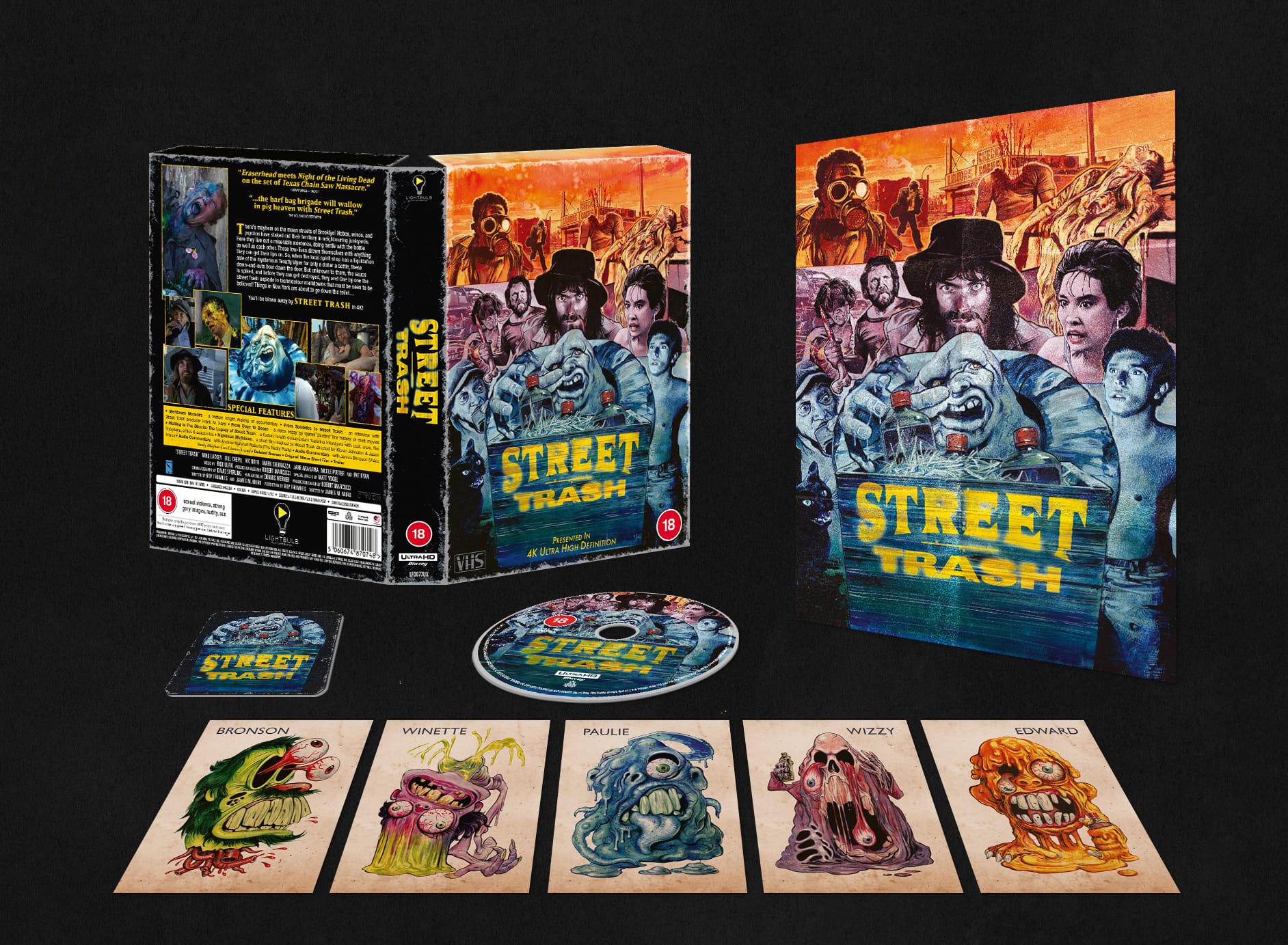
This year, Lightbulb Film Distribution has re-released Street Trash in a 4K UHD Collector’s Edition Blu-ray. Housed inside a nifty retro VHS box, it comes jam-packed with over five hours of extras, newly recorded commentaries and exclusive artwork from illustrator Graham Humphreys. For a movie that once lurked in the video store bargain bin, this deluxe treatment feels like someone arguing the case that Street Trash still has something important to say. Rewatching it almost forty years after it first shocked midnight audiences, that argument holds up.
Street Trash is available on 4K UHD and Digital from 27th April 2026 and returns to select cinema screens.


