
Alireza Hatamvand takes a spoiler-laden look back at the Oscar-Winning short that launched a Martin McDonagh's career on screen.
When it comes to the legendary Martin McDonagh, he is mostly remembered for features like In Bruges or The Banshees of Inisherin. Although his feature filmography consists of four hits with not a single miss - and he has earned countless accolades - it may still come as a surprise to many that the only Academy Award he's ever won was for a short film released in 2004.
The 26-minute film Six Shooter is essentially a work that bridges McDonagh the playwright to McDonagh the filmmaker. Of course, because McDonagh had already established himself as an artist, this film is far from an average micro-budget first short.
The film’s plot begins with Donnelly (Brendan Gleeson), being informed by a hospital doctor (David Murray) that his wife has died in the early hours of the morning. Shocked by the news, Donnelly goes to see her body. The doctor informs him that the hospital has seen two cot deaths and a woman murdered by her own son, leaves Donnelly to it. And this is only the beginning...
On the way home by train, Donnelly sits next to an antisocial, nonsense-spouting young man (Ruaidhrí Conroy) and a grieving couple. Coincidentally, this is very boy who killed his mother, and the couple are the parents of one of those two cot-death infants. But the film lets these details surface slowly, drop by drop, and that steady, deliberate pacing sharpens the dark, tightening atmosphere with real precision. Even before anything is fully exposed, before the police stop the train, and before the violence escalates, it is obvious that nothing good is ahead. Yet McDonagh keeps his cards pressed tightly against his chest; nothing in the plot, nor in its underlying meaning, is predictable.
In the final scene, Donnelly, exhausted by this relentless onslaught of cruelty, loads the six-shooter, which has only two bullets remaining. He first shoots his pet rabbit, perhaps the last reminder of his wife, and then, when he tries to use the final bullet on himself, the gun slips from his hand and fires, leaving no bullet for him to end his own life.
McDonagh’s composition here is extraordinary: Donnelly sits on the left third of the frame with the dead rabbit in his arms, and on the right third sits the portrait of his wife, while the rabbit’s blood has splattered the wall beside it. And Donnelly’s reaction to all of this? Just one line: “Jesus... what a fucking day.”
This line is undeniably the key to analysing the film, the perfect absurd, pitch-black humour. Of course, the film’s absurdism is evident long before this final moment. The film takes place in less than 24 hours. Even the boy’s bizarre story about the cow that explodes from bloat adds to the death toll.
But of course, this day is not just a day. On paper, one could easily accuse McDonagh’s plot of being inorganic and contrived; however, once we accept that the world is intentionally, even symbolically, compressed, it becomes something else entirely. And right when both we and Donnelly feel that this entire world is made of nothing but death, the sixth bullet misfires and Donnelly survives.
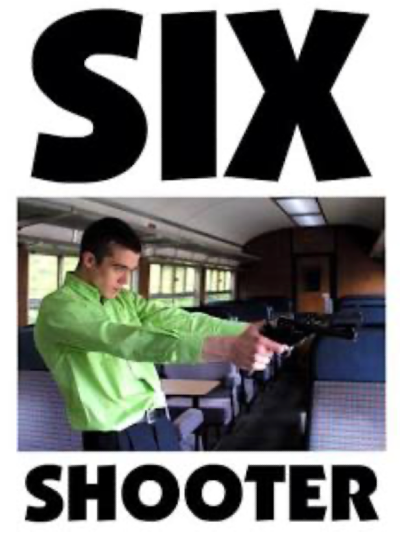
McDonagh's curated world is less about death and more about unpredictability and madness. Even the film’s title can be interpreted as such: the six-shooter is a nod to Western films and the gunslingers in them, a reading represented by the young boy in the distinct stance shooting scene on the film’s poster. It may also, given the way Donnelly tries to kill himself (much like what Brendan's character later attempts in In Bruges, which also fails), evoke the probably most insane game of all time: Russian roulette.
While all of the above praises McDonagh as a screenwriter, in terms of direction the film is clearly a strong and confident beginning. He doesn’t shy away from shifting through different shot sizes within a single scene, and this boldness allows the story and the characters to be viewed from multiple angles: the close-ups make us mournful, and the medium and long shots let us observe the proportions of this heightened world.
The film is further strengthened by Brendan Gleeson's brilliant performance and Ruaidhrí Conroy's impressive work. Gleeson, as always, displays his special talent for portraying characters full of cold, heavy thoughts, while Conroy delivers as an infuriating antagonist so convincing, we lose our patience even before the passengers on the train do.
With Six Shooter, McDonagh secured his position as a filmmaker, earning critical acclaim and major awards, including the Academy Award for Best Live Action Short Film. In these 26 minutes, he introduces the viewpoint and voice he has stayed loyal to throughout his career. One that's cold, brutal, morally challenging, and yet soaked in absurd comedy.


