
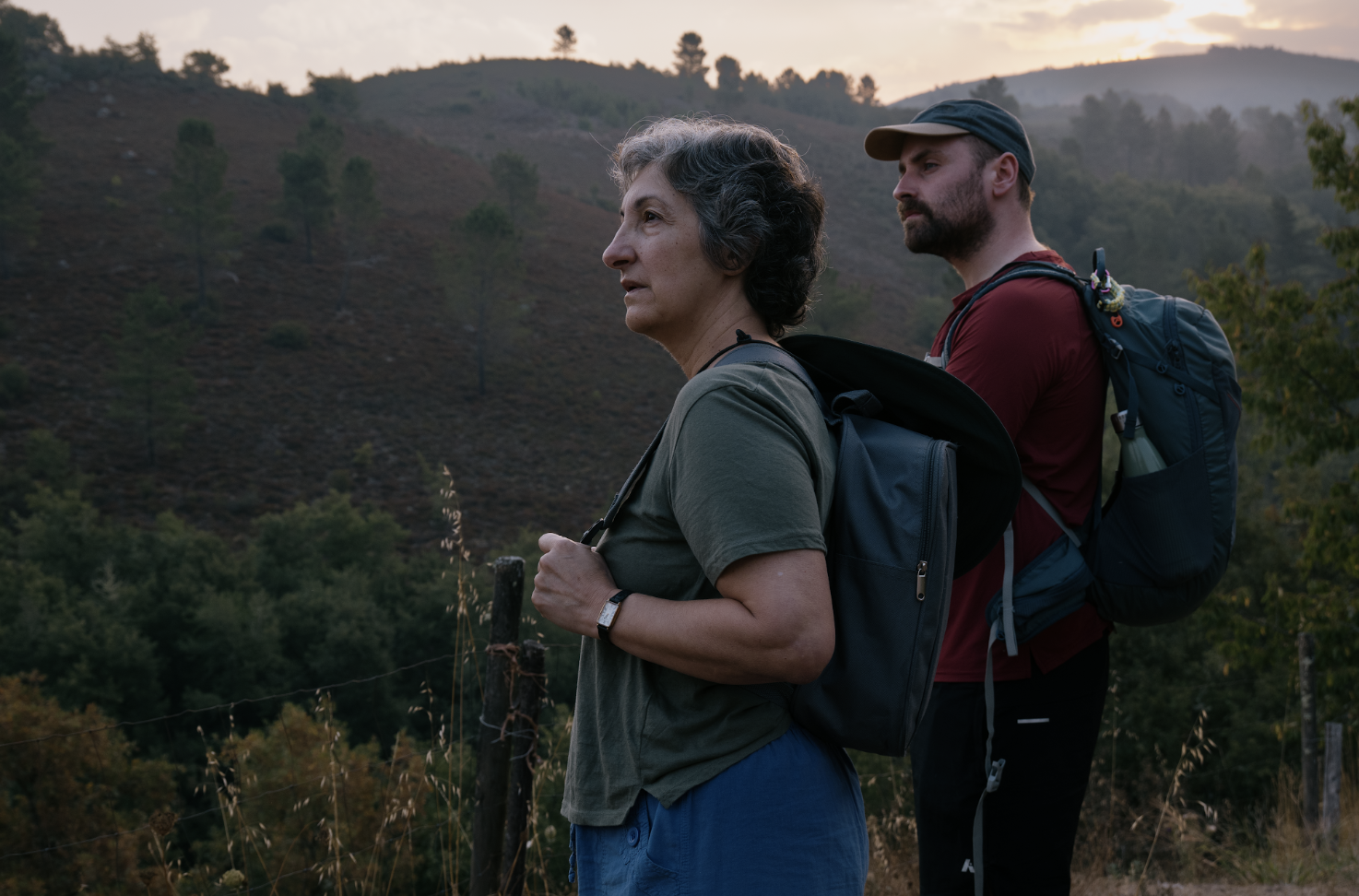
An office worker leaves his job behind to walk the Camino de Santiago in memory of his mother, but his journey takes an unexpected turn when he encounters a Galician grandmother on a mission to collect the ashes of her late son. Starring Amhlaoibh Mac Suibhne and Elena Seijo, Walking Holiday is a poignant exploration of grief, human connection, and the unexpected paths we take in life.
Following its premiere at the Galway Film Fleadh and a recent screening at the Kerry International Film Festival, Walking Holiday is making its way around the festival circuit. Festival correspondent Shannon Cotter catches up with co-director Jack Desmond and (briefly) producer Silvia Laguna López to discuss the making of the film, its inspiration, and bringing an ambitious story to life with a crew of just three.
Tell me how you got your start in film.
Jack: My brother and I have worked together since we were teenagers, and it's always been our dream to make a feature film. We started doing shorts as teenagers. We went to film school before we started making some factual projects and documentaries, including for TG4. All of those experiences, including working on commercials and smaller projects, have really led us to this moment where we can make our own film with a bit of self-sufficiency because you learn technical skills and you learn how to react to different situations. That helped us to do a film like this with such a small footprint and such a small crew. [The film consisted of three crew members in total: two co-directors and a producer who carried out all roles on set.]
Previously, we’ve done a number of unfunded shorts and funded shorts. We made a children’s film, Mamó agus Mise, for TG4, and it won some awards, including the Celtic Media Festival Torc Award. We’ve had a real mix of factual and fictional work, and we go back and forth between English-language and Irish-language work also.
What kickstarted the feature?
Jack: I think what kickstarted us going into a feature was the idea that waiting for something to happen wouldn't ever result in it happening. Seeing other filmmakers doing things on their own or outside the traditional method, like Mark Jenkins or Peter Foott, makes you realise it’s possible. You just have to believe in what you can achieve on your own. And I think what led to us doing this feature was kind of accepting that making films that we like to watch always results in making a better film than thinking of an audience or a target audience. Emulating another style never works, and we wanted to make a feature before we were thirty. Last year, we were twenty-eight, and Cian said to me, “Look, I think it could be this year.”
Cian wrote a treatment, and we thought we’d even make the film with just that, like how Aki Kaurismäki, the Finnish director, only uses treatment. Then we reckoned it’d be easier for everyone and the actors if we had a script. Cian was interested in the idea of making a film in the north of Spain, after visiting the area with Silvia [Laguna Lopez, producer of Walking Holiday] in Asturias. Years ago, he’d heard a story of a guy who took time off work to bike through Northern Spain, and he thought it could be interesting to explore why someone would do that and what they would encounter. It ended up evolving into a physical journey of grief with two journeys, one person ostensibly on a holiday, the other not. When you’re making a micro feature, you have to work with what you have access to. As soon as Cian and Silvia visited her family village in Galicia, we knew we had access to this beautiful setting. We wanted to see what story could we tell using these elements? You could say the location inspired the story, and the story inspired the location. The limitations also inspired the story. We wanted to see what could we achieve with a minimal cast and a minimal crew? What locations could we get that would be cinematic but free to access?
Another kind of interesting thing that impacted the story was Silvia's grandmother, who’s in her eighties and doesn't speak any English at all. Cian didn't speak a lot of Spanish at the time either, but though they couldn't speak the same language, there's still kind of an understanding there, which ended up being very similar to the characters in Walking Holiday.
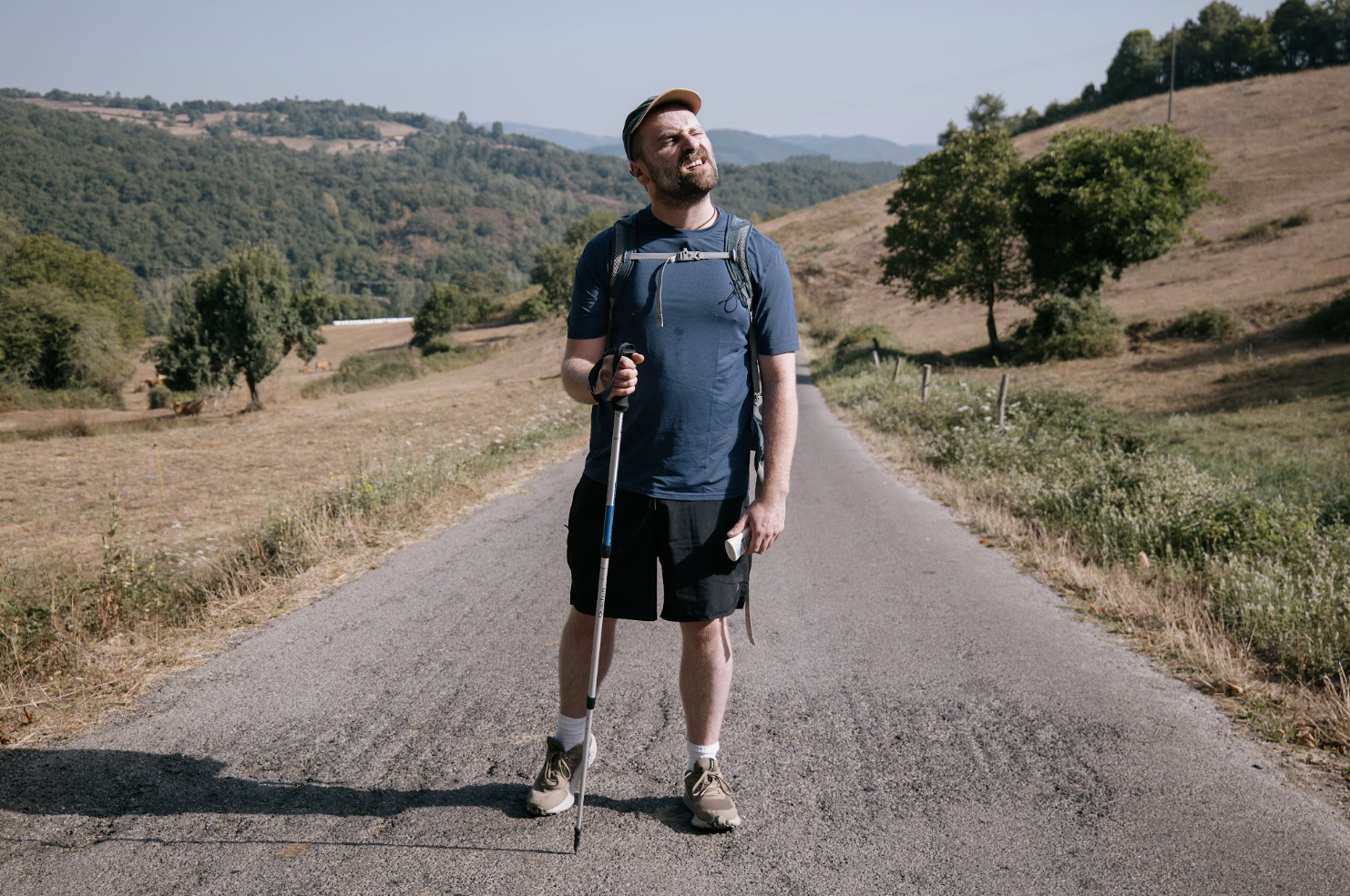
The language barrier between the two of them offers a really unique vantage point to the film. The humour shines through in the film, but it’s interesting that despite not being able to understand each other’s language, their feelings and circumstances can still be shared.
Jack: I remember Cian saying to me that language and understanding other people has always been a theme in our work. In college, I had a film where two people couldn't speak to each other because they didn’t speak the same language. But I think Cian is kind of drawn to the idea that everyone has their own internal story and internal monologue that continues to happen regardless of whether you speak their language and they speak your language. Recognising that shared humanity is a small political message that we hope viewers see.
On top of it being a great film, you shot it with a very minuscule crew and budget. Can you talk about that process?
Jack: Yeah, we had a crew of three, from pre-production to post-production, which consisted of myself, my twin brother Cian, and his wife Silvia. Cian wrote it, he and I co-directed it, and the three of us co-produced it. Silvia was also the composer, and Amhlaoibh [Mac Suibhne, one of the film’s co-leads] actually composed some of the music as well. He’s actually a very talented musician in addition to being an actor, with his own folk punk band called Leevy.
The small crew happened because we didn't have the resources of a large budget, and the most expensive cost in film is paying for people's time. For every person there is, it multiplies the cost of every single thing. We’re quite lucky because we have the skills to do camera and sound ourselves, and we also built up some equipment over the years. Cian and I have built up a kind of workflow where I do camera and he does sound, so we kind of direct and produce it together. We thought if we can do that for a documentary, we could do that for fiction, and it really suited the story. I don't think every film needs a crew of fifty, and I don't think every film needs a huge budget. Some stories suit that, but having a small crew made it so much easier to do a road trip film because we had a small camera and we could move from place to place really easily.
It was really interesting directing and working with Amhlaoibh and Elena [Seijo] because Amhlaoibh doesn't speak any Spanish, and while Elena speaks Spanish, Galician, Portuguese, and English, sometimes we’d actually speak Spanish with her when discussing scenes, or sometimes it would work better if we’d speak English to Elena and she'd respond to us in Spanish, which was interesting.
In terms of cinematography, I think we were attracted to a very simplistic type of cinematography with a lot of big wides that could tell the story of the scene if necessary, which was also kind of a budget thing. To make the film, it was necessary we did it in a sustainable way, so we went in with the aim of doing a few shots and a few takes. Sometimes we got carried away and went crazy with shots, but we did have the general philosophy of getting coverage with a lovely big wide. We rarely use moving shots in the film because it’s a slower, more contemplative kind of movie, and about 90% of it was natural lighting. For the majority of shots, we used almost only one lens, an old Nikon 28mm lens. Because it was an indie film, keeping it simple made it achievable.
Cian and I edited the film together. I might take a scene and do a pass at it, and Cian would maybe have a look at it and he might change things. So we divided it up by different scenes that we were attracted to or eager to get started on. We were actually doing that remotely most of the time using DaVinci Resolve. I had my old laptop, and Cian had an entry-level Mac Mini – we didn't need the best devices to edit the film! It worked really well with Silvia composing music and Cian doing the post-sound. He also did a lot of foley work, which I think really made a big impact with the film. Even from creating the smallest hiking pole clicks to using a filing cabinet to make the sound of sliding doors. I did the colour grade myself, and we did the post ourselves. We didn’t use any post-production house because, again, we just wanted to keep things simple.
I'm really interested in hearing, though, about the casting process because the language barrier is really interesting. How did you go about bringing Amhlaoibh and Elena on?
Jack: We started with casting Seán. We've been friends with Amhlaoibh going back since we were teenagers. He was also previously in a short film of ours called Setanta and Jim Cullen. Amhlaoibh is just a natural talent. He's got no formal training with acting, but he has a brilliant way of getting into character that we don't try to question. We know he can do it, and we're confident that we're always on the same page with him. He did an amazing job in this film.
Elena Seijo plays the part of Ana, and we found her on a casting website in Galicia. We made contact coming out of the blue as random people from Ireland, and we asked her if she’d be up for a meeting. Elena’s a very experienced theatre actor. She’s done lots of Galician TV series and movies as well that are on Spanish Netflix. When we went to Galicia first in June 2025 to do some location scouting, we met with Elena and did a script read-through. She was glad to do it, and she happened to have a free slot, so it really worked out perfectly. I'm glad that she was able to put her trust in us as filmmakers, and I hope that she's happy with the film that we made.
As we were saying, it was interesting because, in real life, Amhlaoibh really didn't understand Elena, and she maybe understood him more. Just like the film, there was a language barrier in real life, but despite that, it didn’t stop the chemistry.
There’s quite interesting parallels between the characters of Ana and Seán, in that one has lost a mother and another a son. They almost seem to take a substitute role in each other’s life.
Jack: That parallel between the two characters was one of the things we were always attracted to. It grew and developed organically as we were discussing the story and revising the script in pre-production. Like the best creative experiences, it happened almost like a series of slow realisations, until it felt very natural. The two characters are travelling on different paths, but find this surrogate mother-figure and son-figure, and they end up supporting each other.
What’s amazing about this whole journey as well is that you guys premiered yesterday at the Galway Film Fleadh, which is one of the most prestigious festivals in Ireland. What was it like getting that acceptance? Were you expecting that you might have a feature showing here?
Jack: One year ago to this day, we screened our short film Mamó agus Mise, and then one year later, we have our feature, which is amazing. You know, we're really, really proud and honoured to be shown at Galway. We've loved coming to Galway for years and seeing amazing films, so to be here is a huge honour. It was definitely one of our goals to get into Galway. We’re happy we got here because it makes it all feel worthwhile, all those long months working on the film and post. You’re never sure how it will turn out in the end. Will people enjoy it? But having a full house yesterday was an amazing feeling, and hearing the audience react to the film was brilliant. There's a lot of really nice things that people were saying to us that, you know, they didn't have to say, but they did, and it was lovely to hear that people seem to relate to the film. People were saying that they could see themselves on that journey of grief and that it kind of helped them.
It’s so hard to talk about praise, but one guy said to us that it was nice that you can walk into a random film off the street and it might change the way you think of cinema. I thought that was a lovely compliment, and people seemed to be surprised that it was such a small crew and such a low budget. We’re going to bring the film to Ourense Film Festival in Galicia soon, so it’ll be great to show the film to a Galician audience and see what they think.
One thing that's really nice about this film is that it’ll hopefully be used as an inspiration for young filmmakers to see what's possible on a minuscule budget. Having received such a warm response, does everything feel a lot more possible now that you’ve seen what you can do when constrained by limits like that?
Jack: I think anyone who makes things like films, especially maybe Irish people, might have higher criticism for their own work than for films that they like. You always have a higher standard for yourself because you might want to make something similar to films you’ve enjoyed, and your taste might be higher than what you think you can make. So to be received so warmly, it's a nice reminder that we're doing okay and we should keep going. We really liked the format and the way we did things with Walking Holiday in terms of being self-sufficient. We like doing our own things and seeing how that has an impact on our own work. It feels direct and kind of like handcrafted in a way. I think we'd like to do that again.
The Fleadh is a great platform for introducing films to producers and distributors... along with other possibilities. What would you like to see going forward for ye in the long run?
Jack: I think we'd love to continue making films in Ireland for Irish audiences and for international audiences specifically because I think cinema is still the best place to watch a film. There’s nothing else like it in the world. Film is a long-form visual art, just like books are a long-form art – you can't read a book in five minutes, and I don’t think you can watch a film on your phone either, in my opinion. We’d like to see more Irish films made in Ireland by Irish people that are telling Irish stories, and we want to see more low-budget films being made in Ireland. We also want to do more Irish-language medium films. We've done several projects in the past in Irish. I don't think that Irish-language films should be a separate category in film festivals or TV or cinema. I think Irish language should almost be the default as a creative medium in Ireland. Cultural funding in Ireland should go towards cultural stories. We don't need to spend taxpayer money on more stories that could be set in America or stories that have transplanted from England to use Ireland as a backdrop.
I think there's more cultural worth to having a film in Irish, not in a tokenistic way, but in a natural way. There should be higher criteria for using state funding so there’s more room to tell cultural stories, even if it doesn't make a profit. It’s better to put a million euros towards multiple low-budget films than a million euros towards an A-lister's salary. There's no cultural value in that.
And do you think there's a new wave of that rising? With Irish-language films like An Cailín Ciúin and An Taibhsedoing so well, do you think there’s a cinematic reclaiming of the Irish language at the moment?
Jack: I think there definitely is, despite the status quo that every film in the local cinemas most weeks is American or British. Audiences have shown naturally that they want to go see films like An Cailín Ciúin. It was a massive success in cinema. Kneecap was a massive success in cinema. If we fund stories that are naturally told in Irish, I think there’s an audience for that, especially if you get it into cinema because people enjoy the big screen. And it's great that TG4 is funding more and more long-form fiction projects, and expanding its remit from TV to include cinema and other art forms in Ireland.
Here's a bonus question, that was answered online by producer, Silvia Laguna López! Why film in Galicia?
Silvia: For me, it’s that personal connection with the place. It can also be linked with the title. Going to the small village is like going on holidays. Every time I go there, you feel like you’re dissociating from reality a bit, slowing down and coming across things you don’t see the rest of the year. It’s a small village in Lugo province with a population of probably about 10 people. It’s in the mountains, in a valley, and a half-hour from the nearest town. Every summer, my family, my grandmother, and my cousins stay a few weeks in the house my grandfather was born in. We spent wonderful summers with neighbours and friends in the area, who then helped us generously with this film. Some were extras in the film. Iria, who plays Ana’s granddaughter, is from the village herself. We definitely couldn’t have made the film without this lovely support network.
The story for me also feels inspired by Cian’s communication with my grandma. The previous year, I brought Cian to Galicia for the first time. We spent a few weeks in the house with my grandmother. Cian didn’t speak much Spanish at the time. My grandmother is a big conversationalist, and she kept talking at Cian in Spanish. They always found a way to understand each other.
Walking Holiday premiered at the Galway Film Fleadh on 9th July 2026, before screening at the Ourense International Film Festival in Galicia on 28th September and 2nd October, the Kerry International Film Festival in October, and opening the Disappear Here International Film Festival on 16th October 2026.


