
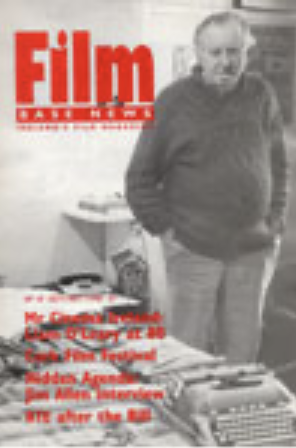
'I don't care if the Eskimos preserve them, so long as they're not lost forever!' On the occasion of his 80th birthday, Liam O'Leary – archivist, campaigner for an Irish film archive, filmmaker, historian and author – talks to Eugene Finn about his life in film.
You have only to look at the programme for the exhibition 'From the Liam O'Leary Archives' at the National Library to realise that Liam O'Leary's contribution to the development of an Irish film culture has been enormous one, an immense labour of love.
In 1936 he founded the Irish Film Society. In the optimism of the early years of the state he produced this polemical work, 'Invitation to the Film' (1945), which made a passionate plea for the establishment of an Irish film industry.
Liam O'Leary was sponsored by Seán MacBride's Clann na Poblachta to make a film showing the urban poverty that existed. Our Country (1947) was the first film ever made in Ireland in support of an election campaign. However, the film was badly received by the Fianna Fáil party, and in government it stifled O'Leary's next project, A Portrait of Dublin (1952) – a series for the Cultural Relations Committee depicting aspects of the city. In 1953 he went to London, and he never made another film.
In 1963 Liam O'Leary became Acquisitions Officer at the National Film Archive. On his return to Ireland in the Seventies, he worked for RTÉ and completed his biography of the Irish film director Rex Ingram.
A documentary on his life, At the Cinema Palace: Liam O'Leary, was made in 1983 by Donald Taylor Black. During this summer's Galway Film Fleadh he presented a season of Ingram's films. He celebrates his eightieth birthday on 25 September. His work continues.
Eugene Finn: I wonder could you tell me a little about the exhibition at the National Library?
Liam O'Leary: It was very kind of the National Library to propose this exhibition to celebrate my eightieth year. I have devoted all my life to films, and the National Library now houses my archives – which I thought was the most appropriate place for them to go, because they're not specifically films but documentation, photographs, records of all kinds, research into the history of cinema in Ireland.
In 1976 the Dublin Arts Festival asked me to do an exhibition on Film In Ireland. I didn't know that much about it, because it wasn't a specialized interest of mine at the time, but the few months leading up to the exhibition convinced me that there was a tremendous amount of interesting material to be dug up and resurrected.
And what I found was that not only were there so many Irish films made from the very early days in 1896, but that there were always seemed to be somebody with a desire to make Irish films or to have an Irish film industry. It was a sort of recurring theme but in the troubled political situation at the time it didn't develop.
Irish patriots regarded the cinema as a foreign thing against Gaelic culture, instead of realising that it could have been used for Gaelic culture if they'd had the vision and imagination. For example, the great Russian film period of Eisenstein and so on was due to the intelligent element in the Soviet government, particularly somebody like Lunacharsky, the Minister for Education, who realised the tremendous value of theatre and cinema for expressing national and political attitudes, and of course propaganda. It was reflecting the life of Russia, and we could have done the same with our revolution. Alas it didn't happen.
The contribution to Hollywood by the Irish was very great. Kevin Brownlow once said that Hollywood was founded by the Cohens and the Kellys, and that wherever you see a Jewish impresario there's an Irishman working with him. From the very beginning the Irish got rights in on the ground floor – you had the master of the slapstick comedy, Mark Sennett, who of course was of Irish origin. Mary Pickford's grandmother was from Tralee. You find a tremendous Irish influence in the development of Hollywood. Herbert Brenon, who was on of the big Hollywood directors, was born in Dún Laoghaire. Also, for example, Alexander Arthurovitch Row, the honoured artist from the Soviet Union who specialized in films for childrens – his father came from Wexford. You find Irish connections all over the place. It's absolutely fascinating. It's a detective work that never ends.
We hope the exhibition will reflect this, and also stimulate. I want to tie up the present enthusiasm for filmmaking in Ireland, which I am very glad I have lived to see, with the past history of the film in Ireland, of which there is a considerable amount.
I would like to see the Irish film industry developed with a world perspective. Whilst we mustn't neglect the expression of our own feelings and attitudes to our country, we must keep the international thing in sight, because art is ultimately international. The ultimate thing of course is good quality, good art, good creativity. That transcends national barriers.
You have said that 'art is international in its content but national in its detail and attitudes'.
Yes, you're giving something to the world which the world hasn't got. I mean art is giving, essentially. Art is not acquisition, and this may seem a very strange statement coming from a curator who's acquired everything he could lay his hands on. Art is revolutionary, in the sense that it's fighting the acquisitory spirit – the narrow ruts into which people and societies get. Art should break down barriers and contribute not merely to the nation but to the world. I think that's very important.
You have described cinema as your university.
Well this is true because, you see, I grew up in an Irish provincial town, in the town of Wexford. I was reading, and one thing leads to another. I've always tried to create a synthesis of the arts and I was interested in what was happening, not merely immediately around me but in the great big world. And the cinema was the means of seeing this, because I was in a lucky time -the artistic development in the cinema in the Twenties was enormous.
And it was also international. I could go down to Cinema Palace Lance and read all the posters for, say, a Swedish film like The Atonement of Gosta Berling, based on the Selma Lagerlof story. And of course that immediately sent me to reading the Selma Lagerlof novels. I learnt a lot through going to the cinema, because the cinema was a window on the world.
I was seeing the best films of D.W. Griffith, the great German Expressionist films, today regarded as classics of the cinema. But in those days they were what you saw in the ninepennies. It was the ordinary people that saw these films.
Was Wexford a particularly good place for film culture?
Every place in Ireland was, because the cinema had a monopoly. It was a world that had no radio, no television, no long-playing records. The cinema was the unique thing. And, particularly in the Twenties, you saw the world. And also as the cinema developed it was also developing a grammar, creating a visual culture which they didn't have before. We have been educated subconsciously by going to pictures, because the only way you appreciate art is to see it. Reading books, with all due respect, is no bloody use. You've got to see the films.
I think this is one of the things modern people are deprived of, and I think it's one of the tragedies of the cinema: its inaccessibility. With classic books you can read Tolstoy's Was and Peace and so on, but how many young people have the opportunity of seeing The Batlleship Potemkin, for example? There are young people growing up all the time who have never seen these treasures of the past. That is why I think archives are so important, to promote a visual culture.
So that was the culture that I grew up with. I saw Siegfried by Fritz Lang, I saw Moana by Flaherty and a whole lot of other films which won't even be mentioned today, secondary classics but films of distinction.
I regret that archives and film writers concentrate on films by Griffith and so on, but there are thousands and thousands that are really well worth showing and exploring. The video holds tremendous possibilities for disseminating the experience of film. It may not be the ideal way of seeing a film, because I think the ideal way of seeing a film is the old way. You went to the pictures and it was a community experience – you laughed at Charlie Chappin, you cried at whoever was giving a dramatic performance, Lillian Gish and so on.
What's amazing about Hollywood, commercialized as it is, is that so many beautiful things came out of it, it was amazing the number of masterpieces.
Your preference, even today, seems to be for the silent cinema.
This is probably the sentimentality of my age to some extent, but not entirely, because this was a great period of the cinema, where new ideas were being tried out. There was a freshness about everything. Today the techniques that they discovered have been used over and over again until they're jaded. The Twenties was a very great creative period when you had great directors like Griffith and Murnau and Pabst and Abel Gance and all these people.
And it was a universal language.
Yes it was a universal language, because Dublin's filmgoing consisted of films from France and Italy and Germany and Hungary as well as the English-speaking films. But when the talkies came in the English-speaking film got a monopoly. As a result we were cut off from the continent, and that's why I was involved in the creation of the Irish Film Society in 1936.
Can you talk a little about your dedication to Rex Ingram?
When I was very young I had a friend and I used to be invited to his birthday party and we were all given ninepence for the cinema. I saw a film called Under Crimson Skies and it left a great impression on me. I didn't know who it was by or anything.
Then some years later I went to the Theatre Royal in Wexford to see the famous Four Horsemen of the Apocalypse, and that left a tremendous impression on me. It was a magnificent film and it was presented in its full glory with sound effects for the battle scenes. I mean you could hardly see the picture for the saltpetre coming out into the auditorium. They had a man from the local dramatic society speaking the prologue, a passage from the Apocalypse: 'I speak as the apostle John'. And a voice shouts from the gallery 'You are not, I know who you are. You're Micky'.
Then through the film society and later going to work as Acquisitions Officer in the National Film Archive in London, I gained a lot of knowledge about Rex Ingram. I was interested in him for two reasons. First of all he was an Irishman and probably Ireland's greatest contribution to the art of the film.
Secondly he was a very individual, creative director who fought the box office all along the line. When he became dissatisfied with Hollywood, he went to France and founded the Victorine studios there. He was internationally recognized but not a great deal was known about him, and his films weren't very easily got hold of. I thought it was about time somebody did something about him so I got down to it, and I spent ten years researching that book. It went to Hollywood and was fortunate enough to meet his wife, Alice Terry, who was a charming woman, and a great star. And I met his brother, and one thing led to another, and in this way I built up all the information.
Alice Terry said when I met her 'it amazes me that you never met Rex, because you know more about him than I do!' So I took that as a great compliment.
Can you tell me about your work in the archives?
I worked in the National Film Archive in London. Not only did we put special emphasis on the British contribution, but also on the films that were shown in Britain, because the impact of foreign film on a community becomes part of the heritage of that community.
How did you discover the Kalem Company's films?
I had read about the Kalem films in Louis Jacob's book on the rise of the American cinema. He has one paragraph on the good quality of the Kalem films which were made on location. At that time a lot of the stuff was faked in studios, but Sidney Olcott came to Killarney and felt that he would film Boucicault plays in an Irish environment.
One day a chap came into me and put down this rusty can of films on my table and said, would that interest you. I looked at them and nearly fainted because it was the first of the Kalem films to surface and that was Rory O'More. I realised that Ireland has no facilities for the preservation of films and it would have been a nuisance for me to try to cope with them in my little flat. So I had a working arrangement with the National Film Archive that any Irish film that I thought had historic interest, it would be quite within the scope of the archive to preserve it.
Séamus O'Connor, who works in RTÉ, got in touch with a man who had a load of films in his basement and he said you should get in touch with Liam O'Leary, and he did. The films were very, very important films of the Film Company of Ireland, which must have made about twenty films in the 1920s, like The Colleen Bawn, Knocknagow and In the Days of Saint Patrick, Norman Whitten's film. I was very happy, because they were nearly the three key films in Irish film development. I immediately packed them off to London, so that they would be preserved there, which they are. And of course I don't care if the Eskimos preserve them, so long as they're not lost forever!
There seems to be a growing awareness in Ireland at the moment of the need to establish an archive on a national scale.
I think so, and I think the [Irish Film] Institute is doing a marvellous job in making people aware, and getting down and doing it.
What were the aims behind your book 'Invitation to the Film'?
Well it's terribly out of date in many ways, but it was the first book written on the cinema in Ireland and it really grows out of the experience I had in the Irish Film Society. I felt it was time that the cinema should be acknowledged in Ireland in the form of a book, and that all the information I accumulated would go into it. So it's got a sort of encyclopaedic scope.
I think it did help a lot to encourage an interest in the cinema, because there was in the beginning a snobbery towards the cinema – it's a popular thing therefore it can't be good, this kind of attitude.
Film is a very powerful propaganda weapon. Do you think there has been a fear of that?
Naturally, governments and institutions are conservative in their attitudes and they're afraid of spotlights been thrown on them. Film is a very, very powerful informational medium apart from its artistic and creative side.
On the subject of political intervention, you had a certain amount of trouble with your own film, Our Country.
Well that was understandable. Seán MacBride's attitude to film pleased me very much. He had fresh ideas on the whole social approach. His policy was to get away from flagwaving and all the old clichés, and he saw the cinema as a possibility that could be developed. When he wanted to make a little film about his Clann na Poblachta campaign he asked Brendan Stafford and myself to help him make it. So we made this film in a very short time. Implicitly it was an attack on the government. It didn't name names, but it showed emigration, unemployment – it only ran eight minutes but we packed an awful lot into it – and we had three comparative political unknowns: MacBride, Noel Browne and Noel Hartnett.
We put out the film and the powers that be absolutely hit the ceiling, it was implied that it was make by Russian red money. But we got the film into the cinemas, because there had been a very heavy tax on the cinema and the cinema managers welcomed us. We had no problem getting it shown – about a hundred copies of it came out in a fortnight.
I remember going into the Masterpiece Cinema one night just to have a look at the audience there when it came on the screen, and it made me realise how important Irish films were. Here was a film speaking straight to the audience about themselves.
But anyhow the film had its impact. Seán MacBride established the Cultural Relations Committee, and he wanted to make films on cultural subjects, to send abroad. I was then on that committee, and the first film we made was a tribute to W.B.Yeats. Also the Portrait of Dublin film. Brendan Stafford and I worked on it and we intended it to be the pilot for a whole series on a specialized aspect of Dublin. But in the meantime Brendan Stafford and I had been in Africa working on a feature film. And when we came back we found that there'd been a change of government and my film was chopped.
Did this cause you distress?
It was a shame, because I was just beginning to get the feel of making films. It was what I wanted to do and I felt very frustrated and unhappy. Then the job at the National Archives in London was offered to me. So I worked there for fourteen years, in the archives, which was a wonderful experience because it extended my knowledge of the cinema in many ways.
Are you still writing about film?
I have plans for a three-volume history of the cinema in Ireland. The first will take it up to 1916. Then from 1916 to '35, the artistic, creative development. And then from '35 to the present day, which will cover everything. There never will be a definitive book on anything, but I would like to get as near to it as possible.
A thing that intrigues me is your remark to Lindsay Anderson that John Ford is a central figure in your work. Can you expand on this?
Yes, because he was a great filmmaker that went on making films in Hollywood over a very long period. He had a marvellous visual sense, and he has this instinctive feeling for landscape and the rhythm of the cinema. A lot of the ideas, especially when he's dealing with Ireland, are very quaint and dainty. But in spite of the sentimentality, you've got to remember that it was John Ford that made The Grapes of Wrath, an outstanding film and a great social document. I think his contribution has been very great and he certainly has his place in the pantheon of Irish filmmaking because he was very influenced all along by a savage devotion to Ireland.
Ford was very closely associated with Maureen O'Hara – whom I could nearly say I discovered. I was doing plays on television and this little girl conveyed to her mother that she was interested in acting. I remember going out to a house in Churchtown. I knocked on the door and a little girl said 'Maureen is upstairs putting the children to bed, Mammy and Daddy have gone to the pictures'. So Maureen came down and I talked to her and I tried her out. I gave her a book to read and she brought down a volume of Shakespeare. So we sat on the couch and did the balcony scene in 'Romeo and Juliet'.
Can you tell me about the incident back in the Thirties when you and some friends had a film removed from Dublin screens?
Well, I was a student at University College in the early Thirties. I had perhaps rather rigid ideas but I remember that Cearbhall Ó Dálaigh, who later became President, was very prominent in the college. News came that this film Irish Eyes Are Smiling was showing at the Savoy and that it was all about pigs in the kitchen. So Cearbhall and some other friends of his organized a raid on the Savoy cinema, and I ran with the mob. We reached the cinema, and at a signal we brushed past the huge usher and got in. The lights went up so the manager came out, detectives arrived very quickly, lorryloads with guns trained on us – it sounds very dramatic, but it happened – and the manager came out on stage and talked with the protestors. Cyril Cusack was one of them. The manager agreed that he would discuss the matter with the leaders and we agreed that we would let the film continue. We would sit it out but we would not stay for the second film, which was by Seastrom, with Greta Garbo in it. Anyhow it was agreed that the film was a travesty, and it was removed. That was my one bit of activity.
You once said that cinema is only really healthy when it reflects the national scene out of which it is born.
I look back on a particular Ireland which doesn't exist any more. We've had the trauma of two world wars, life has become more violent. Take Reefer and the Model, which had a very violent element in it. I suppose it reflects certain youthful attitudes today, but I deplore them. I think the cinema should be used creatively to create a feeling of peace, more positive. I have seen so many battles and so many human lives destroyed by civil war, national war, world wars. The destruction of life in any shape or form is a terrible thing, and anything that encourages or promotes it should not be condoned. It's the negative spirit of destruction that I deplore. Destruction, disaster is what the news will give you. It's negative living. Let's be positive, let's explore the beauties of the world.
Has there been any film of more recent years that you would see as satisfactory in an Irish sense?
The irony is that the more I devote myself to film the less I see films. I don't have time, but I do try occasionally to see the odd one, just to keep up with the Joneses. I now see myself as a film historian and that is often just sweating your guts out at a table, writing. There's a price to be paid for everything. You become a writer on the cinema, you don't see films. It's a paradox. Everything has to be paid for ultimately. I would love to see Nureyev dance at the Point but I don't have the time, I also don't have the money! I'm trying to buy time as fast as I can and you've got to conserve your energy at eighty. You're not a youngster any more, although you may think you are. The old carcass kicks!
This article was printed in Film Ireland 19 (Sep/Oct 1990).