

With Disclosure Day recently in cinemas, Erin McDonagh looks back at 80's classic E.T.
Hope can represent a lot of things. For Elliot (Henry Thomas), his version of hope is wishing for his family to come together like they used to. These days, his parents barely look at each other. When an extraterrestrial crashes into his back garden, Elliot finally finds the sense of purpose he believes has been missing from his life. Along with his siblings, Elliot hides the alien at home and affectionately names him E.T. As nefarious government agents search for E.T., Elliott does everything he can to get E.T. back home.
Directed by Steven Spielberg and written by Melissa Mathison, the pair also produced the film. Spielberg is said to have drawn inspiration for the film from his childhood in the '60s when he created an imaginary friend in order to cope with his parents' divorce. He had originally been planning to pitch an alien horror film titled Night Skies, a follow-up to Close Encounters of the Third Kind, but later drew elements from it, particularly its benevolent alien Buddy, which later inspired E.T.
Empathy is at the heart of Spielberg’s themes for the film. He intended for E.T. to be an “ambassador for peace” and create a film that would encourage the understanding of outward differences. When Columbia Pictures passed on the film, Spielberg pitched his idea to Sid Sheinberg, then president of MCA, Universal's parent company. Sheinberg read the script and was enthusiastic about the project, and Universal subsequently acquired it from Columbia for $1 million.
The film was fully financed by Universal on an estimated production budget of $10.5 million. The production also secured a promotional partnership with Hershey, which agreed to spend $1 million on promotional activity tied to the film in exchange for featuring Reese’s Pieces. The deal gave audiences one of the film’s most memorable moments, when Elliott uses a trail of Reese’s Pieces to lure the shy E.T. out of hiding and into his home.
Principal photography for the film started in California in 1981. Italian special effects designer Carlo Rambaldi was brought in to oversee the design of the alien puppet. He built the design of the character over the course of three months at the cost of $1.5 million. The creature’s face had a unique method to it. They used a composite of baby photos, with eyes inspired by Albert Einstein, Ernest Hemingway, Carl Sandburg, and Rambaldi’s own Himalayan cat. These creative choices set the course for an image of a character that would be remembered for a long time.
Instead of using a single puppet, E.T. was an intricate blend of animatronics, three torsos, four separate facial heads, and multiple performers that could rotate in and out of puppeteering. Scenes that would require E.T. to walk, run, fall, or sway in an awkward stance were performed by real individual performers wearing a suit. These performers included Matthew DeMeritt, Tamara De Treaux, and Pat Bilan. Spielberg assembled an all-star team that consisted of himself, Mathison, Rambaldi, composer John Williams, producer Kathleen Kennedy, cinematographer Allen Daviau, production designer James D. Bissell, visual effects supervisor Dennis Muren, and voice designer Ben Burtt.
Spielberg made the choice to film the movie in a chronological sequence. This allowed the child actors to bond with E.T. in real life, a choice that showed itself to be vital in how Henry Thomas portrayed Elliot. This remarkable breakthrough performance for a child actor was supported by a talented cast including Drew Barrymore, Dee Wallace, Peter Coyote, Robert MacNaughton, and Pat Welsh as the voice of E.T.
The film had a significant theatrical launch, originally premiering at the closing of Cannes Film Festival in May of 1982 before its US theatre debut in June of the same year. Cannes generated early international attention for the film, and it eventually achieved a record-breaking original theatrical run of $359,311,596, a record that it managed to hold for 11 years until the release of Spielberg’s Jurassic Park.
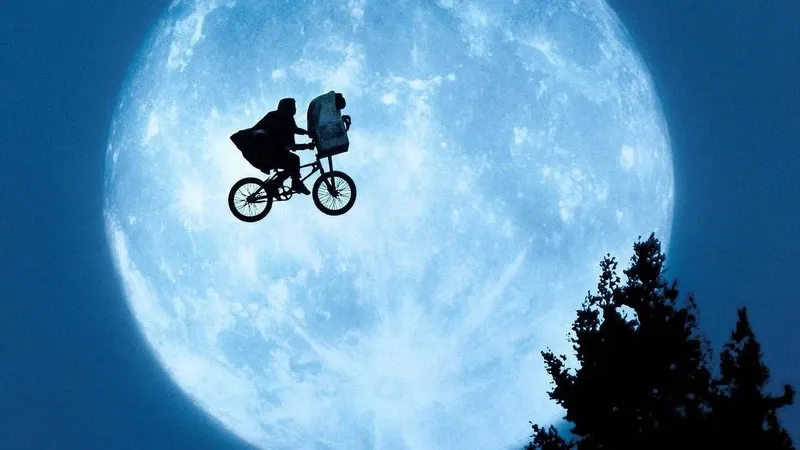
E.T. has stood the test of time by remaining a focal point in pop culture with its immediate iconic imagery. It also brought us the words "E.T. phone home", words that have been spoken, parodied, and remembered in many shows since.
More than four decades since its initial release, E.T. still resonates, showing how following ones heart can guide a person to their most desired destination. For Elliott, that destination was a healed family. For E.T., the destination was home.
E.T. recently screened in the Irish Film Institute on June 7th as part of their Spielberg Sci-Fi curation. It is available on several digital rental, purchase, and streaming services.


