

Our resident horror expert Conor Bryce looks as the most brutal death scenes in The Omen Franchise.
Fifty years ago, a well-dressed diplomat unknowingly brought the Devil home in a baby basket, and horror cinema hasn’t really been the same since. Richard Donner’s The Omen landed in 1976 with studio gloss, Gregory Peck’s gravitas and a choir deliriously serenading Satan. It made evil feel organised, powerful, unavoidable. It also delivered death scenes that people still talk about.
Half a century later, the franchise – four original films, plus a remake and a prequel – remains uneven but unforgettable. For every tense, slow-burning moment, there’s one of gleeful excess. The Omen played a huge part in legitimising modern horror. Damien: Omen II doubled down on spectacle. Omen III: The Final Conflict handed the devil a power suit and let Sam Neill purr his way up the corporate ladder. Later entry Omen IV: The Awakening and 2024’s prequel The First Omen weren’t disasters, but their demises never quite scaled the same operatic heights. The bulk of the series’ reputation rests on those first three movies, and boy do they deliver – they changed the way horror handled death by force majeure, and clearly paved the way for movies like Final Destination, Escape Room and Saw.
So, with the Antichrist celebrating his golden anniversary, here are the six most audacious, creative deaths the franchise has to offer. Some are grotesque, some darkly funny, some genuinely upsetting. All of them carry the same warning – if you stand in the way of the Devil, the world itself will find a way to remove you. Permanently.
6. Weather warning (The Omen)
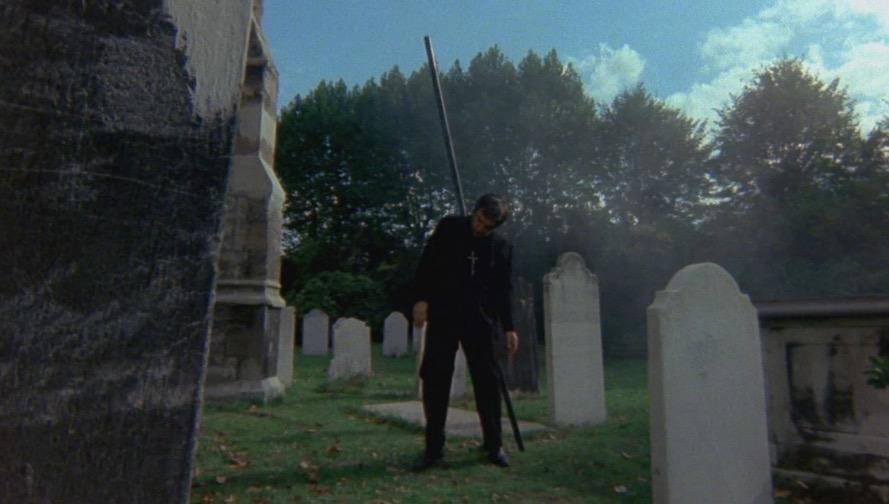
The OG wastes little time in declaring its intentions, and Father Brennan pays the price for trying to warn Gregory Peck’s sceptical diplomat Robert Thorn about the hell he’s walking into.
Patrick Troughton plays the doomed priest like a man already convinced his days are numbered. After Thorn dismisses his rants and raves about the coming of the Antichrist, Brennan finds himself in the epicentre of a sudden, furious storm. He seeks refuge in a church – delicious irony – but seeking sanctuary after pissing off the Devil is a fool’s errand. As thunder cracks overhead and composer Jerry Goldsmith ratchets up the score to reach the cheap seats, a bolt of lightning hits the roof. A metal rod snaps loose and plummets, spearing Brennan from shoulder to torso.
There’s no slow-motion build-up, no exaggerated physics or excessive bloodletting. One moment Brennan is frantically stumbling through rain, the next he’s skewered like a butterfly in the Dead Zoo. The 2006 remake’s version looks slick and technically polished, but the original’s rawness can’t be beat. For the first time in the movie, it’s clear that the environment can – and will be – complicit in Damien’s ascension. There’s no need for cultish assassins or demonic minions to get the job done. Wind, rain, even the house of God. Nothing is safe. It’s the Devil’s work, disguised as weather.
5. Going down (Damien: Omen II)
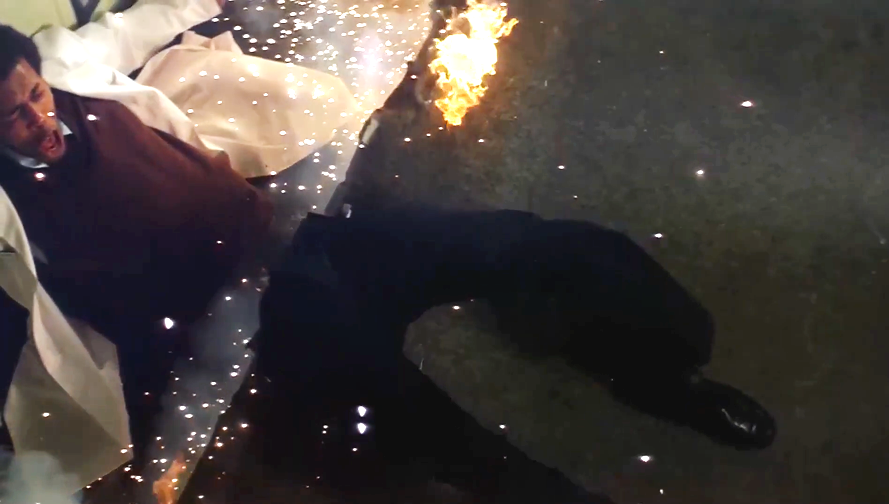
The Omen’s first sequel has a big ol’ chip on its shoulder. It knows it’s following a critical and commercial smash hit, so it responds by turning the volume up. Subtle dread with splashes of violence is replaced with excessive, bombastic carnage. Case in point – poor Dr Kayne.
Kayne’s fate is sealed by his scientific curiosity. Young Antichrist-to-be Damien survives a gas leak that hospitalises his classmates but leaves him strangely unscathed. The doctor runs blood tests and finds something that would give any geneticist nightmares – the boy’s cellular structure resembles that of a jackal. It’s the sort of discovery that warrants a stiff drink and perhaps a visit to the local church. But Kayne steps into a lift, and the Devil isn’t interested in his findings being published.
What happens next is complete mechanical chaos. The elevator stalls. Lights flicker. Metal groans. Then ... WHOOSH. The movie toys with a simple drop, but that would be too easy. The lift crashes to the floor and a terrified Dr Kayne falls to the ground with the impact. But then, a cable high above snaps loose and plummets too. It covers the distance in seconds, then whips through the carriage, slicing Kayne cleanly at the waist. The last thing he sees are his own “hotdogs”, falling out like so much bolognese.
The scene is excessive and darkly funny. It captures the sequel’s determination to up the creative death stakes. The staging sells it – the confined space, the escalating malfunctions, the horrible anticipation as the cable reaches its destination. Damien: Omen II has no problem with shouting to be heard, and Kayne’s death is the loudest moment in the room.
4. Hold my calls (Omen III: The Final Conflict)
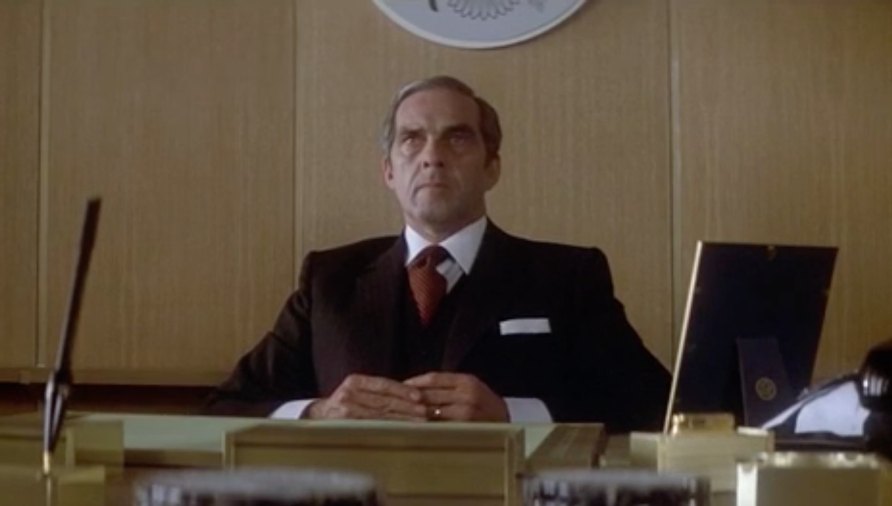
By the time we reach The Final Conflict, Damien’s grown into Sam Neill. Recently departed and sorely missed, Neill gives the adult Antichrist a silk-smooth menace. It’s not hard to see why he screen-tested for James Bond a few years later – this Damien strategises, smiles for cameras, hides his plan beneath an infinite supply of roguish charm. What’s the plan? To become the American ambassador to the United Kingdom, usurping the current one. Kid’s stuff for the Prince of Darkness.
The soon-to-be ex-ambassador’s death is handled with unsettling precision. After a sinister game of ‘who blinks first’ involving a rottweiler with unnerving focus, he returns to his office in a trance, calm and determined. He rigs a gun to fire when his office door opens – attaching the trigger to a length of ribbon from an electric typewriter, wrapping this ribbon around his room’s doorknob with careful hands. Then he sits behind his desk, the gun’s barrel angled at his head, makes a call to host an urgent press release ... and waits.
When his secretary (fun fact – an uncredited Ruby Wax) innocently turns the handle, the blast erupts. The impact is swift and shocking, the aftermath grotesque. The camera lingers just long enough to show the damage (not the expected hole in the forehead, but an awkward entry point below the nose), then drifts to a small detail that elevates the entire sequence. The ambassador’s foot twitches against his desk, tapping rhythmically. That damn tapping. No matter what the movie, no matter what the death scene – I see a body twitch, I curl into a ball.
The whole thing feels disturbingly organised. The ambassador is completing a task. The task just happens to be his own death. Neill’s presence hovers over the scene even though Damien is not physically there. This is a version of Antichrist akin to the ruthless Wall Street yuppies of the movie’s decade. Damien wants something ... so he takes it. Gordon Gecko, eat your black heart out.
3. Happy Birthday Damien (The Omen)
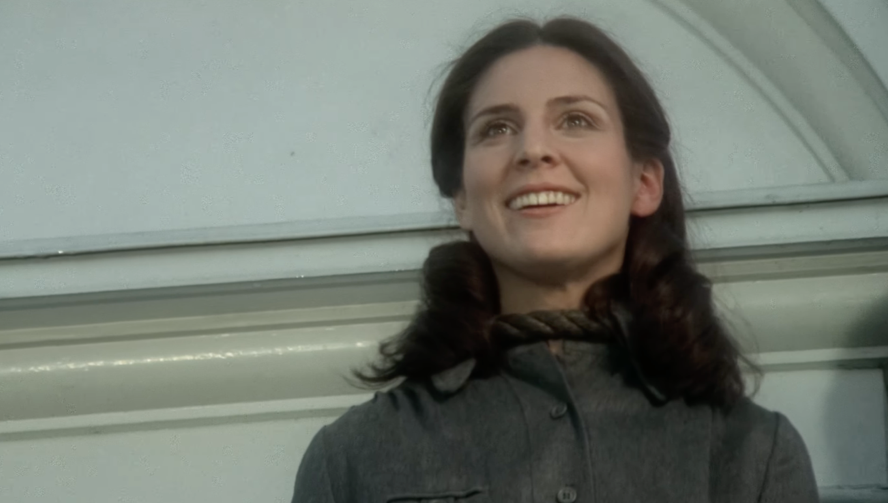
Not many horror moments became iconic as quickly as “It’s all for you, Damien!” The Thorn family is hosting a fifth birthday celebration for their little devil; a lavish garden party packed of waspy adults and spoiled children. Then his noosed-up nanny emerges from an upper floor window, calls for attention ... and leaps.
Guests freeze, children stare (one little tyke even seeks comfort from a clown, something unheard of these days). Mrs Thorn looks on in shock, her face a rictus grimace, her eyes impossibly huge (some amazing acting from Lee Remick). The camera does not cut away in haste. We watch the nanny’s body swing, shattering a window as she crashes back against the house. Goldsmith’s score, usually front and centre during the movie’s death scenes, is cleverly absent, replaced with a mix of muted, joyful fairground music and the children’s screams.
What really sticks with you is her expression. Like Omen III’s ambassador, she’s being replaced with a sinister successor (Billie Whitelaw on BAFTA-nominated form as Mrs Baylock). She’s serene and joyous, glad she’s playing a part in Damien’s rise. She waves to him, urging him to witness her sacrifice. “It’s all for you”. Her life. Her soul. The world.
The 2006 remake recreates the moment almost beat for beat, feeling no need to reimagine something so potent. It often tops polls as the scariest moment in the whole franchise, and for good reason – audiences will always remember the first time they watched a children’s party transform into a ritualistic suicide.
2. On Thin Ice (Damien: Omen II)
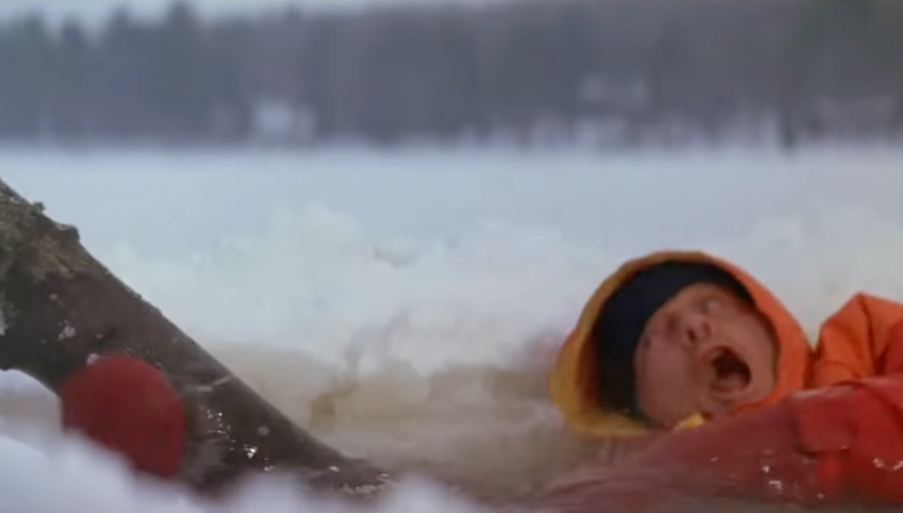
For all its gleeful excess, Omen II also knows when to slow the pace and crank up the tension. During a hockey game on a frozen lake, family friend Bill Atherton joins in the fun. Skating up a storm, he’s unable to stop before he reaches a thawed part of the makeshift rink. He struggles, arms everywhere, but ends up crashing through and disappearing into the freezing water below.
What follows is pretty damn hard to watch (it definitely messed me up as a kid). We watch, bystanders, as poor Bill floats along beneath the ice. His hands desperately slam against the solid barrier, just inches from air, the other players frantically following his path. There is a moment of hope – he finds a weak spot, begins to break through, grabs a branch like a lifeline. For a moment it seems he might claw his way out. Then the current – or something else – drags him back down.
Muffled thuds of fists against an impenetrable barrier. Silent screams from a face distorted by ice. The reliably bombastic score fades out in time with Bill’s life; he’s not reaching the surface again. It’s a slow, measured death, infinitely crueller than a self-inflicted gunshot to the head or a weathervane through the heart. It’s not the most famous scene in the franchise, but it’s probably the most nerve-shredding. Cold, quiet, and utterly hopeless.
1. Heads Will Roll (The Omen)
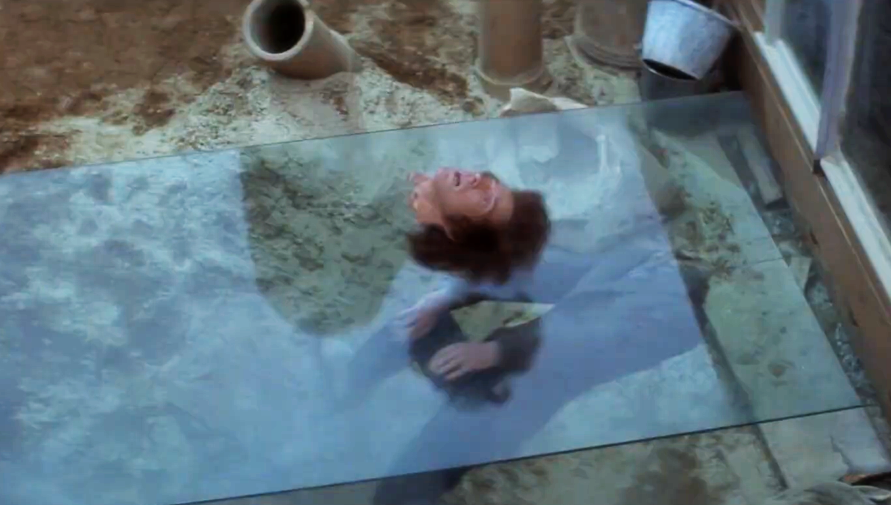
If the franchise has a crown jewel, this is it. Curious photographer Keith Jennings spends much of The Omen shadowing the Thorn family and piecing together the truth about Damien. He discovers the candid photos he’s been taking are premonitions of ghastly deaths – one of Father Brennan contains an ominous shadow across the priest's body. Another dark shadow is found in a shot of Damien’s doomed nanny, looking uncannily like a rope around her neck. And then comes the kicker – while photographing Father Brennan's room after his death, Jennings captured himself in a mirror ... and there’s a sharp line across his throat.
The sequence begins with Robert Thorn and Jennings in Rome, unearthing the full horror of Damien’s origin. Faith and sanity are crumbling as they stumble their way through a packed street, arguing over what needs to be done. Thorn casts aside a set of daggers meant for the ritual slaying of Damien, and Jennings stoops to collect them. And then the moment hits; brutal and impossible to forget. Death plays out in slow, dreadful increments:
In the distance, a lorry’s handbrake “accidentally” disengages.
It rolls down an incline towards Jennings, gathering speed.
It hits a sand pit in front of him, coming to an abrupt stop.
A sheet of glass comes off the lorry like a bullet as Jennings turns to look ...
Then his head takes an unscheduled flight, body crumpling to the ground. The death is so swift that, like the shocked onlookers, we barely have time to process what’s happening before Jennings’ dead eyes are staring up at us.
Back in 1976, this kind of scene felt shocking in a big studio horror movie. The genre was in transition then – death scenes abrupt, shadowy, politely framed, like everyone was still pretending not to enjoy them. The Slasher boom hadn’t yet arrived; Halloween was still two years away, Friday the 13th, four. The Exorcist had proved that audiences would show up for a serious, prestige fright, but its shocks were rooted in possession and blasphemy – heady, (mostly) bloodless concepts. Graphic, intricately staged deaths were found in low budget fare like The Texas Chainsaw Massacre and Italian Giallo like Deep Red. There are shades of both in this scene – the gnarly, sudden shocks of Tobe Hooper’s masterpiece coupled with the operatic bombast of Dario Argento’s definitive thriller.
And that chef’s kiss of a decision to repeat the shot of Jenning’s head spinning in mid-air four times? Unsurprisingly, it was a suggestion from the movie’s virtuoso editor Stuart Baird to director Richard Donner, who loved the idea. It doesn’t matter if the audience looks away for one, two, three seconds, a gleeful Donner explained in an interview in 2006. They’re still not getting away from it. When they look back at the screen on four ... that head will still be spinning.
50 years on, it hasn’t stopped.


