
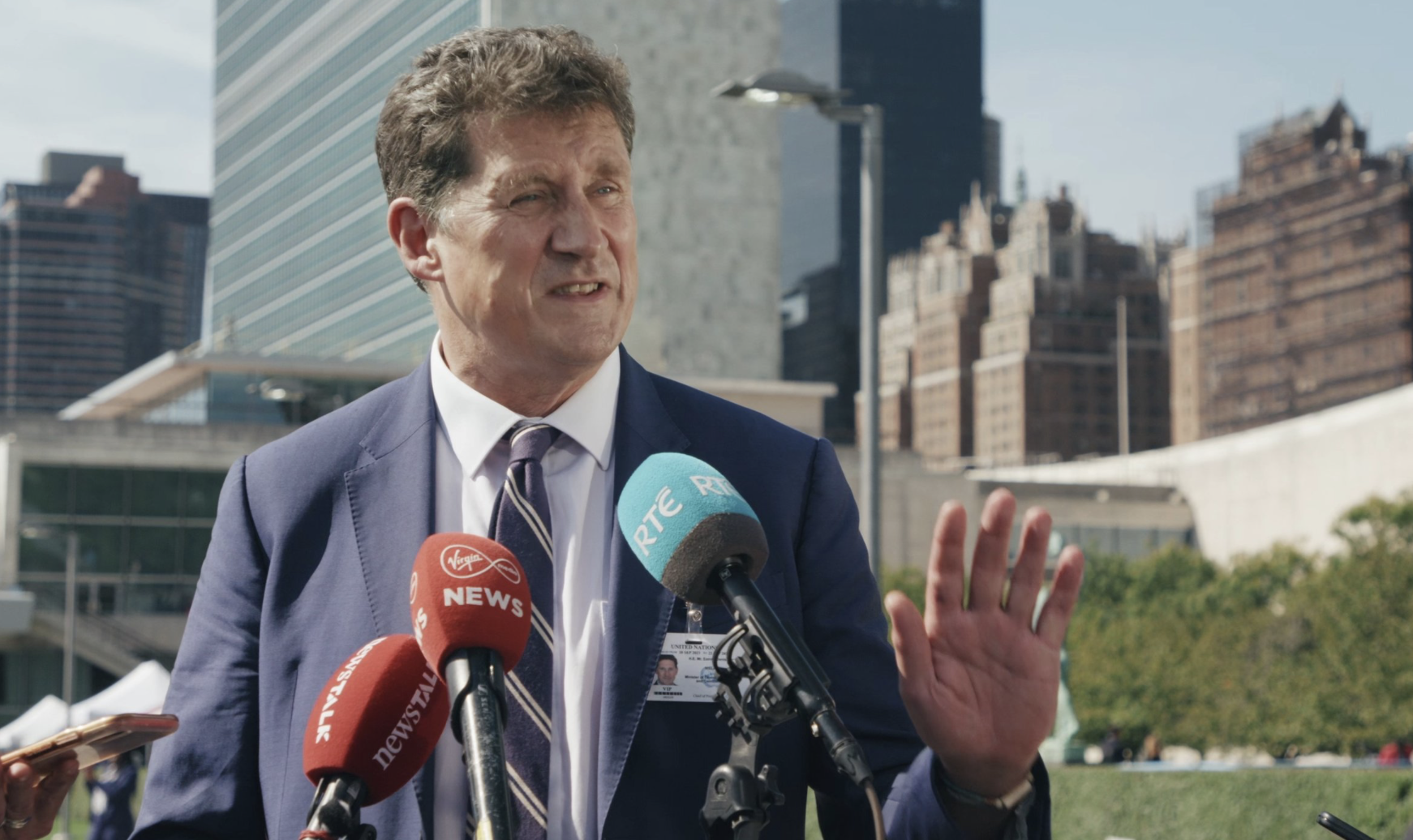
Climate action is increasingly struggling to hold its place on the global political agenda, making Forever Is Now an especially timely documentary. Dami Akinniranye sits down with Eamon Ryan, former Green Party leader and Minister for the Environment, Climate, Communications and Transport, and award-winning documentary filmmaker Neasa Ní Chianáin to discuss the political obstacles, personal pressures, and persistent challenges of pushing for climate action during Ryan’s final months in government, as well as the process of bringing his story to the screen.
In cinemas for Climate Action Week, Forever Is Now follows Eamon and his team during his time as Green Party leader over 18 months of pushing Europe's most ambitious climate agenda. At the same time, the world shifts towards war, while rising populism, soaring energy costs, and a toxic information environment threaten climate progress and democracy itself.
I first want to commend you on your vulnerability in this film. I would like to know more about the creative process behind deciding what to share and when to turn the camera off.
Neasa: With the political, I would shoot as much as I possibly could because I never knew when I was going to get access to something or whether I'd be allowed in the room or not. Not from Eamon and his team, but from the other people who were involved. So I probably shot too much because it's very hard to know what would come up and what wouldn't come up, and you just grab what you can get.
For the personal, it's more a negotiation, and you can feel it in the room, especially working with Tommy. Tommy did, on occasion, say, “Enough,” and I would obviously honour that. As a documentarian, you try to get as close as possible to your main participants.
How long have you and Eamon known each other? How were you able to develop that trust to film?
Neasa: I knew Victoria, Eamon's wife, before I met Eamon. I think we established it was for 30 years – that was about a year ago. So, 31 years now we've known each other. It was more my relationship with Victoria, really. And how did we establish trust? I don't know. As we've known each other for 30 years, we know what our values are. Eamon, do you want to add to that?
Eamon: We've been raising our families together as well. We go up to Donegal every year. We used to go up for a music festival just after Christmas, the Frankie Kennedy Music Festival, and I think it was there that Neasa asked me, a year before I started filming. It took me about a year to say yes. I thought, “Would it intrude on my work or on family?” When Neasa asked whether they could do this fly-on-the-wall filmmaking documentary, I came around and said yes, firstly because I trusted her and David Rane (the producer), but also because I knew I was going to go into an interesting period.
I knew I was going to be working in international climate negotiations; I was going to be co-chairing the International Energy Agency; and I thought, just as for the record and for transparency. And also because, fundamentally, the biggest challenge we have had in the environmental movement is how we tell the story about the destruction of our natural world and how we frame it. So having a film which was focusing on that, for me, was a very attractive prospect.
Neasa: To be fair, you said yes, but then we had to come in and pitch it to his team, and that was very scary because we didn't know any of them. Of course, it's always easier to say no than to say yes. But it was fantastic, really, because Edel Hackett, Eamon's media adviser, was incredibly supportive from the beginning, as was Paul Kenny, his energy adviser. I think they understood the difficulty of climate communications. Everybody's struggling with it, and they're still struggling with it. It's difficult to tell a very complex story in sound bites.
It's very hard to dance the line between honest work and propaganda for a certain party. How were you able to stay honest with Eamon, because he's your friend?
Neasa: He's my friend, but I also admire him and his work, and what he and the Green Party were doing. I was extremely excited by the Climate Action Plan, the programme for government that they had managed to negotiate. It was one of the most ambitious in Europe. That inspired me a lot, and I was excited for what was going to happen and how this was going to unfold.
We said from the beginning that they would have no editorial control, that we had to have that autonomy and we had to have that freedom to put in what we wanted to put in. And they understood that. They work in communications, they work with media, and they understand the freedom that the director, the author, or the journalist has when you decide to open up a world to them. So I think that is important.
Eamon: Just to follow on from that: the film's going out in general release, and people come up to say, “Oh, your film is coming out.” It ain't my film. You're featuring in it, but it was an interesting learning experience for me, the craft of filmmaking, which I had nothing to do with in this film. You get a sense of the amount of filming that's been done, the amount of editing, the amount of finishing, music, and so on. To a certain extent, we opened the door, but that pretty much was the end of our involvement. In this sort of fly-on-the-wall thing, my job is to say, “We provide the access,” but it pretty much ends there.
Neasa: Politics moves. Their lives moved at such speed; you wouldn't have had any room in your life to let anything else in anyway.
How did you navigate the harder conversations about Irish society or your constituents? Many of them can be very rude, especially over the internet. Many constituents have valid criticisms and simply want their politicians to listen, while others may be more far-right or feel alienated. How did you make sure you captured these different perspectives?
Neasa: From my point of view, I was really disturbed by the image that was being created on social media of Eamon, because even beforehand, I knew that was not the person that I knew. I didn't know him in his political role. I'd never had access to that, but I knew that wasn't him. I think that was always going to be a very important narrative in the story, because I do think that social media is hijacking our democracies. We know that Eamon would post something and then, within seconds, there'd be a hundred rebuttals or bots. We’ve heard about American bots and, you know, Russian interference. Look at what's happening in Brazil right now. Bolsonaro's son is neck and neck with Lula. That's totally on social media; it’s hijacking and creating an alternative narrative.
I've been told that, in Eamon's case, it's not necessarily attacking Eamon, the individual, but it's attacking the values that he stands for. I believe that's a really important thing for the general public and for voters to realise: how they are being manipulated...
because so many people have lost faith in institutions, they've lost faith in mainstream media, and they think that they're getting the truth on social media. That's completely unvetted information that's been put there.
Eamon: I went into politics 30 years ago, at the same time I met Neasa and David. I remember the first time running for election: there was some byline on the back of an article in the middle of a newspaper that no one would ever read, making comments about me, and I could hardly sleep at night. They had mentioned me in a way that wasn't, I thought, favourable. By the time this film was made, to be honest, you become immune to it.
I would get very, very strong abuse: death threats, occasional physical intimidation. When you meet someone on the street, at times you feel it's not safe. I had a guard, which goes with the job, but it didn't really impact me. People would say, “Oh God, how can you look at the comments?” Well, I rarely did. And if I did, no matter how nasty they were, it didn't bother me.
Partly for two reasons. Well, the main reason being that the real-world people are much nicer. You very rarely meet someone who's really aggressive and threatening. And if you do, you learn to walk away.
What's more interesting, and this is, in some ways, what the film is about, is this: has social media, and the nature of the way algorithms run our communication systems now, changed the way politics is seen, or the way it's evolving? I think it has. It's really hard to prove. You can ignore it, but it does poison the well of how people think about you. I think that is part of what's interesting about the film: it's one angle. It's one view on one tributary of that huge river of political communication that is defining a lot of what's happening at the moment.
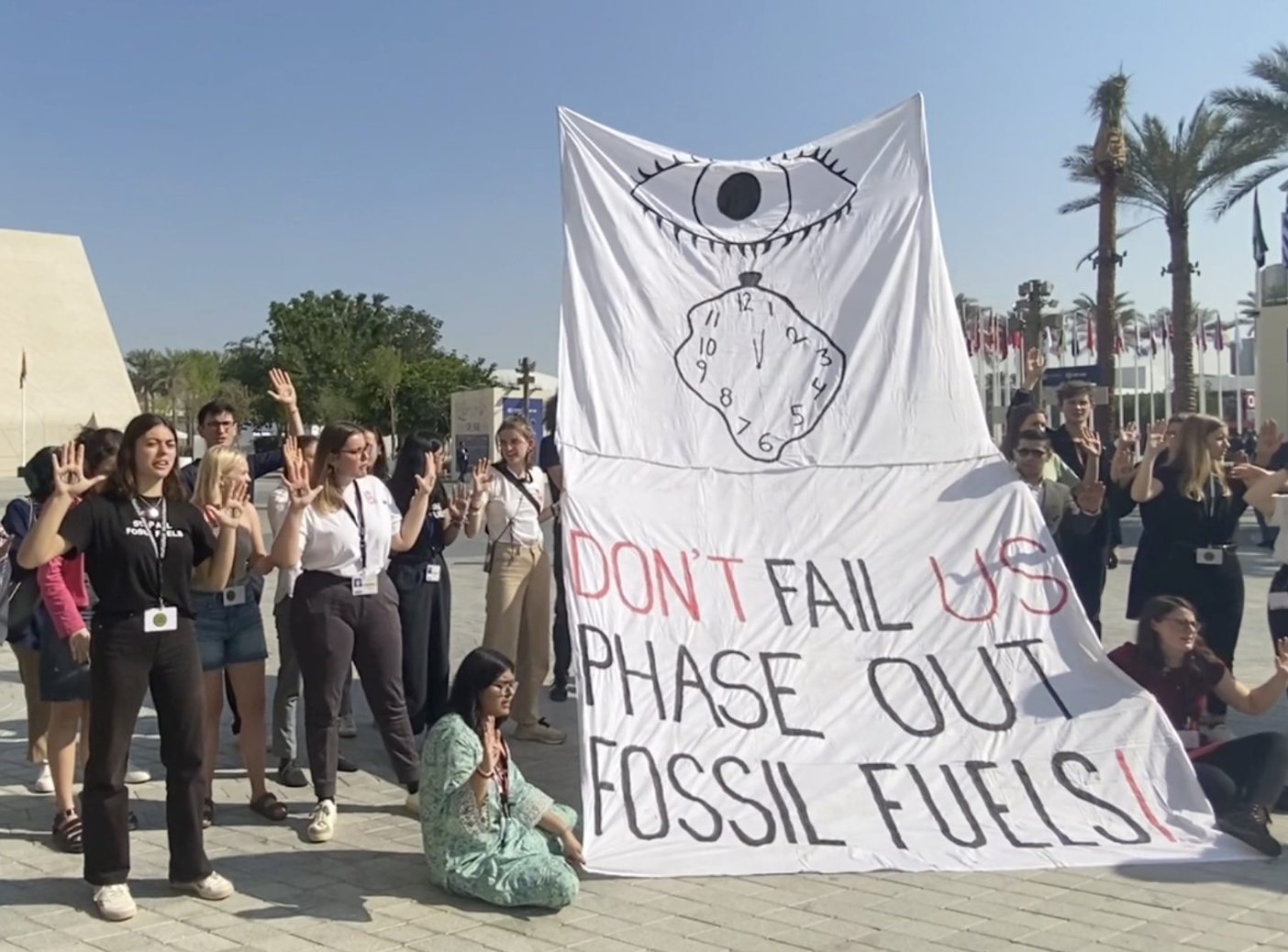
Many politicians are embracing social media in a way where they can utilise it to their own benefit instead of just being attacked. The film makes brilliant use of the documentary medium to express the existential nature of the climate crisis in the face of policy and a growing anti-science sentiment. In narration, Eamon puts it plainly: “Sometimes political science trumps climate science."
Neasa: Eamon would use social media. Edel was constantly doing social media. You were trying to communicate your message and what you were doing on social media. I think you see some of that in the film, but it's very, very difficult to bubble to the surface through all the noise. I think all politicians recognise how important social media is.
This documentary is a good, in-depth response to a lot of the critiques you get on social media. It was very apt to say that people are critiquing more the values Eamon represents rather than him himself.
Neasa: It's true. We did some test screenings and showed it to some twenty-somethings who were not normally the audience for documentary, and the feedback we got was that it was really great. People really enjoyed seeing just how passionate Edel and Eamon and the team were about the work that they were doing, and they felt really comforted by the fact that they could see that there were good people out there fighting the fight. Maybe we don't see enough of that.
Maybe politics needs to lift the curtain a little bit and allow people in a little bit more to see how hard they work, and that it is a complex world and there are lots of moving parts. Multilateralism works, but it takes a lot, a lot, a lot of effort.
During the fuel protests and the boycotting, the narrative that was going on was, “Oh, these fancy people in Dublin, they don't know how to work.” It was good to see the brainstorming and the travelling and the toll of exhaustion that comes with going around and strategising, or the mental labour.
How did you handle being a film star, a politician, constantly advocating for your views so passionately every day? How did you avoid burnout?
Eamon: Just stubborn. Absolutely stubborn. It's a root stubbornness to keep going. I'm still working on climate in a variety of different ways. It's also a privilege. There's nothing like being elected, no matter what, if it's the smallest council or that job when you're in government. It's a real honour, and that overcomes a lot of the negativity.
It's very hard, which I think the film portrays. It's hard on families, because they don't stand for election but they get a lot of the backwash. That's hard because you can't control it. For me, it didn't really bother me because I sensed that that's part of the job, but for them it wasn't. And that's hard.
The film-star bit, my main one is one of mortification, where you see yourself on screen. I'm used to seeing myself on telly or something, but this camera's around you, behind you. And I said, “Oh God almighty, I look quite stressed.” And I didn't feel that stressed at the time. I was just so used to what is a stressful environment when you're leading a party in government. But that was my main thought looking at it. I said, “God, I wish I'd lost 10 kilos and didn't look so stressed.”
To be honest, it wasn't primarily just about me. It is about the team around me. And what Neasa mentioned, not just Edel and Paul and Darcy and others getting the idea of why we were doing it, but actually coming out of it as central characters, shows that it isn't just one person. It is teams of people. That stubbornness goes across. That's a shared stubbornness. The Green Party have been very resilient, I think. We've lost our seats, completely been wiped out. Nearly the same happened last time. But you dust yourself down, you get back in the saddle, you keep going.
I saw Mia Mottley speak recently, the Prime Minister of Barbados. She's really impressive. She was doing an interview with Mary Robinson (who appeared in the film), and she was saying, “You're working on something, and it's no, no, no, no, no, no, no, yes.”
You keep going, and you have to be stubbornly in favour. I think she was referring to Nelson Mandela in that: he's there in prison, and he's keeping going and keeping going. And then one day, it turns. And that's what keeps you going. You don't take no for an answer.
Your film gives a lot of people hope and direction. You mentioned canvassing in your younger years. I would love to hear more about that...
Eamon: That's also the privilege. That's why people can look at social media and think, “God, you give up your faith in the human race. Are we really that nasty? Are we really that antagonistic to each other?” And the truth in politics is that you go knock on 10,000 doors, which is what you need to do to get elected in Ireland.
That's a lot of doors!
Eamon: The funny thing when you're canvassing is that you never know who's going to open up the door. Every single person is different, and you can tell in the first three seconds: do they want to talk? Do they not want to talk? Do you just say, “Listen, I can see you're busy. Here's my flyer. Give it a read, see what you think. Give me a call if you need anything”? Or, in another case, you get a sense that maybe the door is opening in a way that would make you ask a question: “Listen, are there any issues at the moment that are bothering you?” And you find yourself 15 minutes later with the canvassing manager pulling you away because you're in a conversation.
That's how you get elected. People vote for people they know, people they've met, people they meet in person.
It's a strength, particularly in Irish politics, because it's very local. It's very small-scale. There is a sense of connection to politicians of all parties. It doesn't belong to anyone. It is also incredibly rewarding. It would restore your faith in human nature. If you're down and lacking energy and thinking, “God, giving up hope,” go out and knock on 100 doors and actually come away energised and with more hope for our common decency.
This is a bit more of a contentious question, but you addressed it in the film. Do you think that wealthier, higher-emitting nations owe the Global South the cost of transition?
Eamon: The reason why I said yes to the film was because I knew I was going to be involved in the United Nations climate negotiations. I knew I was going to be chairing the International Energy Agency, which gives you a certain role in the whole process. I would come from this perspective anyway, talking to a lot of my advisers and people I would trust on the energy and climate side.
As we were going into that period, we agreed that the most important thing for progress on climate was to address what Mia Mottley had highlighted: in a developing country, you'd be paying interest rates of 20 per cent; in a developed country, five. There were more solar panels in the Netherlands than in the entirety of Africa, even though Africa would have 60 per cent of global solar radiation.
One of my heroes in that whole time, Ali Mohamed, was the climate envoy for Kenya. We went to Nairobi for their climate conference, and I came away from that with a clear sense: this is what we need to do. So when you see those sorts of scenes in the film with John Kerry and so on, that was part of a two- or three-year strategy which we had devised to try and push a development perspective on climate. It's a mixture of different finances. So that is the core of the film in my mind.
The negotiations in Azerbaijan, where I was a lead negotiator, in that case for the COP presidency, were all around that issue. Now, we did not succeed, like the US$300 billion deal agreed there [at least US$300 billion a year by 2035]. To be honest, it's not just what that figure was, but it was: are we fundamentally changing the global banking trading systems to make sure that no country misses out on the development? And the answer is no. But you don't give up. You don't take no for an answer. You keep going until you get the yes.
The film ends on a party for a departing leader, a warm message from his staff, and Ryan clearing his desk while watching Donald Trump's inauguration. Since then, war in the Gulf has left tanker traffic through the Strait of Hormuz well below normal, and Brent crude is trading above US$100 a barrel. Choke points and price shocks make the case for home-grown renewable energy easier to see. Ryan's own advice still stands: “You keep going until you get the yes.”
“You keep going until you get the yes.”
Forever Is Now is in Irish cinemas from 16th October for Climate Action Week. Free tickets for young people, resources and screening details are all available at guthgafa.com and you can donate to get the film in UK cinemas here.


