

Ahead of Thursday's screening of Life Support in Galway, Rachel Walshe looks at this powerful documentary.
In the aftermath of 7th October attacks, the Israeli government cut off access to food and water entering the Gaza Strip, and denied entry to international media outlets. In this vacuum, medical teams became some of the only outside witnesses to what unfolded. Life Support, a documentary by Daniele Rugo and produced by Pressure Cooker Arts, Cocoon Films, and Metafora (with exec producers Susan Sarandon, Melissa Barrera, and Farah Nabulsi attached), harnesses these eyewitness accounts, documenting when medics became the media.
Composed of interviews, archive footage, drone shots, and the medical staff’s own video diaries (many of whom are associated with Medical Aid for Palestinians – MAP, or Healthcare Workers 4 Palestine), the film chronologically details the onslaught from October 2023 to November 2025. It begins with the testimony of Dr Tanya Haj Hassan, a Jordanian-American paediatric intensive care surgeon, who delivered a speech at the UN Speech on 26th November 2024. At the time, the death toll was approximately 44,000. “We’re here in solidarity with our Palestinian healthcare workers,” she says, “and with the Palestinian people. You cannot witness what is happening in Gaza, and not emerge enraged, and determined to stop it.”
It’s around 1.40 into the running time [that] smoke first rises from the distance as a bomb detonates. Another bomb drops, this time next to a marketplace. People scream, running for cover. This is Gaza as many of us know it. On-screen graphics remind the audience that the enclave is only 40km long and 12km wide, and is home to 2 million Palestinians. In context, on an area of roughly 365km², Gaza is smaller than County Louth, yet before the war it was home to more than 2.2 million people. Then the image shifts. Gaza, 2022. Long shots of people on the beach, families playing, markets hot and alive. There’s colour. There’s life. Buildings stand, cars travel along roads. It can be easy to forget how this place once stood, when so many of us only became fully conscious of it as it fell. Life Support will not let us forget.
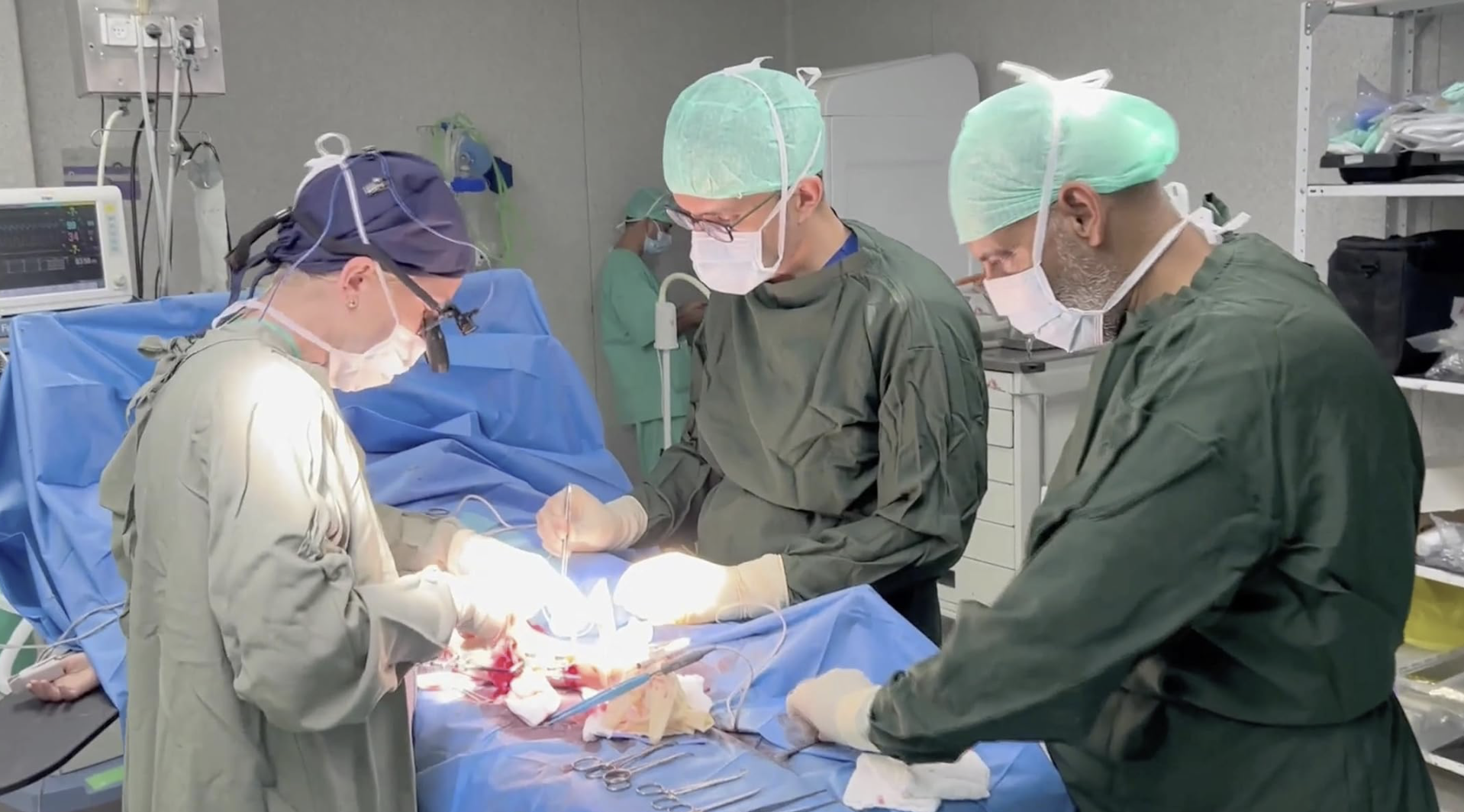
This is where chronology, a logical choice of storytelling, becomes a gut punch. Much of the testimony in the documentary comes from recordings taken by the medical team on their own phones. What can be harrowing in Life Support is that so much of the footage is so well known, including the medical teams’ own recordings, that over the past three years it can become one homogeneous image – a white, decimated canvas. Those viewing may have borne witness and forgotten the details. Social media, while instrumental in getting stories out of Gaza to a worldwide viewing public, is also an ineffective method of archiving. Life Support preserves. The ache of remembering is visceral throughout, as Rugo unflinchingly chronicles the events as they unfolded.
However, there is an interplay between past and present in the editing that echoes throughout the film, cut by Masahiro Hirakubo (The White Helmets, Trainspotting), with whom Rugo has collaborated previously (After a War). Children pre-genocide run smiling through the streets, and in the present, climbing the rubble to begin a game. It’s as heartwarming as it is heartbreaking to know that, through all things, children play.
Images of Al Shifa Hospital as it was, melting into how it stands now, first raided in November 2023 when the Israeli army alleged it was being used as a Hamas command centre. Impressively, the word “Surgery” remains – physical manifestation of the stubborn courage of medical teams, both international and, crucially, Palestinian. The doctors continuously remind us that their Palestinian colleagues are battling loss, hunger, and ever-worsening conditions while attempting to save lives. There is a discussion of the babies who died in their incubators, their first and final resting place. There are bullet holes and broken beds, and the bodies of 381 people discovered. This was March 2024. At one point, there is more footage of Dr Haj Hassan, this time in Gaza on shift. She notes it is two months after the ICJ interim ruling on genocide (26th January 2024): “It can’t get worse than this.”
Local cameramen Mahmoud Abou Hamda and Suleiman Hejjy, whose incredible work under such circumstances is profoundly courageous, are responsible for much of the footage both before and during the assault. Rare glimpses of the outside world come through the doctors’ video diaries, showing them entering the enclave through different points, or at press conferences, trying to get these messages out. The soundscape (that of Gaza itself) is unrelenting: bomb, scream, ambulance, yells. Repeat. Repeat. Repeat. (Robert Del Naja, Euan Dickonson – Massive Attack, Habib Shehada Hanna) because of the horrors on screen, but it does, when noticed, offer moments of poignancy.
Israeli soldiers feature little, outside of images of tanks and the bullet holes cutting through each hospital. In one segment, the POV of a tank approaches a “Gaza” sign. The tank rolls over it. This is the soldiers’ point of view.
In one interview segment, while discussing their role, Dr Ana Jeelani, paediatric surgeon, says, “We are the vessels for their stories”. There are other critical documentaries such as NAZA (Yuval Abraham and Rachel Szor, No Other Land), which premiered this year at the Venice Film Festival, attempting to shed light on the atrocities committed during the ongoing genocide. While in no way diminishing the courageous work of filmmakers such as Rugo, Szor, and Abrahamson (each has made space within their art to hold stories such as these), or indeed any of the medical staff featured within Life Support, it is worth noting that there is an insidious reason for vessels in the first place.
That international journalists were not allowed into Gaza to offer outside perspective has been used as a way to discredit and undermine Palestinian voices. Each witness to this film thus also becomes a vessel, and it is of the utmost importance that it is not a hollow one. To its immense credit, the film understands this deeply. The final words are those of Alaa Alqaisi, Palestinian translator and writer (a current PhD candidate at Trinity College), read by Denise Gough.
And when the world finally turns the page – if it ever does – let it not say that Gaza was silent.
Let it not imagine we vanished without speaking.
We spoke with mouths filled with dust.
We sang, even with broken teeth.
We prayed from fractured knees.
And though the world may have looked away, let this much be remembered: we named the hunger.
We bore it.
We endured.
Let that remain.
Life Support screens at Town Hall Theatre in Galway on 8 October 2026, followed by a Q&A with Dr Victoria Rose and Professor Nick Maynard, who feature in the film. The Q&A will be moderated by Dr Afif El Khuffash.


